Which Aviation Stakeholders Need to be Consulted for Wind Projects?
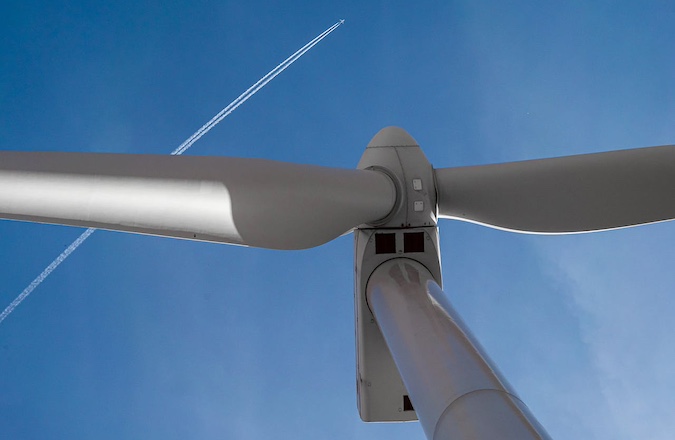
Aviation can be a key planning risk for new wind developments. Consultation with the relevant stakeholders helps identify issues early, allowing for more informed site selection and identification of constraints.
Here we review the key aviation stakeholders for wind developments, discussing why they might be affected and, where possible, established consultation distances.
Specifically, we will discuss:
- Local airports and airfields;
- NATS;
- The Ministry of Defence;
- The Met Office; and,
- The Commercial Aviation Authority.
The goal of this piece is not to provide a detailed technical exploration of potential impacts, but to highlight the key seats at the table and why they may comment on new applications. Further technical articles are linked throughout.
Local Airports and Airfields
Perhaps the most intuitive consultee are airports and airfields in the vicinity of a proposed development. The distance at which an aerodrome becomes relevant however, is not so straightforward. Different operations and equipment can be affected out to different distances. The orientation of an airport’s runway, relative to the development, can also factor in.
When reviewing a wind application, an airport will consider a number of matters, including but limited to:
- Impacts upon radar;
- Physical safeguarding and obstacle limitation surfaces;
- Effects upon communication, navigation, and surveillance equipment;
- Potential infringements of Instrument flight procedures;
- Crane operations; and,
- Aviation lighting requirements.
For further information on each of these specific concerns, you can explore our linked articles.
Many airports will have a “safeguarding zone”, within which they wish to review applications and outside of which they do not. This distance will vary by airport and may be discoverable on their website or from the relevant planning authority.
General aviation aerodromes, private airfields and local flying clubs, are typically more concerned with physical safeguarding. Such airfields are less likely to have a radar or operate instrument flight procedures. Each airfield will have unique operations and if concerns are raised, a detailed safeguarding assessment should be carried out. Unlike licenced airports, a set safeguarding distance is less likely to be established, however 20km may act as a reasonable starting point for most developments.
NATS (formally National Air Traffic Services)
NATS operate a network of en-route radar and navigation aids throughout the UK which are used to monitor aircraft transiting UK airspace, and to provide Air Traffic Control (ATC) services and internationally. More information regarding NATS’ role can be found here.
In simple terms, radar can be primary or secondary. Primary radar detect moving objects, while secondary radar specifically detect airport transponder signals. Wind developments typically do not impact secondary radar, and therefore primary radar are the concern when reviewing new applications.
NATS safeguard this network of equipment to ensure aviation operations and safety are not comprised by new developments. There is not a fixed distance at which consultation should be carried out, and effects can materialise dozens of kilometres from some radar. Due to the widespread nature of NATS’ network, it is wise to consult in all instances.
The Ministry of Defence
The Ministry of Defence (MOD) also operate a network of radar, both for air traffic control and air defence purposes. More information regarding military radar can be found here.
Other considerations may arise for developments in the vicinity of military airbases, including obstacle limitation surfaces, instrument flight procedures, and crane operations.
The most widespread military aviation activity is low flying operations, which often take place at night and nation wide. The MOD therefore safeguard against potential obstacles and may request that aviation warning lights be fitted to the turbines. If a reduced lighting scheme is developed, consultation to review the scheme will be required.
With respect to radar, physical safeguarding, and low flying, it wise to consult the MOD on all applications throughout the UK.
An additional responsibility of the MOD is to safeguard the Eskdalemuir seismic array, located in southern Scotland. This array observes ground vibrations, which may indicate nuclear weapons testing, and is part of the UK’s responsibility under the “Comprehensive Nuclear-Test-Ban Treaty”.
Wind turbines cause vibrations which can mask, or be mistaken for, true signs of testing. Therefore the MOD review wind applications within a 50km consultation zone, (centred around the array). More information on Eskdalemuir and recent developments, can be found in our linked articles.
The Met Office
Responsible for monitoring the UK’s weather and providing alerts and assisting in preparation for extreme weather events, the Met Office operate a network of radar stations for weather monitoring.
Wind turbines have the potential to interfere with the ability of these radar to read weather patterns accurately. Typically, a consultation zone of 20km (centred around a given weather radar) is used for new wind developments. Sites within this area should consult with the Met Office and an assessment of technical impacts may be required.
The Commercial Aviation Authority (CAA)
The CAA do not review specific safeguarding enquiries, delegating to airports and radar operators to safeguard their own operations and infrastructure. A responsibility the CAA oversee is reviewing aviation lighting schemes for wind farms, used to alert civil pilots flying visually of the upcoming obstacle.
Aviation lighting is required for all turbines over 150m, however within a site not every turbine may need a light fitted. Guidance exists, particularly CAP 764, which defines rules for which turbines might be lit. A reduced scheme, based upon these rules can be developed and shared with the CAA for their review.
Summary
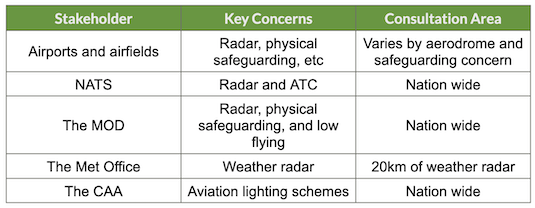
The table below provides a summary of the key stakeholders, their typical concerns for new wind developments, and within what distance they should be consulted.
About Pager Power
Pager Power undertakes technical assessments for developers of renewable energy projects and tall buildings worldwide.
For more information about what we do, please get in touch.
Image accreditation: Karabo Photo. April 2023. Last accessed on 13th April 2026. Available at: https://www.pexels.com/photo/jet-plane-flying-over-wind-turbine-16510280/
post contents
About the Author: Phillip Charhill

Latest News
Iran War puts Renewables in the Spotlight
War and the Cost of Energy Wars have far-reaching impacts [...]
Why the Future of Solar Might Happen After Dark
Ever since the development and advancement of solar panels into [...]
Which Aviation Stakeholders Need to be Consulted for Wind Projects?
Aviation can be a key planning risk for new wind [...]