Articles about Aviation

When we think of disruptions to air travel, we may be minded to imagine things like severe weather events, airspace closures due to conflicts, technical faults or even cyber-attacks. We [...]

Bird strikes are recognised as one of the major controllable hazards to aviation, and the risk does not end at the airport fence. Because birds are highly mobile, attractive features [...]

Early this month, Pager Power appeared at the Onshore Wind Conference 2026, and delivered a short presentation on our new Aviation Feasibility Maps as a part of the Supplier Showcase. [...]

Aviation glint and glare assessments for solar PV almost always become more complex than initially anticipated, and possibly counterintuitively, they typically get more complicated when assessing smaller general aviation aerodromes, [...]

On Tuesday 8th September, an issue in the software of NATS, the body that manage all of the UK civil air traffic, lead to the cancellation of more than 2,000 [...]

City centres are getting taller. New skyscrapers of flats and offices are being proposed and built at a fast pace. Developing one of these projects requires balancing a large number [...]
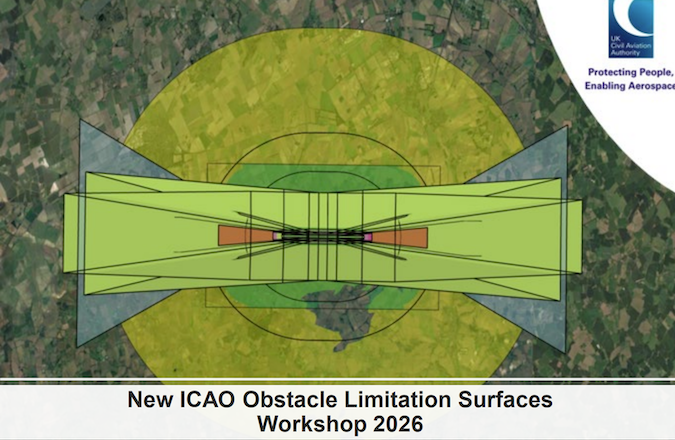
The Workshop In July, the UK Civil Aviation Authority (CAA) hosted a workshop at their office near Gatwick Airport on the future International Civil Aviation Organization (ICAO) Obstacle Limitation Surfaces [...]

Onward 2030 Work Package 3 (WP3) has been produced with the aim of seeking agreement on a strategy for mitigating the impacts of wind developments on aviation systems, mainly Primary [...]

Electronic Conspicuity (or EC) is a term used to describe aircraft that can be identified by electronic means (further details below). Currently, EC is not mandated in the UK, unlike [...]

What are the Onward 2030 Work Packages? Onward 2030 has been founded to ensure that up to 20GW of new onshore wind, as set out in the Onshore Wind Sector [...]