Why the Future of Solar Might Happen After Dark
Last Updated: April 14, 2026
Share:
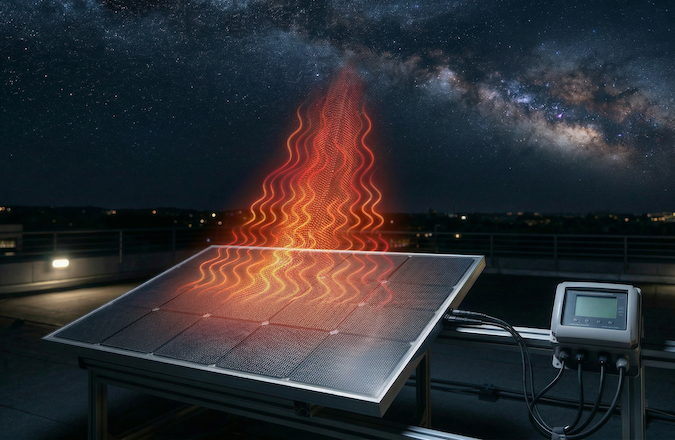
Ever since the development and advancement of solar panels into the mainstream renewable energy sector, we have treated night and darkness as the absence of solar energy. We thought that when the sun sets, solar panels go quiet, batteries take over, and the grid does the heavy lifting. Night has always meant downtime. A new kind of solar technology is starting to change those ideas. You might think, “Oh, it’s capturing the moon’s radiation,” but that’s not true. The idea is to make electricity by sending heat into the cold space.
Turning Darkness into Electricity
When you first think about it, the idea seems strange. How can something actually make energy by getting cooler? This happens because of something called Radiative cooling. Everything on Earth is constantly emitting infrared radiation. Radiative cooling is a natural process in which surfaces release heat by emitting infrared radiation into outer space, effectively using the universe itself as a cold sink [1]. This works because Earth’s atmosphere has a “window” (between 8 and 14 micrometres) that allows heat to escape directly into space [2].
When the Sun is out during the day, it is so strong that it covers up this effect. But at night, the sky acts as a heat sink, reaching a temperature close to absolute zero from a radiative perspective. So if a device is engineered correctly, it can radiate heat into space faster than it gains heat from its surroundings. This phenomenon creates a temperature difference between the device and the environment, which allows for the generation of electricity [3].
Using thermoelectric generators or thermoradiative cells, these devices can produce electricity without sunlight. Solar cells produce electricity by taking in photons from a hotter source, while thermoradiative cells produce current by releasing infrared light photons into cooler environments as long as they are at a higher temperature than their environment [4], [5].
How Night-Time Solar Works
New research suggests that the losses due to air convection and material inefficiencies can be reduced via better thermal engineering. For example, a thermodynamic model of a 24-hour thermoradiative generator predicted a nighttime power density of about 10.8 W/m² under ideal temperature differentials and material properties [6]. More recently, near-field thermoradiative configurations have been theoretically shown to have maximum power densities of nearly 180 W/m² [7], comparable to daytime photovoltaic panels in theory. The current estimated nighttime power densities reach around 2 W/m² in advanced systems [8].
What the Technology Could Power
This technology is years away from replacing regular solar panels, but excels at making small amounts of power all the time, which is useful in places where reliability is more important than output. It has an application to generate power for Off-grid nighttime, where sunlight is unavailable but energy is still needed, such as
- Agricultural and environmental sensors
- Security and monitoring devices
- Low-power digital communication systems
- Lighting solutions, particularly in remote or developing regions
Low-Power Uses and Long-Term Potential
Because these systems can operate without batteries or with minimal storage, they reduce maintenance costs and improve long-term reliability. As Professor Shanhui Fan from Stanford’s research team explains: “It is already financially interesting for low-power applications like LED lights, charging a cell phone, or powering small sensors.” Even more interesting is its potential during the day and night. With the right materials, daytime performance could be three to four times higher, meaning a single system could generate power continuously.
About Pager Power
Pager Power undertakes technical assessments for developers of renewable energy projects and tall buildings worldwide.
For more information about what we do, please get in touch.
References
[1] “Radiative Cooling,” Quantum Photonics and Nanophotonics Group [QPANG] – Mohamed ElKabbash. Accessed: Apr. 08, 2026. [Online]. Available: https://wp.optics.arizona.edu/melkabbash/radiative-cooling/
[2] Md. M. Hossain and M. Gu, “Radiative Cooling: Principles, Progress, and Potentials,” Adv. Sci., vol. 3, no. 7, p. 1500360, Feb. 2016, doi: 10.1002/advs.201500360.
[3] M. P. Nielsen et al., “Semiconductor thermoradiative power conversion,” Nat. Photonics, vol. 18, no. 11, pp. 1137–1146, Nov. 2024, doi: 10.1038/s41566-024-01537-5.
[4] A. Fell, “Anti-Solar Cells: A Photovoltaic Cell That Works at Night,” UC Davis. Accessed: Apr. 08, 2026. [Online]. Available: https://www.ucdavis.edu/curiosity/news/anti-solar-cells-photovoltaic-cell-works-night
[5] “The ‘solar cells in reverse’ that can generate power at night”, Accessed: Apr. 08, 2026. [Online]. Available: https://www.nature.com/articles/d42473-024-00483-8
[6] X. Zhang, G. Yang, M. Yan, L. K. Ang, and Y. S. Ang, “Designing 24-hour Electrical Power Generator: Thermoradiative Device for Harvesting Energy from Sun and Outer Space,” arXiv.org. Accessed: Apr. 08, 2026. [Online]. Available: https://arxiv.org/abs/2101.05691v1
[7] D. Feng and X. Ruan, “Concentrated Near-Field Thermoradiative Device Approaching Solar Cell Performance at Nighttime,” ACS Nano, vol. 19, no. 18, pp. 17357–17364, May 2025, doi: 10.1021/acsnano.4c16433.
[8] “Nighttime Electrical Power Generation via Radiative Cooling | Explore Technologies.” Accessed: Apr. 08, 2026. [Online]. Available: https://techfinder.stanford.edu/technology/nighttime-electrical-power-generation-radiative-cooling
post contents
About the Author: Vijayatha Vijayaraghavan