How Do Wind Turbines Block Microwave or Mobile Phone Links?

Last Updated: February 12, 2026
Share:
Wind turbine developers will be familiar with the constraints posed by wireless links, often belonging to mobile phone networks or utilities. This article presents an overview of why this infrastructure can be a constraint and how best to manage it.
What are microwave links?
Radiocommunication systems, including mobile phones, require data transmission between multiple locations separated by large distances. One option to achieve this is cables, but this has financial and logistical barriers that often make wireless radio links more favourable. Such links can be one-way or two-way, depending on whether data is transmitted only by one end of the link and received by the other, or whether transmission goes back and forth between both ends.
Such links can use a range of frequencies. Mobile phone operators, for example, typically use links with frequencies of the order 1-40 gigahertz, which is within in the ‘microwave’ portion of the radio spectrum. Such links are referred to as microwave links and are typically two-way. Advantages of microwave links include:
- Good for transmitting large amounts of data (compared to lower frequencies);
- Well-suited for two-way links that form large networks;
- Cost-effective for many network operators.
One drawback is that microwave links generally require radio ‘line of sight’ to work reliably, which is to say the path between one end and the other needs to be clear of terrain or other obstructions. This contrasts with lower frequency systems like television broadcasts, which can provide adequate signal even without a clear path between transmitter and receiver. You have very likely seen countless microwave link ends, they are usually clustered on radio masts with white protective covers.
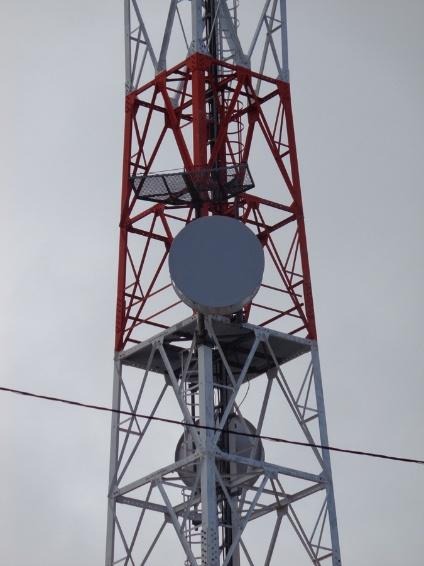
Figure 1 Photograph of microwave links in Greece.
These links form the network between transmitters, which communicate with individual handsets in their proximity.
Wind turbines and microwave links
Microwave links pass invisibly all over countries and even between them. This does mean that when new structures are built, particularly if they are tall, there is a risk that they will block a pathway. Wind turbines, in particular, are slightly more complex because the moving blades complicate the interference mechanisms further, however this topic is not covered in detail here.
There are three ways that wind turbines can disrupt radiocommunication services:
- Obstructing the path between two link ends;
- Reflecting the radio signals in an unwanted direction, specifically towards the receiver; and
- Emitting electromagnetic radiation that causes interference.
The third concern is rarely an issue concern for “normal” radiocommunications equipment. It can be a concern for specialised infrastructure like radio telescopes or in other unusual circumstances.
The second concern is rarely a consideration for microwave links. It does come up for link at lower frequencies, along with other types of infrastructure. Some operators do raise this matter, often due to over-conservative safeguarding approaches, although there can be specific cases where this would be a potential problem.
The first concern is the most common issue for wind development sites that are crossed by microwave links. Essentially, the issue is that if the radio signal blocked, the received signal is weaker and/or disrupted. The most straightforward solution is to ensure that the link path is left clear of turbine blades and towers. It is important to know that being clear of the direct line between the antennae is not enough. There is a zone around the direct path that also needs to be kept clear.
How much separation to leave
Link operators may, when consulted, specify their own separation requirements. One issue here is that these specified distances can be somewhat arbitrary and oversimplified. The scientific way to establish the separation required is via calculation of something called the second Fresnel zone. The topic of Frenel zones is covered more comprehensively in this article. In simple terms, a Fresnel zone is a cigar-shaped region surrounding a link path, which is widest at the halfway point between the antennae. Its dimensions are dependent on the link’s frequency and length. Figure 2 below illustrates a Fresnel zone. If a turbine is located outside the second Fresnel zone, the link performance is unlikely to be significantly affected.
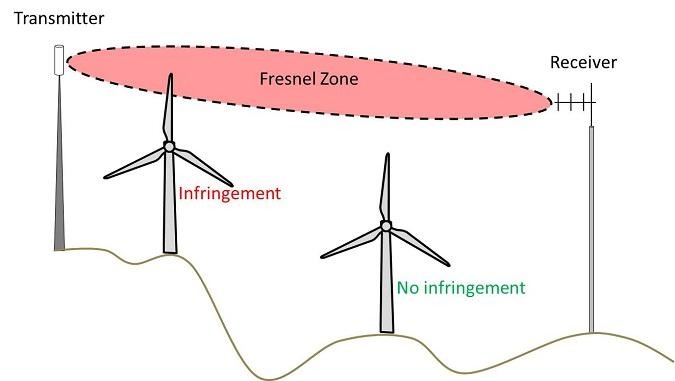
Figure 2 Fresnel zone safeguarding.
How to find out what the constraints are
The most reliable approach to establishing the constraints is consultation with the most prevalent link operators in your region. Depending on the country you are in, there may be public resources that illustrate the location of link infrastructure, however these can often be incomplete or out of date. A good place to start may be with regulators such as Ofcom in the UK, or their equivalent in other territories. It is common for microwave link safeguarding to be somewhat decentralised and fragmented.
Solutions
In cases where the required separation cannot be maintained within the layout, other technical mitigation may be required. Common solutions at that stage including re-directing the link, which is to say altering the link’s path via other masts to avoid the wind turbines. Other solutions exist, their feasibility vary case by case and require close coordination with the link operator in order to reach both technical and financial agreement.
Pager Power
Pager Power has been helping wind developers navigate telecommunication constraints, aviation safety issues, shadow flicker concerns and much more in over 60 countries for over 25 years. If you have any questions about your project, please do get in touch.
Image accreditation: Hrant Khachatryan (October 2022) from Unsplash.com+. Last accessed on 12th February 2026. Available at: https://unsplash.com/photos/a-wind-farm-with-a-wind-turbine-in-the-background-Dbd7bZLlhl4
post contents
About the Author: Kai Frolic