The Clean Industry Bonus: Rewiring Britain’s Offshore Wind Auctions
For over a decade, the UK’s Contracts for Difference (CfD) scheme has been the backbone of renewable energy investment, offering generators a guaranteed strike price in exchange for building clean power. But by Allocation Round 7 (AR7), the government wanted the auction to reward how projects were built, not just how cheaply. This paved to road to the Clean Industry Bonus (CIB).
From Pilot Idea to Policy
The CIB was announced in 2024 as part of the AR7 application process, evolving from an earlier concept called Sustainable Industry Rewards (SIRs). Originally envisioned as a multi-round pilot to be reviewed only after AR9, the scheme’s assessment was accelerated to follow immediately after AR7, replacing the old Supply Chain Plan requirements that had governed applicants up to AR6 [1].
When the AR7 application window opened on 13 February 2025, the CIB became the first live version of the scheme. This acted as an additional funding pot layered on top of the standard CfD strike price, available exclusively to fixed-bottom and floating offshore wind projects. Its stated purpose was to pull investment into the UK’s offshore wind supply chain and push the industry toward more sustainable practices, with commitments verified against a formal “CIB Statement” before payments are unlocked [2].
How the Clean Industry Bonus Actually Drives Investment
The CIB’s power lies in its structure, not just its size. To qualify at all, generators must meet a minimum standard: capital investment in manufacturing facilities, ports, or installation firms in government-designated deprived areas, or commitments to procure from suppliers with Science-Based Targets for emissions reductions [2]. For fixed-bottom offshore wind, that minimum bar was set at £100m per GW, ensuring real money is committed before a generator sees a penny of bonus [3].
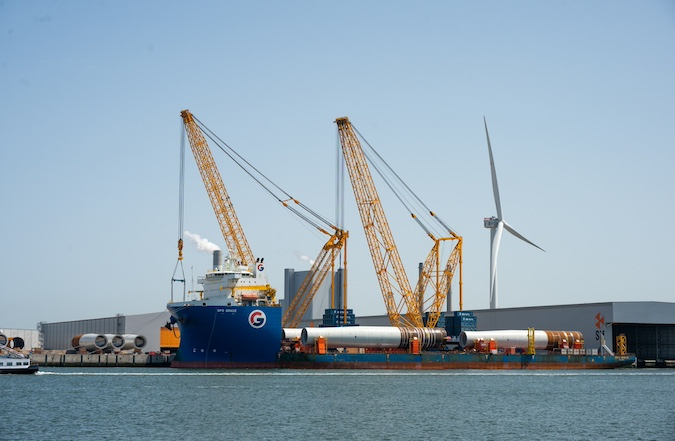
Crucially, the scheme only counts tangible assets, not skills programmes or R&D, and investment must land between March 2024 and the project’s CfD start date – turning subsidy into concrete factories and quaysides rather than promises. Beyond the floor, generators can bid for further “CIB extra proposals,” scored on how far investment exceeds the minimum, with funding allocated competitively. DESNZ then monitors delivery through bi-annual meetings and a final compliance report before certifying commitments as met [2].
The results show real capital movement. Government estimates put AR7’s roughly £204m of public CIB funding as leveraging up to £3.4 billion of private investment in manufacturing, factories and ports [3], which are the very bottlenecks that have long constrained UK offshore wind delivery.
The Money on the Table
The numbers moved fast. The initial AR7 budget was set at £27m per GW, with a ceiling of roughly £200m across an expected 7-8 GW of offshore wind capacity [2]. By the time the government issued its final budget notice in May 2025, that figure had been revised sharply upward: £20.1 million per GW of applying capacity, totalling over £544 million [1], including a portion ring-fenced specifically for the still-nascent floating offshore wind supply chain [1].
A Strong First Outcome
Results were announced on 14 January 2026, with the government calling it a “historic win” [4]. AR7 delivered 8.25 GW of fixed-bottom capacity across six projects at a strike price 19.3% below the administrative cap, alongside 192.5 MW of floating wind at £216.49/MWh [5]. Industry voices such as Offshore Energies UK framed the CIB as central to that success, describing it as critical for putting the integrated UK supply chain “at the heart of delivery” [6].
What’s Next: AR8 and Beyond
Success bred scrutiny. DESNZ opened a consultation in autumn 2025 on reforming the CIB ahead of AR8, aiming to fix operational issues surfaced during AR7 and to extend the bonus beyond offshore wind into onshore wind. Parallel AR8 reforms, including making permanent a ban on re-entering relinquished capacity, signal a scheme still being tightened round by round [7].
Three allocation rounds in under two years have transformed the CIB from a hastily-announced pilot into a fixture of UK renewables policy – one that AR8, AR9 and beyond will now have to live up to.
About Pager Power
Pager Power undertakes technical assessments for developers of renewable energy projects and tall buildings worldwide.
For more information about what we do, please get in touch.
References
[1] AR7 Clean Industry Bonus Allocation Round Budget Notice (May 2025). DESNZ. Last accessed: 19/08/2026 [2] Clean Industry ‘Bonus’ or ‘Burden’? (March 2025). Watson Farley & Williams. Last accessed: 18/08/2026 [3] CfD Allocation Round 8: the Clean Industry Bonus and Contract for Difference changes for AR8 and beyond (March 2026). Birketts. Last accessed: 18/08/2026 [4] Q&A: What UK’s record auction for offshore wind means for bills and clean power by 2030. Carbon Brief (January 2026). Last accessed: 18/08/2026 [5] Allocation Round 7 (AR7) Results and Analysis (January 2026). ORE Catapult. Last accessed: 18/08/2026 [6] OEUK responds to Allocation Round 7 (AR7) for renewable energy (January 2026). Offshore Energies UK. Last accessed: 19/08/2026 [7] DESNZ consults on regulatory reform to the Clean Industry Bonus scheme (September 2025). CMS Law-Now. Last accessed: 19/08/2026Image accreditation: Julia Taubitz (July 2024) from Unsplash.com. Last accessed on 25 August 2026. Available at:
https://unsplash.com/photos/ship-with-cranes-loading-wind-turbine-parts-in-a-port-BFKnnZ3cnIQ
post contents
About the Author: Tori Harvey