UK Onshore Wind: Why Invest in Repowering?

Last Updated: July 10, 2026
Share:
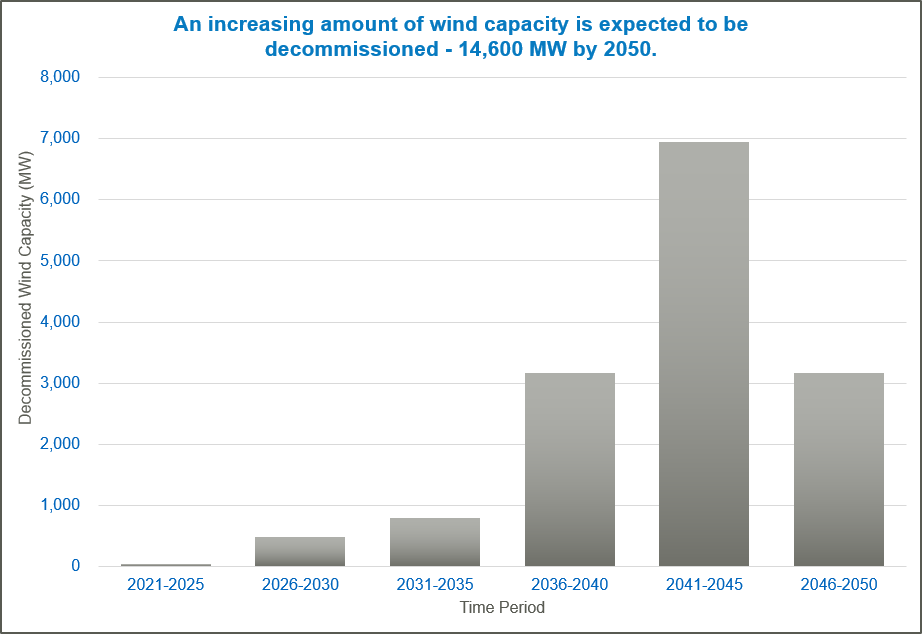
There is currently 316 MW of operational onshore wind capacity in the UK which was commissioned more than 25 years ago (1), and a further 1,125 MW which was commissioned between 20 and 25 years ago [1]. The first generation of wind turbines are now being decommissioned: 92 MW has been decommissioned so far as of July 2026; a further 600 MW will be by July 2031.
As the first generation of wind turbines reaches end of life, future onshore wind energy generation targets are at an all-time high of 27 GW [2], as part of the onshore clean power plan. The UK has around 16 GW installed as of 2026, so almost 3 GW is required every year until the end of the decade – more than has been installed in any previous year in the history of UK onshore wind generation. This will be supplemented by further requirements as electricity requirements are expected to double by 2050, as fossil fuels are phased out elsewhere [3]. Commissioning onshore wind developments on this scale will necessitate not only a greater number of wind turbines, but also the infrastructure that surrounds it. Transport links and connections to the national grid both present a significant bottleneck to achieving UK renewable energy targets; repowering would solve some of these problems. The question then becomes: do the numbers add up for developers?
More Powerful Turbines
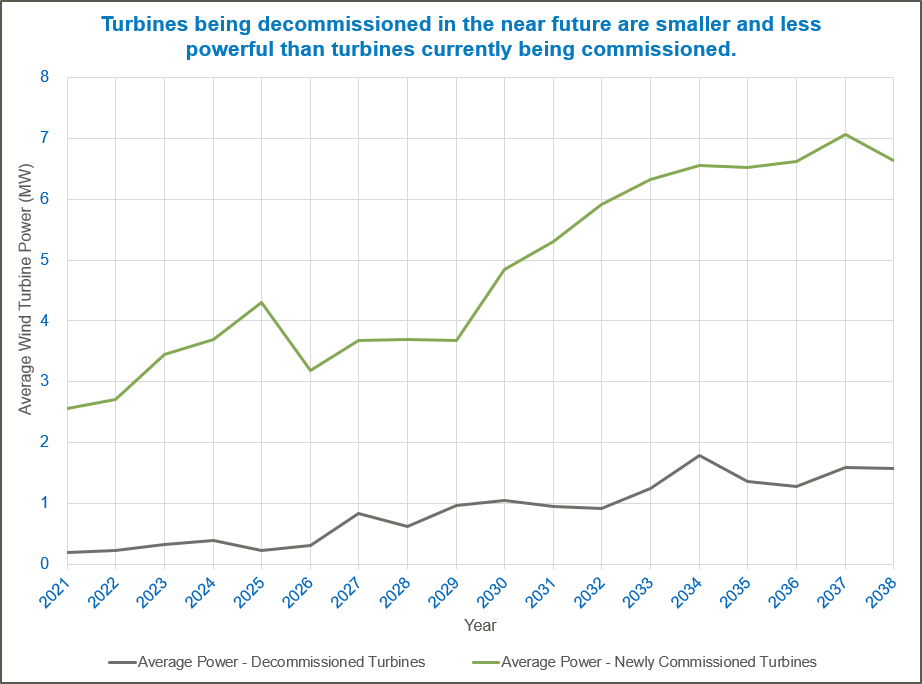
Wind turbines have become more efficient and more powerful: those scheduled for commission in the next 5 years will have average generation capacity of 4 MW per turbine (2), more than quadruple that of those which are expected to be decommissioned in the next 5 years – these have an average capacity of just over 900 KW (3).
If these pre-existing sites can be given a new lease of life, either to generate as much or in some cases more energy than at present, this then presents an opportunity to overcome some of the significant delays caused for want of a grid connection. Wait times for some projects are now in the region of 15 years [4]. Changes currently being undertaken to the grid connection queue may alleviate some of these delays, though this alone will not overcome the problems caused by an underlying lack of infrastructure.
Planning Constraints
Onshore wind turbines being constructed now are taller than their counterparts from 20 years ago. Over 80% of onshore wind turbines expected to start operating in the next 5 years will be more than 100m tall, compared to just 17% for those that are more than 20 years old.
With this additional height comes new challenges, which might not have been present when the original, smaller turbines were built at a site. Larger turbines typically have larger rotors and therefore larger blades to capture a greater volume of wind, which is used to generate more electricity. These blades are typically transported in one piece; if a site is in a remote location with smaller roads, moving these longer blades to site could well be a more complicated process than that for constructing the original wind turbines.
It is also more of a challenge to ensure that these larger wind turbines can coexist with existing aviation and telecommunications constraints. New turbines on a site which previously accommodated smaller turbines have the potential to trigger new planning issues. Larger turbine rotors are more likely to be visible to civil and military radar, with the potential to cause reflections and false returns. As the altitude at the tip of a turbine increases, the amount of clearance between the turbine and any aviation operations in the area becomes less, meaning that the turbine could trigger fresh Instrument Flight Procedure (IFP) or Obstacle Limitation Surface (OLS) concerns.
6GW Additional Generation by 2050: The Economic Opportunity
Despite the challenges which the repowering of these sites might face, there is still a significant economic opportunity, for both the country and for developers. The magnitude of the opportunity will depend on the site and whether the financial benefits will outweigh the financial costs. As of 2026, 1,242 MW of repowering capacity is in the development process [1]; by 2050 it is expected that the majority of currently operational onshore wind farms – 16 GW in total, will reach the end of their operating lives.
A calculation of the repowering factor [5] gives an insight much power might be generated and therefore how much revenue there is to gain out of repowering an existing site.

Things that affect the repowering factor of a site include:
- Site Extension: If a site can be extended, or if new access tracks can be constructed to facilitate the movement of larger wind turbine parts, the repowered site is expected to generate more power.
- Existing Turbines: Sites with smaller or less efficient turbines have the potential to gain the most generation from repowering. If the site already has newer and larger turbines, the potential benefits from repowering could be less as the wind turbine becomes a more mature technology.
Repowering factors vary by project. Most are between 100% and 200%, but they can reach over 500%, as is the case with Hagshaw Hill [5]. A repowering factor in excess of 100% means that the same site, when repowered with new turbines, will generate more electricity than the turbines it replaces. It is expected that those sites with repowering factors in excess of 100%, when taken together, could be used to unlock as much as 6 GW additional supply by 2050.
In addition to the benefits to the UK power network, and the UK’s targets for clean and resilient energy generation, developers too will benefit from repowering. There is an opportunity for pre-existing infrastructure to expedite new wind development. This will make the development process quicker and less expensive, whilst generating wind energy and therefore income more quickly, giving the development a higher present value. This in turn can allow developers to make more competitive bids on these repowering sites whilst being more profitable and more attractive to investors.
How can Pager Power Help?
Pager Power has been assisting wind developers overcome complex aviation issues for almost 25 years. Pager Power has worked on turbines of all sizes and has worked on repowering projects both in the UK and overseas and is well placed to provide assistance with regard to the aviation constraints that can be faced when developing larger wind turbines. Pager Power can assess proposed wind developments against both the existing and future OLS, and can give advice to developers on where their site is located relative to nearby aerodromes, offering a ready reckoner of any IFP issues to maximise chances of success when a project is submitted to an APDO for review.
For more information about what we do, please get in touch.
Footnotes
- RenewableUK EnergyPulse. Operational before 02/07/2001.
- 8915 MW across 2244 turbines.
- 600 MW across 649 turbines.
References
Charts in this article have been prepared by the Author, using charts from the RenewableUK EnergyPulse Database.
[1] RenewableUK. EnergyPulse Database.
[2] Department for Energy Security and Net Zero. Onshore Wind Taskforce Strategy. July 2025.
[3] UK Government. Clean Power 2030 Action Plan: A new era of clean electricity. December 2024. Accessed July 6th 2026. Available at: https://www.gov.uk/government/publications/clean-power-2030-action-plan
[4] Department for Energy Security and Net Zero, Ofgem, National Energy System Operator and The Rt Hon Ed Miliband MP. Press Release: Clean energy projects prioritised for grid connections. Accessed July 6th 2026. Available at: https://www.gov.uk/government/news/clean-energy-projects-prioritised-for-grid-connections
[5] Regen. A Second Wind: Unleashing the potential of repowering. April 2026. Accessed July 6th 2026. Available at: https://www.regen.co.uk/insights/a-second-wind-unleashing-the-potential-for-repowering
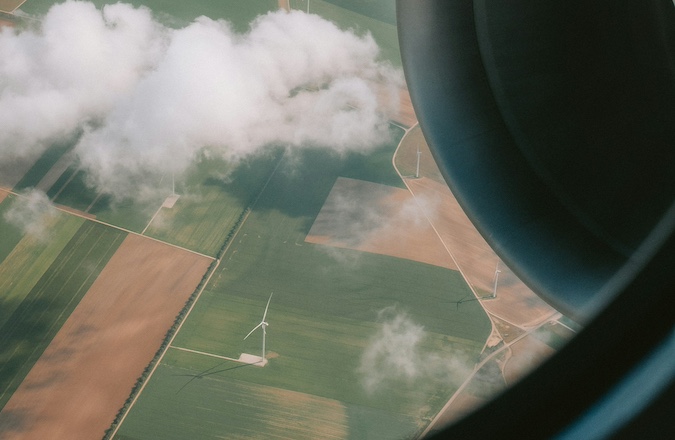
Image accreditation: Zac Wolff (January 2023) from Unsplash.com. Last accessed on 10 July 2026. Available at: https://unsplash.com/photos/a-field-of-green-grass-with-wind-turbines-in-the-background-baXCV2qg9Ew
post contents
About the Author: Harry Watson