The 2026 State of Play for Cooperative Automatic Detection Lighting Systems in the UK

Last Updated: May 27, 2026
Share:
Automatic Detection Lighting Systems (or ADLS as it is more commonly known) is a system that allows the aviation obstruction lighting fitted to wind turbines, or any other obstruction, to be remotely and automatically turned on and off as required based on the detection of nearby aircraft. ADLS is already routinely implemented across mainland Europe, but has yet to take off in the UK due to a historical lack of guidance and operational reasons, including it not currently being mandatory for aircraft to carry the equipment needed to ensure their conspicuity to detection systems – a requirement which is needed for ADLS to work. Of course, airspace changes can ensure that transponders are mandatory on aircraft, but this is a long, complex and costly process and may not be not practical on an individual wind project basis. ADLS is, however, becoming more of a central talking point in wind and aviation communities as onshore wind becomes a more attractive prospect, especially with the release of the newest edition of CAP 764, which frames the use of ADLS more positively. The discussion around electronic conspicuity of all aircraft is also becoming a focal point, and would make the implementation of ADLS across the UK a lot simpler.
This article presents an overview of the basics of ADLS and explores the operational and legislative changes required to implement it across the UK. We have also spoken with an ADLS provider in Germany (Lanthan Safe Sky), and they contribute their thoughts on the current state of ADLS across Europe, and the prospect of ADLS in the UK.
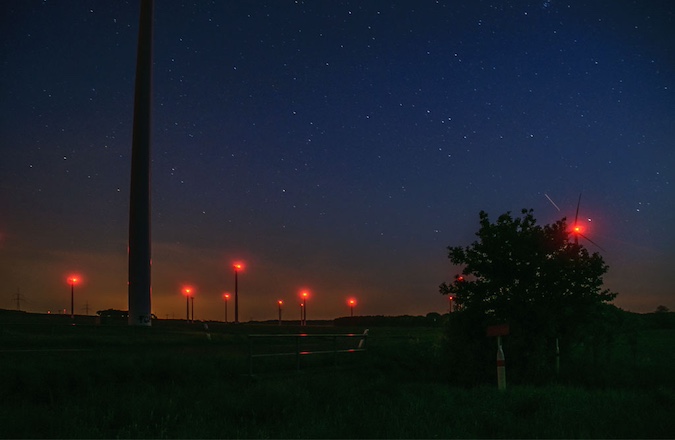
Figure 1: Wind turbine aviation obstruction lighting.
How does ADLS work?
ADLS systems work by detecting aircraft within a set distance from the object/obstructions (typically a wind farm, but it could include static structures, such as television or radio masts). When an aircraft is detected, the aviation lights are switched on for a required duration to ensure they are visible to a pilot throughout their transit of the airspace near the obstruction.
Transponder-based ADLS, or cooperative ADLS, achieves this by receiving the aircraft’s transponder signals. [1] If this occurs within a set distance of the obstruction, then the aviation obstruction (or warning) lights are switched on. The apparatus for detecting the aircraft is typically mounted separately to the obstruction lights [2] i.e. not on the wind turbine, and sometimes not on the wind farm site altogether. In some cases, the detection system can be used by multiple wind developments, as the maximum range of detection is greater than the area required to automate the lights for each obstruction.
Non-cooperative ADLS use primary radar technology to scan the surrounding airspace and detect the physical presence of an aircraft. The remaining principles are the same, whereby the lights are turned on for the required duration, however no co-operation with the aircraft is required to detect it.
For the purpose of this article, primarily cooperative systems are considered due to the current limitations around their deployment in the UK, where transponders are not mandatory. A lot of the surrounding principles around the implementation of ADLS in the UK do, however, overlap between cooperative and non-cooperative ADSL. Uncooperative solutions will be explored further in an article later in 2026.
What are the benefits and drawbacks of ADLS?
The key benefit is that the lights are only on when their visibility is essential for aviation safety, and this means that other environmental impacts, such as those around landscape and visual impacts at night, can be more often avoided. Similarly, it also means that light emissions can be reduced if the obstruction is located in a designated Dark Skies area (see Figure 2 below). ADSL mitigates the visual impact of the aviation lights at night, which can be one of the primary concerns of residents against wind energy projects.
Figure 2: Wind turbines in Dark Skies Areas.
The drawbacks in the UK are that there is no legal requirement for an aircraft to carry a transponder, which means there could be a situation where the lights are not turned on for someone who needs to be aware of the obstruction’s presence. While many do carry a transponder, smaller general aviation (GA) aircraft are not currently required to, which means without a change to necessitate essential electronic conspicuity across all aircraft, the only other option would be to change to the airspace around the obstruction, which would require a Transponder Mandatory Zone (TMZ). A TMZ is an area of an airspace where, to legally fly within the airspace, you need a transponder (or ATC permission), and these have historically been deployed in areas where primary radar coverage is less reliable or for operational or security reasons. Specifically, the CAA [3] say:
Transponder Mandatory Zones (TMZ) are designated volumes of airspace, often found around airports, which require Aircraft to be appropriately equipped. They can be established with or without accompanying controlled airspace. TMZs are utilised to enhance the ‘visibility’ or conspicuity of Aircraft operating within or in the vicinity of complex or busy airspace for the safety of all airspace operators. The airspace is established under SERA.6005* and is implemented to enhance the safe operation of flights into and out of an airport or area by providing as much information as possible to ATC without the need for excessive controlled airspace. Exceptionally, non-equipped Aircraft may be permitted to enter the zones subject to compliance with pre-agreed specific criteria or Letters of Agreement.
… Aircraft wishing to operate within a TMZ in the United Kingdom are required to carry and operate serviceable Secondary Surveillance Radar equipment fitted with Mode S. Aircraft wishing to operate within a TMZ without a Mode S transponder will only be accepted at the discretion of air traffic control. A TMZ may be permanent or temporary.
Implementing ADLS for a wind farm within an existing TMZ is the easiest approach, or as part of an ADLS trial or wider airspace overhaul. However, changing airspace classifications in the UK solely for the purpose of facilitating ADLS will be trickier and require coordination with the CAA (see section below). Changing the airspace to a TMZ for ADLS will be easier for larger developments, where costs can be more readily absorbed, but more difficult for smaller projects. In these instances, the best approach would be to understand the cumulative lighting impact with other wind developers to help create a joint solution.
What is the state of play in the UK?
As of December 2025, in the 7th edition of CAP 764: CAA Policy and Guidelines on Wind Turbines, the CAA has opened the door to the deployment of ADLS, however the CAA require a TMZ for the safe implementation of cooperative solutions to ensure all aircraft that need to see the wind farm can. In reality, the number of aircraft that would need to see the wind farm that don’t already have a transponder is small. This is because all commercial, freight and military aircraft use transponders (though military aircraft can turn them off). Therefore, it is only GA aircraft that happen to be flying at night (or close to it) without a transponder that would not be detected by cooperative ADLS. For private pilots to legally fly at night, which is defined as 30 minutes before sunrise or after sunset, a separate night rating is needed. Given the scenario described above, it results in a very small proportion of aviators who would not trigger the lights who would otherwise need to [4]. Nevertheless, even though this number may be small in the UK, the high threshold for aviation safety required means ADLS needs to be implemented with the correct precautions.
Key paragraphs from the latest edition of CAP 764 include:
4.19 ADLS for wind turbine obstruction lighting will not be permitted within the obstacle limitation surfaces of a licensed aerodrome due to issues concerning the potential late detection of aircraft.
…
4.22 In some parts of UK airspace, there are no legal requirements for aircraft to carry and operate radios and/or devices that broadcast an aircraft’s location in space and in most cases its altitude (e.g. transponders or ADS-B). Therefore, the use of passive sensors for ADLS in these areas may require additional mitigation. An example might be the use of a Transponder Mandatory Zone (TMZ), although this would be subject to the CAA’s Airspace Change Process (further information available in CAA publication 1616).
…
4.26 The CAA will not approve the installation or operation of the ADLS, nor will it undertake continuous regulatory oversight of such systems. However, the CAA will need to provide a permission under point 6 of Article 222 of the Air Navigation Order to operate ADLS at a wind farm and a declaration of the system meeting minimum requirements must be submitted to the CAA prior to its operational use. The CAA may request additional information from the wind farm operator with regards to the performance of the system demonstrated during its commissioning or as necessary for the purpose of ensuring safety.
…
4.28 Range
a. The horizontal coverage of the surveillance system shall extend to at least 4 nautical miles (NM) away from the perimeter of the wind farm/group of wind turbines.
b. It is recommended that a single sensor surveillance solution to have an 8 NM range or a range sufficient to cover 4 NM away from the perimeter of the wind farm, whichever is greater. Where a sensor network is used, this may vary to provide coverage for at least 4 NM horizontally from the perimeter of the wind farm. The range should be limited to avoid unnecessary RF transmissions beyond the range required for the detection of targets prior to entry to the zone within which the obstacle lights must be switched on.
4.29 Vertical coverage
The vertical coverage should extend up to at least 600 m AGL measured above the highest part of the turbine or group of turbines. Note: Paragraph 4.35 describes the volume in which the lights are required to be activated.
4.30 Probability of Detection
a. The system shall successfully detect targets entering the zone between 4-3 NM away from the perimeter of the wind turbines with 99% Pd of detecting the target when entering or within this zone. b. Where targets are continuously tracked by the radar-based On-Demand Lighting Activation System, the targets shall be tracked until leaving the 4NM horizontal distance away from the perimeter of the wind farm and the vertical boundary with a 90% Pd. c. The required Pd shall be achieved for a target with a radar cross section of 1m2.
…
4.35 The ADLS must illuminate the obstruction lights in sufficient time to allow the lights to illuminate prior to an aircraft penetrating 1000 ft (304m) above the tallest point of the wind turbine or group of wind turbines in the vertical coverage volume specified above, and prior to, at least, 3 NM horizontally from the perimeter of the wind farm.
4.36 For systems that are capable of continuously monitoring aircraft while they are within the 3 NM / 1000 ft volume, the obstruction lights should stay on until the aircraft exits this volume.
Who provides ADLS solutions?
There are a number of providers of ADLS solutions worldwide. One organisation that Pager Power has recently been in contact with is Lanthan Safe Sky, an organisation based in Germany that provides cooperative ADLS systems for wind developments across Germany and Europe.
Julian Bialk, the company’s Business Development Manager for International Markets, had the following to say on the current state of ADLS across Europe, and the prospect of ADLS in the UK: ‘As the inventors of cooperative ADLS and having equipped thousands of wind turbines in continental Europe, we are thrilled to see that this technology is now also usable in the UK. We are confident and positive that solutions about airspace use and transponder use at night can be found pragmatically by respectfully involving all stakeholders.
The first trial we conducted in Scotland was very promising, and the results, both in terms of safety and light-off-performance, were outstanding.
We are committed to continuing our support of the UK wind industry to adapt and integrate ADLS into their portfolios. At a very low cost per turbine, ADLS boosts the acceptance of wind energy projects amongst residents and the public.’
For more information about Lanthan Safe Sky’s ADLS system, click here.
Conclusions
The first deployment of ADLS across the UK as a mitigation solution for negative lighting effects remains to be seen, but new guidance has opened the door to its implementation more than ever. For cooperative ADLS to be implemented efficiently across the UK, legislation in this area will need to change to ensure all aircraft flying legally can be observed by electronic means, or individual TMZs will need to be deployed. Project-specific airspace changes in the form of TMZs are complex and can be costly, and while possible, they make ADLS more difficult to implement. That being said, the need for ADLS in the UK will remain niche, and progressing through an airspace change will more than likely be greatly beneficial and worthwhile to developers in those situations where this lighting solution is needed. Nevertheless, once all aircraft have electronic conspicuity, as is becoming more likely to occur, cooperative ADLS systems will become much more readily deployable across the UK.
For more information on the current policy and legislation around the lighting of wind turbines and other tall structures in the UK and internationally, click here.
Speak to an Expert
Pager Power has extensive experience dealing with aviation lighting issues, which includes designing CAA-compliant lighting schemes for wind and building developments. For more information on our aviation lighting services, click here.
If you would like to receive advice on aviation lighting for your project, or to receive a quote for an assessment, please make an enquiry or give us a call on +44 (0)1787 319 001.
About Pager Power
Pager Power is a dedicated technical consultancy that has been providing independent guidance and advice regarding solar, wind, and building developments internationally since 2002.
Pager Power has completed over 1,800 glint and glare assessments, over 1,000 aviation, radar and safeguarding assessments, and over 1,000 telecommunications assessments, including the assessment of point-to-point link infrastructure, and television, mobile phone, and radio reception surveys. Pager Power is a truly international technical planning consultancy, having worked in over 60 countries.
References
[1] Primarily, co-operative ADLS technologies listen to an aircraft’s transponder transmissions to gauge its location. [2] There can be different configurataions, with detectors located on turbines, however the most common approach is to not mount the detectors on the wind turbines themselves. [3] Transponder Mandatory Zones (TMZ), CAA. Last accessed 12.5.26. [4] There are other non-cooperative ADLS solutions available that could solve this issue, however this article has focused on those requiring electronic conspicuity. Non-cooperative solutions are typically more expensive.Figure 1: Georgfotoart (2016) from wikimedia commons. Last accessed on 27th May 2026. Available at: https://commons.wikimedia.org/wiki/File:Windpark_Ferchland-Nielebock_03.jpg
Figure 2: Lanthan Safe Sky.
post contents
About the Author: Danny Scrivener