


Back to Basics, Part 5: A Brief Timeline of Photovoltaics
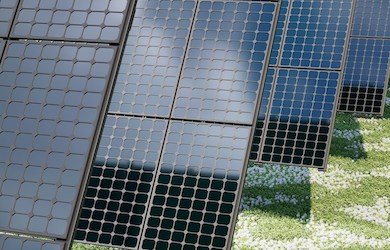
The fifth topic in the ‘Back to Basics’ series sets out the timeline for the development of modern photovoltaics.
Alongside the sun naturally providing its energy to grow crops, ancient civilisations used ‘passive solar’ to provide heat for homes, light fires, and even cauterize wounds [1]. These early interactions with solar radiation show awareness of our ability to harness the energy of the sun. Indeed, the sun is revered by most and appears as a deity throughout history [2]. The first discoveries about the properties of light in relation to electrical conductivity, however, were only made around 200 years ago…

Figure 1. The sun god Helios in a solar chariot. [3]
1839
In 1839, French scientist Edmond Becquerel discovered the photovoltaic effect. Becquerel explained this as “the production of an electric current when two plates of platinum or gold immersed in an acid, neutral, or alkaline solution are exposed in an uneven way to solar radiation” [4].
1873
Some years later, in 1873, Willoughby Smith observed photoconductivity in the element selenium. Smith was an English electrical engineer who stumbled across the unique relationship with sunlight whilst developing a means to continually test underwater cables during installation [5]. The discovery of selenium as photoconductive contributed to the development of early light sensors, television components, xerography (photocopying), and of course, solar cells. Today, the material is primarily used in glass production [6].
1883
Charles Fritts was then credited with creating the first working selenium cell. Unfortunately, the panel only achieved a conversion rate of 1% and was deemed unsuitable as a means of energy supply [7].
1887
Heinrich Hertz observes the photoelectric effect, where light is used to free electrons from a solid surface to create power. Modern-day solar panels rely upon this effect to convert sunlight into power [8].
1905
Albert Einstein published a paper “On a Heuristic Viewpoint Concerning the Production and Transformation of Light”. He was later awarded a Nobel Prize in Physics for his contributions to explaining the photoelectric effect [9].
1954
Numerous patents were distributed during the first half of the 20th century, but emergence of the first viable, modern solar cell was announced in 1954 out of Bell Labs in the USA. By this stage, photovoltaic efficiency had increased to approximately 6% and the cell was the first to be capable of powering an electric device for several hours of the day. The cell uses silicon as opposed to selenium [9].
1958
Vanguard 1 was launched on St Patrick’s day in 1958; the world’s first partially solar-powered satellite. This satellite is still circling the earth today, making it the oldest man-made object in orbit [10].
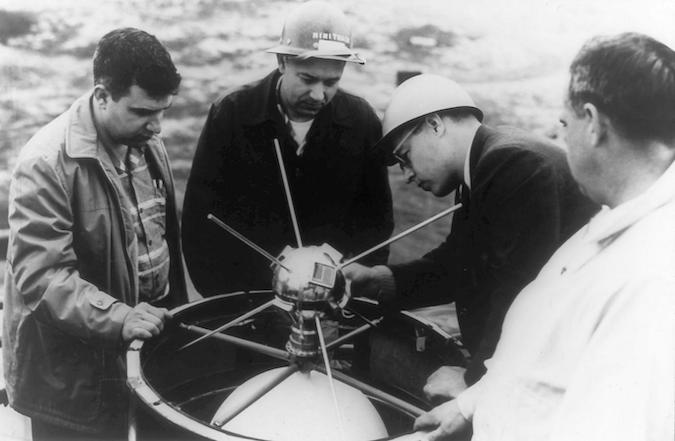
Figure 2. Scientists mounting Vanguard 1 to a rocket in 1958 [15]
1960s
After numerous breakthroughs in the photovoltaic efficiency of solar cells, Hoffman Electronics achieved a 14% conversion rate [11]. The commercialisation of solar begins to root itself alongside a growing awareness of our potential impact on the climate.
1982
The first 1MWp solar farm was built by Arco Solar in California at the end of 1982. The site has since been decommissioned [12].
2014
Golmud CPV Solar Park, China, becomes the largest solar power station in operation globally. The 138MWp station uses concentrator photovoltaics, which utilise lenses or curved mirrors to focus sunlight onto solar cells for increased efficiency [13].
2024
Is selenium making a comeback? In March, researchers published an article that explores the 50% efficiency of selenium and silicon mixed-material solar cells [14].
About Pager Power
Pager Power undertakes technical assessments for developers of renewable energy projects and tall buildings worldwide. For more information about what we do, please get in touch.
References
[2] https://en.wikipedia.org/wiki/Solar_deity
[3] Yair Haklai (2019) on WikiCommons. Last accessed on 20.05.2024. Available at: https://commons.wikimedia.org/wiki/File:Sun_God_Helios_relief_(Altes_Museum).jpg
[4] https://en.wikipedia.org/wiki/Photovoltaic_effect
[6] https://en.wikipedia.org/wiki/Selenium
[7] https://en.wikipedia.org/wiki/Charles_Fritts
[8] http://article.sapub.org/10.5923.j.ep.20221201.01.html
[9] https://en.wikipedia.org/wiki/Timeline_of_solar_cells#cite_note-72
[12] https://en.wikipedia.org/wiki/Photovoltaic_power_station
[13] https://en.wikipedia.org/wiki/Golmud_CPV_Solar_Park
[14] https://journals.aps.org/prxenergy/abstract/10.1103/PRXEnergy.3.013013
[15] Naval Research Laboratory (1958) from WikiCommons. Last accessed on 20.05.2024. Available at: https://commons.wikimedia.org/wiki/File:A_team_of_Vanguard_I_scientists_mount_the_satellite_in_the_rocket.jpg
Thumbnail image accreditation: Kamran Abdullayev (2023) on Unsplash.com Last accessed on 20.05.2024. Available at: https://unsplash.com/photos/a-row-of-solar-panels-sitting-on-top-of-a-grass-covered-field-T-WlAGX7yGI
post contents
About the Author: Tori Harvey

Latest News
US Continues to Build Out Solar Capacity
Earlier this month, the Solar Energy Industries Association (SEIA) released [...]
China’s Airborne Wind Turbines
In early 2026, China successfully developed an airborne wind turbine [...]
Shadow Flicker Assessments for Wind Turbines: A 2026 Update
Shadow flicker is the effect of rotating turbine blades, causing [...]








.jpg)
