


Why it is Rarely Just a Glare Issue – Solar PV and Aviation Safeguarding
Last Updated: September 17, 2026
Share:
Aviation glint and glare assessments for solar PV almost always become more complex than initially anticipated, and possibly counterintuitively, they typically get more complicated when assessing smaller general aviation aerodromes, compared to larger international airports. Aviation glare assessments require more nuance and specialist knowledge of aviation operations and guidance, compared to those assessments where safety is not a key consideration. Wider knowledge and understanding of the Air Navigation Order, Civil Aviation Authority guidance, aircraft and aerodrome operations are all required to undertake an assessment accurately. Furthermore, when developing solar PV, conversations with the planning authority and aerodrome often shift from glint and glare effects to wider aviation safeguarding concerns, such as engine failure and turbulence, for example. It is therefore imperative that aviation safeguarding is understood to ensure the accuracy of the assessment, which will be rightly interrogated by key stakeholders. This article explores the key safeguarding issues that arise around aviation glint and glare assessments and why expert knowledge and understanding of aviation operations and the modelling are required to navigate them effectively.
Glint and Glare Modelling
Forge Solar is the industry standard for aviation glint and glare modelling; however, whilst it is relatively easy to use, it does come with pitfalls in terms of results interpretation and best-practice use. With respect to the modelling of aviation PV glint and glare effects, modelling standard approach paths is often not sufficient for general aviation operations, and therefore a more complex understanding of operations, airspace and the aircraft are flown at the aerodrome (fixed wing aircraft, microlights, gliders, etc.), is required to undertake a representative assessment. A consultant must also ensure that the assessed panel areas are representative of the total reflector area to avoid understating the intensity of the solar reflection. There must also be a question about the extent of modelling required to produce a credible answer. Undertaking glint and glare modelling for a volume of airspace may seem comprehensive, but it often raises more questions than it answers and it can easily be misinterpreted by those unfamiliar with the modelling outputs. Therefore it is important that the modelling undertaken is suitable for understanding the impact, without being misleading or overly conservative.
Common Mistakes and Pitfalls
Underestimating the level of assessment required or misunderstanding the operations of an airfield is a common misstep when undertaking an aviation glint and glare assessment. Furthermore, the assessment of glint and glare often comes with broader aviation safeguarding concerns, most notably the loss of land in the event of a forced landing, which is typically caused by an EFATO (engine failure after take-off). These also need to be considered as part of the wide impact assessment, and failure to do so could lead to redesigns or even refusal. The aviation stakeholder’s position carries significant weight with the planning authority, and therefore, their position should be considered as early as possible in the project timeline. Failure to consult and understand key concerns can result in project difficulties further down the line.
Best Practice and Consultation
Reviewing an aerodrome’s safeguarding map (if available) can give a good indication of the potential risk of any new development. Furthermore, Pager Power always recommends consulting aerodromes to understand concerns and gain key insights into their operations as early as possible, with participation in meetings at the aerodrome always preferred. Giving the aerodrome the opportunity to raise any safeguarding issues is fundamental to the process so that the key concerns can be identified more clearly. It will always be the case that some risks are more significant than others, therefore a fundamental role of the expert consultant is to carefully consider what is and what isn’t a genuine risk to the project and aviators, and to provide reassurances where risks and the associated impact assessments are not taken forward.
Whilst consultation is always recommended, it is acknowledged that this isn’t always possible, with reasons for this commonly including time constraints, meaning assessments need to be submitted possibly before consultation can be started or finished.
Other best practice recommendations include designing a solar PV layout that takes into account safeguarding guidance and approaching the pre-planning process with a spirit of partnership in mind with surrounding stakeholders. Any new PV development in the vicinity of an airfield will most likely evoke a strong reaction from stakeholders that needs to be carefully managed through the planning process.
Conclusions
Knowledge around aviation safeguarding should be a prerequisite for undertaking an aviation glint and glare assessment. Simply knowing how to use the model is not enough, and it can often lead to delays, broken stakeholder relationships, re-designs and refusals if not managed correctly. There also needs to be a wider consideration around the aviation safeguarding impact of the development as a whole. For those developments in close proximity to an aerodrome, it is rarely just about glare impacts that need to be considered, and other aviation risks may come to light that need to be investigated. As with most planning projects, early consultation is key. By understanding the risks early, you can quickly narrow them down to those that affect the planning prospects of the development. Expertise and knowledge in the wider theory of aviation safeguarding (and not just glint and glare) is therefore fundamental to managing proposed solar PV developments near or on aerodromes.
Speak to an Expert
Pager Power has extensive experience dealing with aviation PV glint and glare issues. For more information on our glare and aviation safeguarding assessment services, click here.
If you would like to receive advice on any of the topics discussed in this article, or to receive a quote for an assessment, please make an enquiry or give us a call on +44 (0)1787 319 001.
About Pager Power
Pager Power is a dedicated technical consultancy that has been providing independent guidance and advice regarding solar, wind, and building developments internationally since 2002.
Pager Power has completed over 1,900 glint and glare assessments, over 1,000 aviation, radar and safeguarding assessments, and over 1,000 telecommunications assessments, including the assessment of point-to-point link infrastructure, and television, mobile phone, and radio reception surveys. Pager Power is a truly international technical planning consultancy, having worked in over 60 countries.
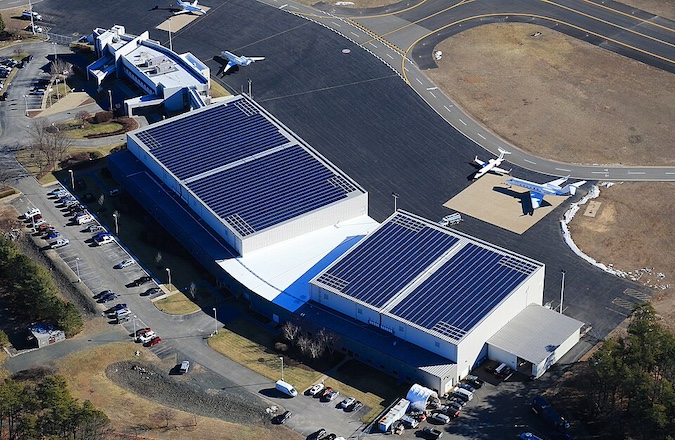
Image accreditation: PV rooftop systems on airport buildings (January 2016) from WikiMedia Commons. Last accessed on 17 September 2026. Available at: https://commons.wikimedia.org/wiki/File:Lau_000400_169104_512846_4578_(36129074764).jpg
post contents
About the Author: Danny Scrivener





.jpg)