What Aviation Studies are Required When Developing a Tall Building Near an Airport?

The expansion of cities worldwide has meant that many of these settlements are encroaching on the land around their respective airports. This urban sprawl must be carefully considered by those who safeguard the airports to ensure that the two can safely coexist. There are various aviation studies that can be undertaken in order to ensure that this objective will be achieved, covering the communications, navigation, surveillance, and aircraft clearances that all need to be maintained for safe operations.
What Risks Do Tall Buildings Pose to Aviation Safety?
Communications, Navigation and Surveillance Equipment
Various equipment can be found on an airfield which enhances the safety of aircraft operating at the aerodrome:
- Communication equipment consists of VHF communication antennae, which broadcast and receive signals, allowing pilots to speak to and receive assistance from air traffic controllers.
- Aircraft can tune into Navigation equipment, which means that approaches can be made using the assistance of precision and non-precision instruments.
- Surveillance equipment includes radar, typically used by air traffic control to identify and provide assistance to aircraft.
What unites these separate equipment types is that they all use electromagnetic waves to provide signals between aerodrome and aircraft, and tall buildings can block these signals if improperly placed.
Collision Risk
Aircraft arriving and departing from airports are typically flying at much lower levels than those in the middle of flight. It means that arrival and departure are the most sensitive stages of flight, and that care must be taken to ensure proper separation between the paths of incoming and outgoing aircraft, and between any potential obstacles such as taller buildings projecting further into the sky.
Occlusion of Aviation Lighting
Pilots need to have clear sighting of the aviation approach lighting placed along the extended runway centreline, and of the runway lighting itself. Tall buildings have the potential to block aviation approach and runway lights, inhibiting the ability of pilots to see this lighting when landing.
The converse issue, of lighting on buildings providing a distraction from aviation approach lighting, can also occur. This can be a particular issue at night, and it is necessary to consider what these buildings are expected to look like when illuminated by internal lighting.
What Assessments are Required for Tall Buildings near Airports?
There are six types of assessment which may be specifically required when planning a tall building near an airport.
1. A Communication, Navigation and Surveillance (CNS) Assessment can be used to determine whether tall buildings risk blocking signals from CNS equipment. Such an assessment is carried out in line with UK [1] and international methodology [2]. Depending on which equipment is present, an assessment may be required for tall buildings within a range of up to 15km from an aerodrome with the equipment.
2. An Obstacle Limitation Surfaces (OLS) Assessment can be used to determine whether tall buildings present a collision risk to the most sensitive parts of flight. Obstacle limitation surfaces consist of imaginary 3D planes which extend upwards and outwards from an aerodrome, in accordance with guidance published by the CAA [3,4] and MOD [5] in the UK, EASA [6] in Europe, the FAA [7] in the US, and ICAO [8] elsewhere. An OLS assessment is needed in the vicinity of licensed and certificated aerodromes. It is also sometimes requested or used as evidence when undertaking development in the vicinity of unlicensed aerodromes. An OLS assessment might be required for a proposed tall building up to 15km from an airport, depending on its size.
3. An Instrument Flight Procedure (IFP) Assessment applies specifically to those aerodromes that have instrument flight procedures, and is used to determine whether suitable clearances will be maintained between aircraft flying those procedures, and any new proposed development. Instrument Flight Procedures, like Obstacle Limitation Surfaces, are used to manage aircraft collision risk, but they come in a much wider range of shapes and sizes depending on the operational requirements of an aerodrome. Depending on the height of a proposed tall building, one of these assessments might be required up to 60km from an aerodrome. Note that this is dependent on the size and scale of the project, and the terrain and other developments surrounding a given aerodrome.
4. Tall buildings in the vicinity of an aerodrome might be required to have aviation lighting fitted, in order to be considered acceptable. An Aviation Lighting Assessment can be used to determine what sort of lights might be required, and how they should be spaced. For tall buildings above 150m, this assessment can be required everywhere in the UK [9]. For shorter buildings, it will typically only be done alongside other aviation assessments when within 15km of an aerodrome [3].
5. A Public Safety Zone (PSZ) Assessment is required for developments, including tall buildings, that are likely to increase the population living or working in the area immediately preceding a runway landing threshold. Public Safety Zones are assessed in accordance with guidance published by the Department for Transport [10], and are typically required for tall buildings close to the extended runway centreline, within 1.5km of a runway threshold.
6. An Aviation Lighting Plane Assessment may be required to ensure that a tall building does not adversely impact a pilot’s ability to see lighting placed on a runway approach by obscuring it from view. It might be required when a development is situated on or near to the extended runway centreline, within 2km of a runway threshold.
Pager Power additionally offers a Technical Aerodrome Safeguarding Assessment for buildings and wind developments in the vicinity of aerodromes. This assessment provides a high level analysis of multiple issues presented above, and it includes a quantitative study with any required modelling being completed using bespoke internal software.
What Other Considerations Surround the Planning of Tall Buildings?
Proposed tall buildings can require additional assessments, which are not specific to those in the vicinity of an airport. These developments are more likely than others to block television and radio signals, and may therefore require a Telecommunications Impact Assessment, Television Impact Assessment or a Terrestial Television Reception Survey. Tall buildings can also have an impact on other aviation operations, not specific to a particular airport.
There are also considerations surrounding the amenity of new buildings for those who live or work in them. Buildings should be adequately lit, and have access to broadband and mobile phone signal. It is for these reasons that developers of tall buildings might also consider a Daylight and Sunlight Assessment, a Broadband Connectivity Assessment or a Mobile Phone Reception Survey for their project.
Speak to an Expert
Pager Power has been assessing the impact of buildings and wind turbines upon aviation operations since 2002, and can complete all of the assessments mentioned in this article for developments requiring them.
If you’re still unsure whether you need to assess your tall building against aviation impacts, please use this link to submit an enquiry. Alternatively, feel free to call us on +44 (0)1787 319001 if you’d like to speak to us directly.
For more information regarding our buildings sector services, please click here.
References
[1] Civil Aviation Authority. Civil Aviation Publication 670. Third Issue, Amendment 1/2019, 1 June 2019, Effective 1 August 2019
[2] ICAO. Eur Doc 015 – European Guidance Material on Managing Building Restricted Areas. Third Edition – November 2015.
[3] Civil Aviation Authority. Civil Aviation Publication 168. Issue 13 – December 2025.
[4] Civil Aviation Authority. UK Regulation (EU) 139/2014.
[5] Ministry of Defence and Military Aviation Authority. Regulatory Article (RA) 3512: permanent fixed wing aerodrome: obstacle environment. Issue 3, March 2023.
[6] EASA. Certification Specifications and Guidance Material for Aerodrome Design (CS-ADR-DSN). Issue 7, May 2025.
[7] FAA. Federal Aviation Regulations Part 77 – Objects Affecting Navigable Airspace. Amendment 11, 1989.
[8] ICAO. Annex 14 to the Convention on International Civil Aviation – Aerodromes Volume I: Aerodrome Design and Operations. Ninth Edition, July 2022.
[9] Legislation.gov.uk. The Air Navigation Order 2016, article 222.
[10] Department for Transport. Control of development in airport public safety zones. Updated October 2021.
Image accreditation: Taipei 101 in Xinyi district. Songshan Airport in the foreground, elephant mountain in the background. Timo Volz (August 2020) from Unsplash.com. Last accessed on 9th March 2026. Available at: https://unsplash.com/photos/city-skyline-under-blue-sky-during-night-time-TdMu9cbTggM
post contents
About the Author: Harry Watson

Latest News

US Continues to Build Out Solar Capacity
Earlier this month, the Solar Energy Industries Association (SEIA) released [...]
China’s Airborne Wind Turbines
In early 2026, China successfully developed an airborne wind turbine [...]
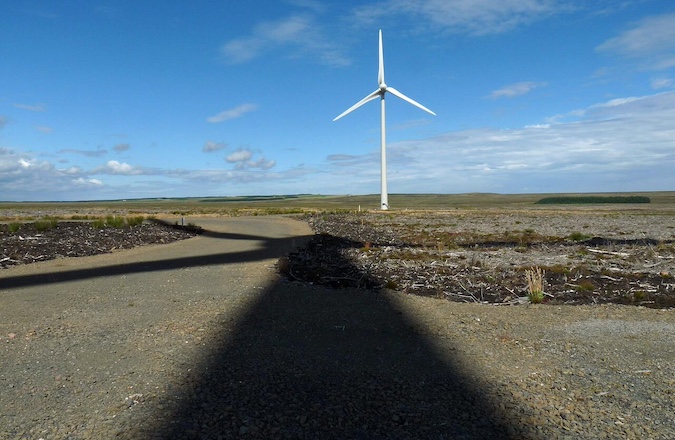
Shadow Flicker Assessments for Wind Turbines: A 2026 Update
Shadow flicker is the effect of rotating turbine blades, causing [...]