Solar Grazing: Striking a ‘Baa’-lance Between Sheep and Solar
We recently published an overview of the types of farming that come under the term agrivoltaics. The current article will delve deeper into the notion of solar grazing and how this is being adopted across various continents.
A Case for Combining Solar Farms and Sheep Grazing Pastures
In recent years, tensions have grown in rural communities in response to rapid development of utility-scale solar energy production facilities over the proper use of rural land, particularly between agricultural and solar energy production.
When solar arrays are installed, it is beneficial to have grassland underneath. Vegetation prevents stormwater runoff and corrosion from polluting the water supply, but it also needs to be controlled. Tall vegetation could cause shadowing of the panels, making them less efficient. But more of a concern, with attention drawn to the impacts of climate change, is the potential fire hazard presented by hectares of dry grass.
Alongside this, in the US as an example, the population of sheep has fallen from 50 million to just 5 million since the mid-1900s [1]. The mutton industry is struggling, and more than half of the country’s lamb is imported.
A Sustainable Solution for Renewable Energy and Agriculture
The concept of solar grazing originated in Europe, particularly in countries like Germany and the Netherlands, where solar farms began incorporating livestock to maintain vegetation.
Since 2016, Enel Power has been using sheep to maintain vegetation at its solar arrays in Greece. And since 2015, the solar farm at Saint-Amadou, in the Occitanie region of France, has been home to hundreds of sheep [1].
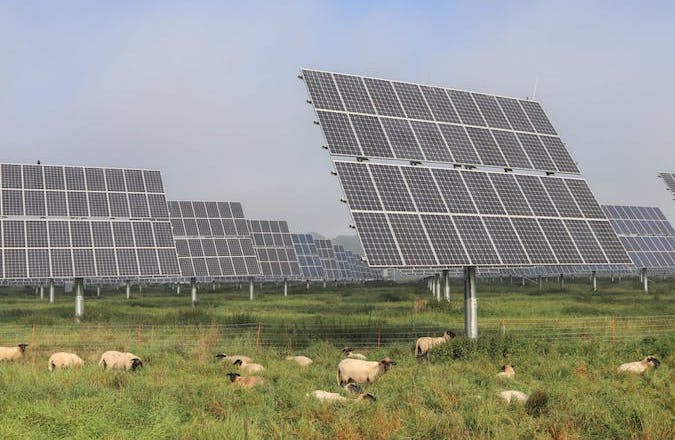
The practice is gaining popularity in the US and Australia as solar energy projects continue to expand. SB Energy, based in Austin, operates the fifth-largest solar project in the US, capable of generating 900MW of power across 4,000 acres [2]. The company also employs the stomachs of approximately 3,000 sheep as ‘natural lawnmowers’ to maintain the undergrowth at the solar park.
“The industry tends to rely on gas-powered mowers, which kind of contradicts the purpose of renewables,” said James Hawkins, the asset manager at SB Energy.
Solar grazing also creates additional revenue streams for farmers who lease their livestock to solar sites, providing a source of financial stability in an unpredictable industry.
Organisations like the American Solar Grazing Association (ASGA) are helping to formalise best practices, connecting farmers directly with solar site operators. According to data from the National Renewable Energy Laboratory, over 200 solar grazing sites are now active across the US [3].
Here in the UK, a 1GW project in Nottinghamshire plans to share its 4,000 acres with a flock of almost 4,000 sheep. That number is expected to climb to 9,000 once lambing begins and has the potential to save the project £5 million in mowing costs across its 40-year lifespan [4].
Currently, there are no studies which consider long-term environmental impacts, such as how viable the soil will be for future agriculture. However, dual land use benefits of putting the animals to work, combined with a much-needed boost for the lamb and wool markets in certain economies makes it likely that this practice will continue to snowball.
Benefits for the Livestock and the Land
Research published in Applied Animal Behaviour Science found that sheep with access to solar panels spend more time grazing than those without [5]. Researchers believe that part of the reason is that the panels provide sheep with shade.
In a separate report in 2018, it was found that the shelter of the panels also increases soil moisture. Condensation and rain runoff add to this, creating better forage with high protein content [5].
As the sheep move around the field, they trample old plant matter into the soil, fertilising and rejuvenating the earth. As well as bolstering the quality of forage, this has been shown to improve the soil health long term, increasing carbon storage and nutrients [1].
SolarPower Europe found that grazed soils under solar panels stored up to 80 per cent more carbon. Water retention is boosted by 20 to 30 per cent, and the company identified a 60 per cent increase in pollinator presence [6].
Alongside improving the quality of vegetation growth, studies have shown that the sheep themselves appear to be ‘happier and healthier’ than those in pastures without solar [7].
Conclusions
Grazing with sheep offers both economic and ecological benefits by controlling vegetation growth without compromising solar panel efficiency. By reducing the need for fossil fuel-powered maintenance equipment and chemical treatments, solar grazing minimises carbon emissions and promotes biodiversity. Whilst the long-term effects are yet to be investigated, the ever-increasing global demand for clean energy means that solar grazing has emerged as a practical and eco-friendly solution that benefits farmers, solar companies, and the environment alike.
About Pager Power
Pager Power undertakes technical assessments for developers of renewable energy projects and tall buildings worldwide. For more information about what we do, please get in touch.
References
[1] J. Bailey (2025). Nature’s best lawnmower: How solar grazing is changing the photovoltaic landscape, Euro News, Last accessed: 14/02/2025
[2] N. Lathan (2025). Why sheep have become the unlikely hero of the booming US solar industry, The Independent, Last accessed: 14/02/2025
[3] S. Fall (2024). Lighting the Way for Agrivoltaics: How NREL Empowers Communities To Capture the Benefits of Solar Energy, Agriculture, and Ecosystems, National Renewable Energy Laboratory, Last accessed: 14/02/2025
[4] M. Green (2024). Agrivoltaics deal to bring 9,000 sheep to 1GW solar park, Solar Power Portal, Last accessed: 14/02/2025
[5] E. W. Kampherbeek et al. (2023). A preliminary investigation of the effect of solar panels and rotation frequency on the grazing behavior of sheep (Ovis aries) grazing dormant pasture, Applied Animal Behaviour Science, 258, Last accessed: 14/02/2025
[6] SolarPower Europe (2024). Agrisolar Handbook, p6
[7] R. Wheeler (2024). Solar Grazing: A Win-Win Solution for Solar and Agriculture, Last accessed: 14/02/2025
[8] Vincent Delsuc September 2021 from Pexels.com. Last accessed on 17th February 2025. Available at: https://www.pexels.com/photo/a-flock-of-sheep-in-a-solar-farm-9684128/https://www.pagerpower.com/wp-content/uploads/2025/02/agrovoltaics-tori.jpgpost contents
About the Author: Tori Harvey

Latest News
US Continues to Build Out Solar Capacity
Earlier this month, the Solar Energy Industries Association (SEIA) released [...]
China’s Airborne Wind Turbines
In early 2026, China successfully developed an airborne wind turbine [...]
Shadow Flicker Assessments for Wind Turbines: A 2026 Update
Shadow flicker is the effect of rotating turbine blades, causing [...]