Precision Approach Radar: The Little-Known Radar That Can Cause Big Problems
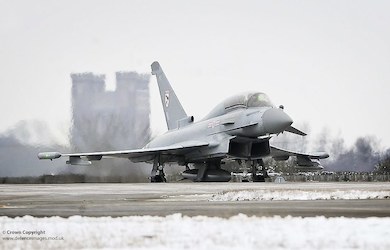
With the positivity surrounding the UK onshore wind sector, it is a good time to refresh the memory of the safeguarding constraints that exist around aviation and wind development. One of the most significant constraints surrounding wind and military aviation is the safeguarding of the Precision Approach Radar or ‘PAR’. These radar installations are specifically designed to guide an aircraft into land at aerodromes predominantly during poor visibility to maximise safety.
The good news is that relatively few aerodromes have precision approach radar when compared to those with ATC, air defence and en-route radar systems, and the comparative safeguarded area is relatively small. The bad news is that technical mitigation options effectively don’t exist, operational acceptance is highly unlikely (although not entirely unprecedented), and the safeguarded areas associated with precision approach radar can be treated as de-facto exclusion zones from an onshore wind perspective. That being said, this position may need to change to facilitate development and meet renewable targets.
This article takes a deeper dive into the PAR, its use and how it is safeguarded to better inform those who are looking to develop new wind farm sites.
How does a PAR Work?
Simplistically, a PAR works by transmitting signals that are intercepted by an aircraft and reflected back to a receiving antenna. The signals received at the radar are used to determine both the lateral and vertical position of the approaching aircraft relative to the runway centre line and required approach angle. PAR operate in a similar manner to Instrument Landing Systems (ILS), with both facilitating precision instrument approaches. The key difference between the two is that a PAR does not require any onboard equipment to use, with the outputs being issued as instructions to approaching pilots by ATC, whereas ILS outputs are for pilots in the aircraft only. At this time, the use of PAR remains exclusively with military activities rather than civil ones.
What is the PAR Safeguarded Area?
A PAR is used by military air traffic controllers to provide guidance to the pilot when approaching a PAR-designated runway. It is for this reason that the accuracy of the radar information is critical. The system itself is located alongside the runway and is typically safeguarded out to a maximum of 20 degrees either side of the runway end out to 20 nautical miles. If a wind turbine is located within this coned area, interference to the system can occur and an objection encountered.
The safeguarded area associated with one PAR approach effectively sterilises up to 479 square kilometres of land for wind turbine development per runway bearing (not including other safeguarding factors such as Obstacle Limitation Surfaces and ATC Radar), which is equivalent to over 67,000 football pitches.
The Google Earth images below show the wind farm PAR safeguarded areas for MOD Boscombe Down considering runway 05/23 and approaches on either bearing.
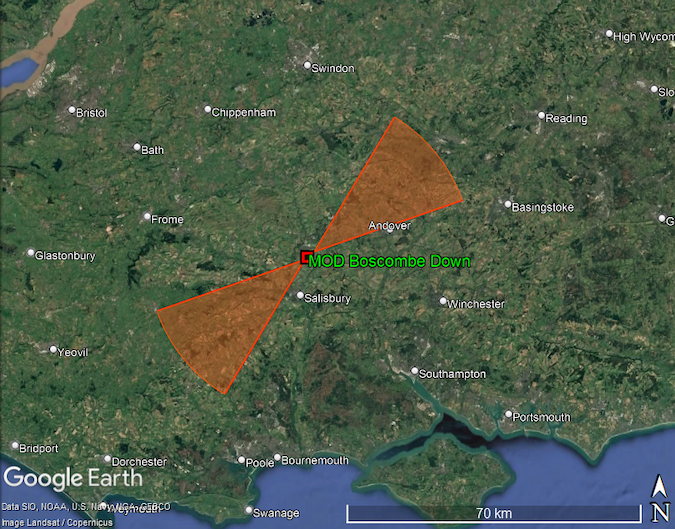
Figure 1 – MOD Boscombe Down PAR safeguarded areas.
What Military Airfields in the UK have a PAR?
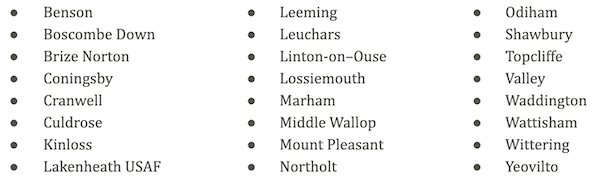
It is understood that PAR are present at the following UK military airfields:
Conclusions
The use of the military PAR remains a key safeguarding constraint for onshore wind, and mitigation techniques have remained firmly in a pre-2015 state, when the onshore effective moratorium was put in place. If a development is in the safeguarded zone, the key considerations regarding the overall impact will be line of sight, and the technical and operational sensitivity to interference. There are many other aviation constraints for wind developers to consider – see the links below for more information.
To find out more about military radar constraints, click here.
To find out more about civil radar constraints, click here.
Finally, to download our Onshore Wind and Aviation Guide, click here.
Speak to an Expert
If you would like to discuss a particular project or need more information on the aviation issues facing onshore wind, you can follow the link here to make an enquiry or click the ‘Enquire Here’ sidebar. Alternatively, we would be more than happy to have a discussion over the phone with you on +44 (0)1787 319001.
About Pager Power
Pager Power is a dedicated technical consultancy that has been providing independent guidance and advice regarding solar developments, wind farms, and building developments internationally since 2002. Further details about what we services we can provide can be found here. Pager Power has completed over 1,400 glint and glare assessments, over 1,000 aviation/radar impact assessments, over 500 television and radio reception surveys, and over 500 telecommunications impact assessments.
Thumbnail image accreditation: Typhoon Aircraft At RAF Coningsby (2013) from Flickr.com. Last accessed on 18th November 2024. Available here.
post contents
About the Author: Danny Scrivener

Latest News
Shadow Flicker Assessments for Wind Turbines: A 2026 Update
Shadow flicker is the effect of rotating turbine blades, causing [...]

Are London Homes Getting Too Hot?
London, like most large cities, experiences an average temperature that [...]
What is Wind Farm Repowering?
There are a lot of potential constraints when it comes [...]