New ICAO OLS Series – The Surface for Straight-In Instrument Approaches
The International Civil Aviation Organization (ICAO) has proposed new Obstacle Limitation Surfaces (OLS) which are expected to be brought into force from November 2028. In this edition we will explore the Surface for Straight-In Instrument Approaches (SIIA). This will be an Obstacle Evaluation Surface (OES), designed specifically to safeguard non-precision instrument arrivals, including aircraft guided by VHF Omnidirectional Radar (VOR) and other Performance-Based Navigation (PBN) instrument approaches.
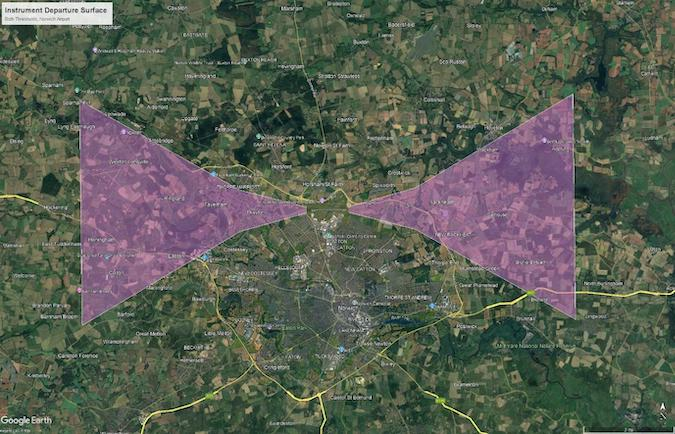
Figure 1: Pager Power modelling output for a potential Surface for Straight-In Instrument Approaches at Norwich Airport, overlaid on Google Earth imagery. This figure is given for illustrative purposes only [1].
What is the Difference Between OFS and OES?
The new OLS is expected to be split into two types of surfaces. The OFS aim to protect airspace in the immediate vicinity of the aerodrome and will provide protection for all designated airspace that aircraft will travel through or near when arriving or departing. The rules are expected to be enforced quite rigidly, with 4.4.4 of the ICAO State letter [2] stating that:
“New objects or extensions of existing objects shall not be permitted above the approach surface, take off climb surface and transitional surfaces and the complex surface extending between the lower edges of the transitional surfaces [obstacle free surfaces].”
This places an effective ban on any new obstructions breaching the OFS. The Instrument Departure Surface is however one of the surfaces with less strict criteria governing its safeguarding, with paragraph 4.4.8 [2] stipulating:
“States shall ensure that obstacles penetrating the obstacle evaluation surfaces are only permitted when, after aeronautical study, it is determined that the obstacles do not adversely affect the safety or significantly affect the regularity of the existing and intended operations of aeroplanes.”
With the OES, further study may reveal that a breach of the surface and aircraft operations can coexist. This is commensurate with the differing purposes of the surfaces, with OES generally inclined towards safeguarding airspace that some aircraft might use, as opposed to that which all aircraft will use.
Does a Similar Surface Currently Exist?
The SIIA is expected to comprise a pair of large horizontal surfaces, and this is the only similarity this surface has with the Inner Horizontal Surface (IHS) and Outer Horizontal Surface (OHS) of the existing OLS. The SIIA is designed for a different purpose though, specifically safeguarding instrument approaches. This compares to the IHS, which is designed to safeguard visual manoeuvring operations, and the OHS, which is more generally designed to safeguard the different route options for arriving and departing aircraft.
At the moment, rules around development in the vicinity of instrument approaches normally revolve around a primary and secondary surface drawn around the aircraft track, providing a level of obstacle clearance (the Minimum Obstacle Clearance – MOC) between the altitude of the development and the altitude of the aircraft. Permissable heights with respect to these procedures can be calculated using detailed modelling, but this is complicated by the fact that the surfaces are sloped, and their dimensions can vary considerably depending on the navigational aid used in the procedure. The aim of the SIIA is to simplify this process for the instrument approach types listed by using flat surfaces with fixed dimensions, applicable to all aerodrome design groups, to safeguard these procedures.
The SIIA- Specifications
The SIIA is established for each runway which operates straight-in instrument approaches. The SIIA consists of lower and upper sections, which are both horizontal planes. The dimensions are the same for all Aerodrome Design Groups (ADGs).
The lower section has the same dimensions as the most restrictive Horizontal Surface OES (as per Aerodrome Design Group 1). It is a racetrack shape 45 metres above the aerodrome elevation, formed by taking arcs 3350m away from the runway thresholds and joining them.
The upper section is a rectangle 60 metres above the aerodrome elevation. It is 7410m long on the shorter side, perpendicular to the runway centreline. The longer side extends 5350m beyond the runway threshold in each direction, meaning that the longer side of the rectangle is 10700m plus the distance between the two thresholds in total.
Figure 2 shows a plan view of the SIIA, the racetrack around the runway being the lower surface, and the rectangle around it being the upper surface.
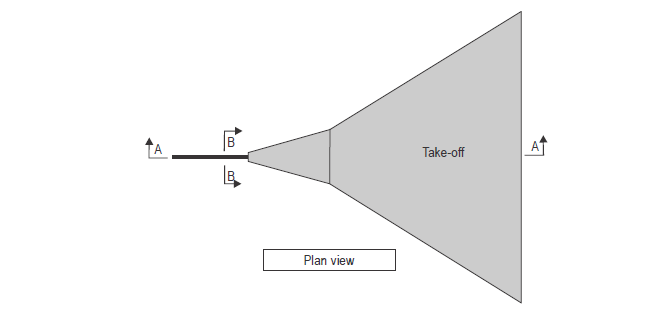
Figure 2: Plan view of the Surface for Straight In Instrument Approaches, as can be found in the ICAO State Letter [3].
How can Pager Power help?
Pager Power has a model for the new ICAO OLS as it is set out in [2]. Pager Power is able to undertake initial modelling of these surfaces and can offer initial consultation to developers and airports who require clarity on the new rules that are to be brought into force, having over 20 years of experience in the aviation sector.
More on Pager Power’s new ICAO OLS Modelling can be found here.
About Pager Power
Pager Power undertakes technical assessments for developers of renewable energy projects and tall buildings worldwide. For more information about what we do, please get in touch.
References
[1] Pager Power modelling output, visualised in Google Earth.
[2] ICAO State Letter (Reference AN 4/1.1.58-23/33)
[3] ICAO, Annex 14 to the Convention on International Civil Aviation, Ninth Edition, July 2022 Volume I
Thumbnail image accreditation: Alexander Mils (March 2024) from Unsplash.com+. Last accessed on 18th March 2025. Available at: https://unsplash.com/photos/a-large-jetliner-flying-through-a-blue-sky-8plEPHtD2Dghttps://www.pagerpower.com/wp-content/uploads/2025/03/OLS-Surface-for-Straight-In-Instrument-Approaches-thumbnail.jpeg
post contents
About the Author: Harry Watson

Latest News

US Continues to Build Out Solar Capacity
Earlier this month, the Solar Energy Industries Association (SEIA) released [...]
China’s Airborne Wind Turbines
In early 2026, China successfully developed an airborne wind turbine [...]
Shadow Flicker Assessments for Wind Turbines: A 2026 Update
Shadow flicker is the effect of rotating turbine blades, causing [...]