Glint and Glare Guidance – Overview and Detail of Changes
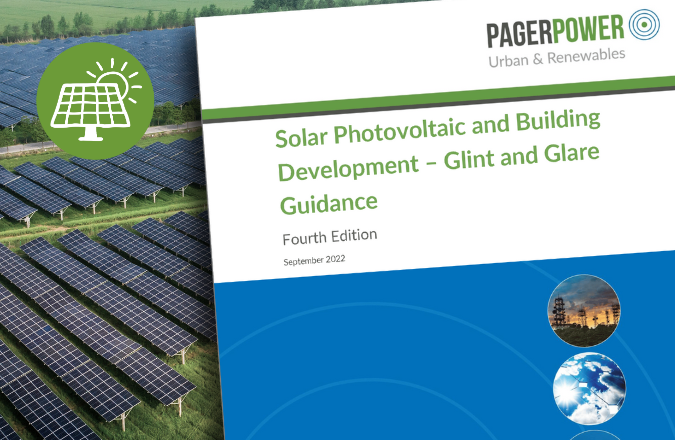
The following article provides a brief overview of what Pager Power’s Glint and Glare Guidance covers, and key details of the changes since its first edition back in 2017.
What is Glint and Glare?
If you are new to the area of glint and glare and the assessments in this area, a good place to start is the definition, which is as follows:
- Glint – a momentary flash of bright light
- Glare – a continuous source of bright light
A more comprehensive definition of glint and glare can be found here.
Why Produce the Glint and Glare Guidance?
The original aim of the glint and glare guidance was to produce a standardised methodology for PV developers, planners and stakeholders to follow, adding clarity to a previously unfamiliar planning issue. The second edition, produced over a year and a half later in 2019, did not reinvent the assessment methodology for PV, it merely refined and added detail where required based on the experience gained subsequently. The requirement for glint and glare assessments of building developments, specifically those with large reflective façades, had also grown between the first and second edition and therefore additional information regarding the methodology for this assessment type was provided.
The third edition refined the guidance and added additional guidance for building developments, specifically in the vicinity of airports and railway infrastructure. The focus remained on the guidance for PV panels, however where required, additional information was presented for building developments. The fourth edition added a further guidance update and improvements to the way effects are determined, and how the significance of impacts are classified.
The Glint and Glare Guidance presents the methodology recommended by Pager Power through extensive assessment experience. It should be used for reference and ideally, efforts should be made to agree a scope of work with the relevant stakeholder where an assessment is required. There may be cases where the assessment scenario does not match the guidance criteria, in this situation, a pragmatic approach is recommended.
What Does the Guidance Cover?
Within the guidance, four separate receptor categories are considered, these are:
- Dwellings (residential amenity)
- Roads (safety)
- Rail (safety)
- Aviation (safety)
In total, there are ten chapters which are titled as follows:
- Chapter 1: Overview
- Chapter 2: Consultation
- Chapter 3: Literature Review
- Chapter 4: Modelling Parameter Requirements
- Chapter 5: Glint and Glare Impact Significance
- Chapter 6: Assessing the Impact upon Surrounding Dwellings
- Chapter 7: Assessing the Impact upon Road Users
- Chapter 8: Assessing the Impact upon Railway Operations
- Chapter 9: Assessing the Impact upon Aviation Operations
- Chapter 10: Overall Conclusions
Overview of Changes
The details of the core changes from editions two to four are listed below.
Second Edition Changes
Amendments and revisions within the second edition include:
- Foreword added
- Added methodology for the assessment of helipad operations
- Additional clarity regarding the previously presented methodologies through the experience gained in the time between edition one and two, though not changed significantly
- High-level comments regarding the impact of building developments, particularly façades capable of producing specular reflections included within the foreword.
Third Edition Changes
Amendments and revisions within the third edition include:
- An updated Literature Review section
- Updated significance flow charts for determining the impact of solar reflections for road and dwelling receptors
- Further comments on common considerations from railway stakeholders for glint and glare assessments including building and solar photovoltaic developments
- Additional details regarding aviation assessments for building developments and the safeguarding of non-typical aviation receptors
Fourth Edition Changes
Amendments and revisions within the fourth edition include:
- An updated literature review section detailing changes to the USA’s Federal Aviation Administration (FAA) guidance
- Inclusion of the UK’s Draft National Policy Statement for Renewable Energy Infrastructure guidance
- Updates to impact classifications for roads, dwellings, railways and aviation within the significance flow charts
The key changes were regarding the impact classifications and flow charts for the relevant receptors (road users, residents in surrounding dwellings, train drivers and signals, and pilots and air traffic controllers). The reason for the change was to ensure the impact classification fitted better with environmental impact assessment (EIA) terminology and to ensure the relative complexity of the assessment is suitably captured when going through the process of defining the overall impact. In addition to this, the flow charts were adjusted to capture as many of the permutations and assessment outcomes as possible so that overall conclusions could be more easily be determined and followed.
Glint and Glare Terminology
Our Glint and Glare Guidance covers the methodology for the assessment of glint and glare. However, there are many terms used to describe glint and glare assessments – with all having roughly the same meaning. For reference, the main terms which may be used are presented below:
- Glint and Glare Assessment
- Solar Photovoltaic Glint and Glare Study
- Glint and Glare Study
- Solar Glare Hazard Analysis
- Glint and Glare Analysis
- Solar Glare Assessment
- Glare and Glint Analysis
- Solar Glare Study
- Solar Panel Glare Study
At Pager Power we typically use the term ‘Glint and Glare Assessment’.
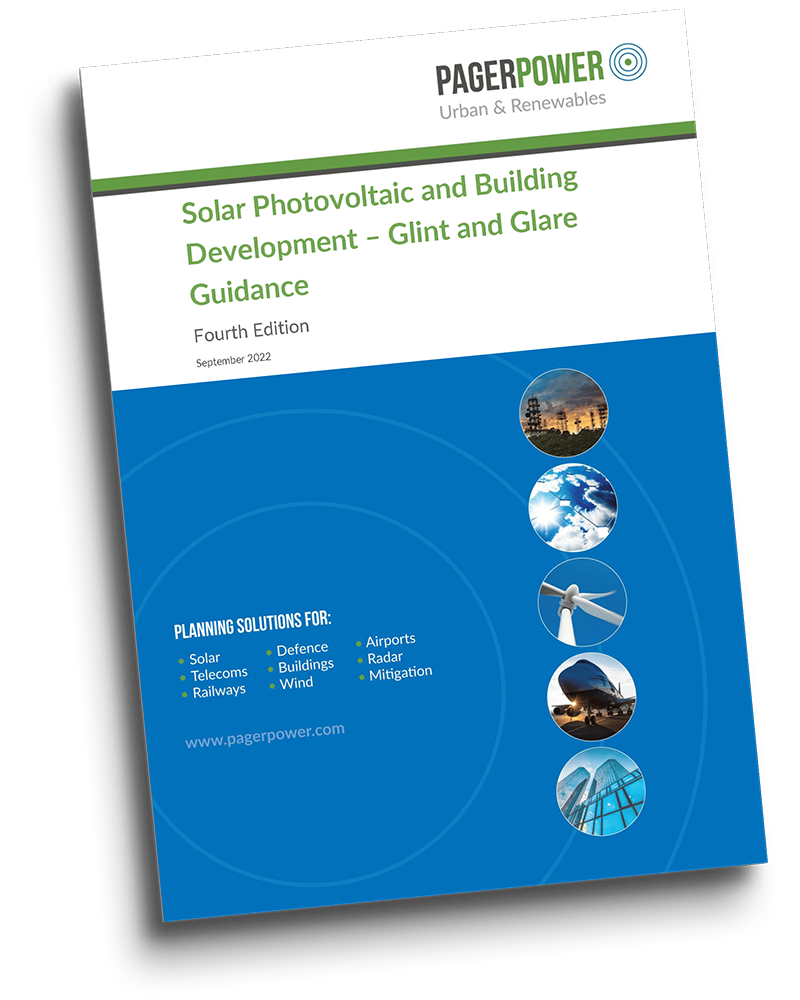
Free Guidance:
Understand the basics of Glint And Glare and the methodology behind the assessment
Download the industry standard assessment methodology, defined from over 10 years’ experience and more than 1,800 assessments. The guide covers the process for assessing roads, dwellings, rail and aviation activity.
Sign up for our industry newsletter and receive the 4ᵗʰ edition of our Glint and Glare guidance today. Just fill out the form below and we’ll send it to you directly.
Speak to an Expert
For more information regarding our glint and glare consultancy services, click here.
If you would like to discuss a particular project or need more information regarding glint and glare, follow this link to make an enquiry. Alternatively, we would be more than happy to have a discussion with you over the phone on +44 (0)1787 319001.
About Pager Power
Pager Power is a dedicated technical consultancy that has been providing independent guidance and advice regarding solar, wind, and building developments internationally since 2002.
Pager Power has completed over 1,800 glint and glare assessments, over 1,000 aviation, radar and safeguarding assessments, and over 1,000 telecommunications assessments, including the assessment of point-to-point link infrastructure, and television, mobile phone, and radio reception surveys. Pager Power is a truly international technical planning consultancy, having worked in over 60 countries.
post contents
About the Author: Danny Scrivener

Latest News
US Continues to Build Out Solar Capacity
Earlier this month, the Solar Energy Industries Association (SEIA) released [...]
China’s Airborne Wind Turbines
In early 2026, China successfully developed an airborne wind turbine [...]
Shadow Flicker Assessments for Wind Turbines: A 2026 Update
Shadow flicker is the effect of rotating turbine blades, causing [...]