Extraterrestrial Wind Farms
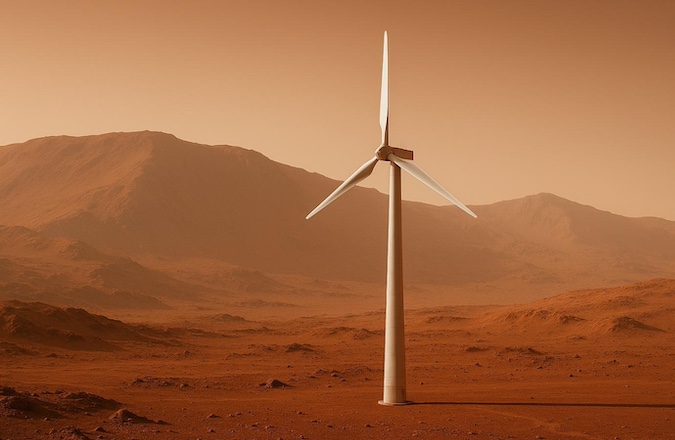
The idea of harvesting wind on other planets can sound like the stuff of science fiction. Yet today, space agencies that plan for sustained operations on the Moon, Mars, and beyond are wondering: how to power these off-Earth outposts. Solar power is the obvious choice, but the idea of using wind power from outer space has started to point out its advantages. Is it possible to create wind turbines to spin one day on Mars or even on Gas giants?
Wind power on Earth
Wind power harnessed on Earth depends on three factors [1]:
Power ∝ ρ × v³ × A
- Atmospheric density (ρ) – thicker air means more kinetic energy
- Wind speed (v) – power is proportional to the cube of wind speed
- Rotor Area (A) – proportional to the rotor radius to capture more moving air
This equation tells us that low air density is a challenge, but high enough wind speeds can compensate for it. Each world would have its own rotor design to adjust to unusual atmospheres.
Why wind matters so much on Mars
Mars has always appeared like a non-starter for wind energy. The average air density is 0.018kg/m^3, which is roughly 0.6% the density of Earth’s [2], [3]. Martian winds aren’t strong enough for a conventional wind turbine. Certain microclimates are known for their seasonally strong, predictable winds, especially crater rims, ridgelines and highlands, polar or near-polar zones, and terrain slopes that funnel and accelerate air [4], [5], [6], [7].
These areas can provide wind power as a supplement to solar. Solar power on Mars has several issues that any long-time habitat would have: seasonal change in sunlight, a plunge in temperature at night to below -100°C, and global dust storms lasting from several weeks to a few months [8]. The sunlight can be reduced to below 30% of normal [9]. Even nuclear battery systems, such as those operating with the Mars rovers, eventually degrade. Wind power could keep life support and scientific operations running through periods when solar arrays struggle [10].
Wind Turbines on Mars might form linear ridges following patterns. They would be placed in the most elevated areas where the wind is at its highest velocity. This would follow a fence-like pattern rather than an Earth-style farm to intercept the narrow bands of stronger airflow [11], [12].
Saturn’s moon Titan as a wind resource
Titan is one of the most Earth-like environments in the Solar System in terms of atmosphere. It has about 60% more atmospheric pressure than Earth, nearly 4 times the air density and nitrogen-rich, stable, low-turbulence conditions. Its wind speed on the surface is very low, measured at no more than 1-2 m/s [13], [14], [15]. However, due to its dense atmosphere, even a gentle breeze contains enormous kinetic energy. Titan has an atmosphere thick enough to offer some protection against coronal mass ejections and solar radiation.
Because of the dense atmosphere and low wind speed, wake effects would be slower to diffuse on turbine clustering. Titan’s atmosphere will make it feasible to have tall and thin turbines that extend into slightly faster winds, with no constraint on tower height [16].
Wind Power on an impossible scale
The gas giants, Jupiter, Saturn, Neptune, and Uranus, have some of the fastest and most energetic wind systems in the Solar System. The kinetic energy in these atmospheric flows is astronomical, orders of magnitude beyond anything on Earth. But Gas giants have no solid surfaces. Turbines would have to be either balloon or drone-supported or orbitally tethered [17].
The engineering challenges, such as corrosive chemical atmospheres, thunderstorm-scale turbulence, and extreme shear forces, are enormous. A 2023 study even suggested that mega-scale wind harvesting on dense, windy exoplanets could create detectable “technosignatures”, visible to future telescopes as unusual thermal or atmospheric patterns [18].
Conclusion
Extraterrestrial wind farms are a feasible option as humans look toward sustained off-Earth operations. Despite the differing conditions on Mars, Titan, and the gas giants, the same set of basic aerodynamic concepts can be applied. The challenge lies in adapting turbine design to each world’s atmospheric conditions. As exploration continues, the possibility of harvesting wind on other worlds moves from speculation toward a realistic part of humanity’s technological development.
About Pager Power
Pager Power undertakes technical assessments for developers of renewable energy projects and tall buildings worldwide.
For more information about what we do, please get in touch.
References
[1] “Wind Energy and Power Calculations | EM SC 470: Applied Sustainability in Contemporary Culture.” Accessed: Dec. 12, 2025. [Online]. Available: https://www.e-education.psu.edu/emsc297/node/649
[2] A. Dasgupta, “Wind Could Power Future Settlements on Mars,” Eos. Accessed: Dec. 12, 2025. [Online]. Available: https://eos.org/articles/wind-could-power-future-settlements-on-mars
[3] V. Schorbach and T. Weiland, “Wind as a back-up energy source for mars missions,” Acta Astronaut., vol. 191, pp. 472–478, Feb. 2022, doi: 10.1016/j.actaastro.2021.11.013.
[4] “Mars Education | Developing the Next Generation of Explorers.” Accessed: Dec. 12, 2025. [Online]. Available: https://marsed.asu.edu/mep/wind
[5] L. Lange et al., “Modeling Slope Microclimates in the Mars Planetary Climate Model,” J. Geophys. Res. Planets, vol. 128, Oct. 2023, doi: 10.1029/2023JE007915.
[6] “Polar Wind Turbines Could Be Used On Mars.” Accessed: Dec. 12, 2025. [Online]. Available: https://www.spacedaily.com/news/mars-base-01e.html?
[7] B. Yirka and Phys.org, “Simulations suggest more wind than thought on Mars for powering turbines.” Accessed: Dec. 12, 2025. [Online]. Available: https://phys.org/news/2022-12-simulations-thought-mars-powering-turbines.html
[8] C. Q. C. published, “Wind farms on Mars could power future astronaut bases,” Space. Accessed: Dec. 12, 2025. [Online]. Available: https://www.space.com/mars-wind-power-support-red-planet-missions
[9] F. He et al., “Martian Dust Storms: Reviews and Perspective for the Tianwen-3 Mars Sample Return Mission,” Remote Sens., vol. 16, no. 14, July 2024, doi: 10.3390/rs16142613.
[10] A. I. Robot, “Dust Mitigation Strategies for Solar Panels on Mars: Engineering Solutions for Global Dust Storms in Colonization Efforts – Undead Monkey.” Accessed: Dec. 12, 2025. [Online]. Available: https://undeadmonkey.org.uk/2025/10/31/dust-mitigation-strategies-for-solar-panels-on-mars-engineering-solutions-for-global-dust-storms-in-colonization-efforts/
[11] D. R. Hood, R. C. Ewing, K. P. Roback, K. Runyon, J.-P. Avouac, and M. McEnroe, “Inferring Airflow Across Martian Dunes From Ripple Patterns and Dynamics,” Front. Earth Sci., vol. 9, July 2021, doi: 10.3389/feart.2021.702828.
[12] “Wind turbine,” Marspedia. Accessed: Dec. 12, 2025. [Online]. Available: https://marspedia.org/Wind_turbine
[13] “Titan: Facts.” Accessed: Dec. 12, 2025. [Online]. Available: https://science.nasa.gov/saturn/moons/titan/facts/
[14] “In Depth: Rain, winds and haze during the descent to Titan.” Accessed: Dec. 12, 2025. [Online]. Available: https://phys.org/news/2005-11-depth-haze-descent-titan.html
[15] M. Bird et al., “The vertical profile of winds on Titan,” Nature, vol. 438, pp. 800–2, Jan. 2006, doi: 10.1038/nature04060.
[16] D. Nield, “Titan Has Enough Energy to Power a Colony The Size of The US,” ScienceAlert. Accessed: Dec. 12, 2025. [Online]. Available: https://www.sciencealert.com/titan-has-enough-energy-to-power-a-colony-the-size-of-the-us
[17] “Windbots Could Explore Solar System’s Gas Giants | Sci.News.” Accessed: Dec. 12, 2025. [Online]. Available: https://www.sci.news/space/science-windbots-solar-systems-gas-giants-03063.html
[18] J. Haqq-Misra and M. Danylov, “Wind Power as a Technosignature on M-dwarf Planets,” Res. Notes AAS, vol. 9, no. 10, p. 279, Oct. 2025, doi: 10.3847/2515-5172/ae13a7.
post contents
About the Author: Vijayatha Vijayaraghavan

Latest News
US Continues to Build Out Solar Capacity
Earlier this month, the Solar Energy Industries Association (SEIA) released [...]
China’s Airborne Wind Turbines
In early 2026, China successfully developed an airborne wind turbine [...]
Shadow Flicker Assessments for Wind Turbines: A 2026 Update
Shadow flicker is the effect of rotating turbine blades, causing [...]