Access To Renewables: Why Are UK Energy Bills Still So High?

Last Updated: January 27, 2025
Share:
In the Clean Power 2030 Action plan, published on 13th December 2024, the government maintains that the rollout of renewable energy across the UK is working to bring energy bills down [1]. Despite this, UK household energy bills remain stubbornly high, and forecasts do not show relief in the near future. This incongruence stems from a combination of market structures, global factors, and policy frameworks that collectively create a disconnect between energy generated by renewable sources and consumer costs.
Why are energy bills still so high in the UK?
The UK’s energy pricing is heavily influenced by the global wholesale gas market. Although renewables like wind and solar contribute a growing share of electricity, gas-fired power stations still play a key role in balancing supply, especially during low wind periods. Since the UK operates under a ‘marginal pricing’ system, the most expensive source of energy sets the price for all electricity [2].
National Grid readings over the past decade, as shown in Figure 1, demonstrate that supply from renewable energy sources such as wind, solar, and hydroelectric are steadily increasing. This figure also shows that the average energy supplied by wind farms even surpassed supply from natural gas across 2024. However, if both gas and renewables have been used in any half-hour period, the more expensive energy source (gas) will be set overall, regardless of whether renewables made up the larger proportion [3,4].
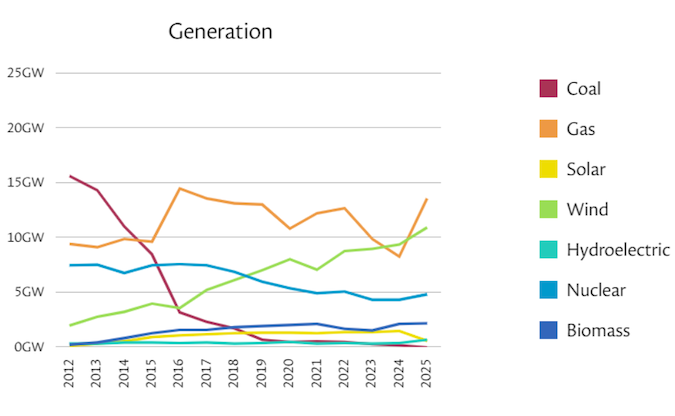
Figure 1: National Grid generation in Gigawatts, averaged over the year, 2012-present day [ https://grid.iamkate.com/ ]
In addition to market constraints, the infrastructure costs of transitioning to renewable energy are significant. Investments in wind farms, solar arrays, and the expansion of grid connections to accommodate intermittent energy sources are passed on to consumers through levies and network charges. This may also be referred to as ‘environment and social obligation’ tax [5].
Further to this, geopolitical events, such as the Russia-Ukraine war, have led to supply disruptions and spiking global energy prices. The UK, although less dependent on Russian energy now [6], still faces indirect impacts through volatile global markets. The fallout from Coronavirus and high inflation also compounded to make energy bills climb for households in Britain [3].
On top of it all, a lack of robust policy and market reforms are impeding the growth of the renewable energy sector and consumer access to renewables. Without definitive reforms to decouple electricity pricing from gas or to implement more effective energy storage solutions, consumers continue to bear high costs.
What is the outlook for consumer access to renewable energy supply?
The UK has had marginal pricing since the late 1980s, when energy companies were privatised. However, it is becoming increasingly clear that this model is no longer fit for purpose in conjunction with the increasing security of renewables.
“There is more that the government can do to ensure that the full value of renewables flows to consumers. This falls into three key areas – preventing profiteering by electricity generators; reducing the costs of building new generation; and ensuring that households get access to renewable power when it is cheapest.”
Susanna Elks, Senior Policy Advisor at E3G [3]
During a recent review of proposals for market reform [6], potential changes include:
- Introducing incentives for consumers to draw electricity from the grid at cheaper rates when demand is low or more renewable energy is available.
- Creating separate markets for renewable and fossil-fuel generated electricity, so renewable energy prices can be set independently from gas.
- Reforming the capacity market to increase low-carbon flexibility technologies that are more responsive to changes in demand and supply, such as electricity storage.
Creating separate wholesale markets is met with uncertainty as there are currently no examples of this in effect [6]. Energy storage is key because it will allow cheaper renewable energy to be saved to meet demand during high-usage periods or on low-wind days. Otherwise, gas must be switched on as part of the equation. To support this, it is expected that incentives will be introduced later this year to encourage investment in long-duration energy storage (LDES) [7].
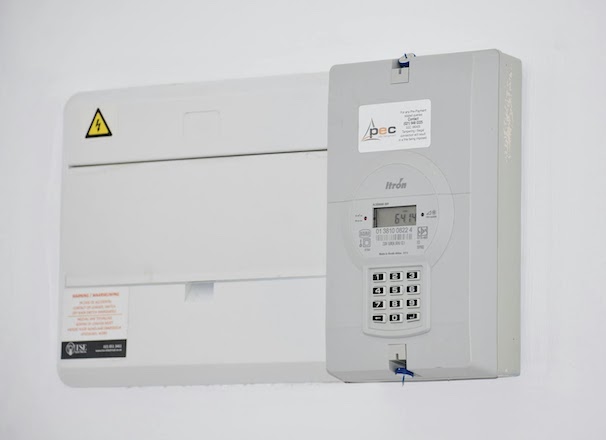
Electricity box on a white wall [8]
Is Zonal Pricing the Solution?
The UK government is considering an alternative model for pricing electricity, dubbed zonal pricing. The result would mean that different geographical areas of the UK would be priced independently of each other. One argument against zonal pricing points out that it would create regional disparity in prices, with areas in the South of England more likely to pay gas-determined prices. To add complexity, concerns have been raised that such a radical transformation of the market could dissuade UK energy investment [3]. Developing renewable energy projects requires considerable upfront capital and businesses must be sure that they can level this investment, meaning that they depend upon stable pricing.
Conclusions
The general consensus is that increasing the capacity for renewable energy should serve to protect consumers from sustained high energy costs. The market is sensitive to change, and introducing zonal pricing will not necessarily result in fair results for the nation. Therefore, the question remains as to exactly how, and when, the beneficial results of the UK’s considerable and continued renewable energy investments will be passed on directly to consumers, as promised.
About Pager Power
Pager Power undertakes technical assessments for developers of renewable energy projects and tall buildings worldwide. For more information about what we do, please get in touch.
References:
[1] https://www.gov.uk/government/publications/clean-power-2030-action-plan
[2] https://commonslibrary.parliament.uk/why-is-cheap-renewable-electricity-so-expensive/
[3] https://www.independent.co.uk/news/uk/politics/energy-bills-gas-electricity-renewables-b2672760.html
[4] https://commonslibrary.parliament.uk/why-is-cheap-renewable-electricity-so-expensive/
[5] https://www.theecoexperts.co.uk/news/electricity-more-expensive-than-gas
[6] https://researchbriefings.files.parliament.uk/documents/POST-PN-0694/POST-PN-0694.pdf
[8] https://www.pexels.com/photo/electricity-box-on-white-wall-13785838/
Thumbnail image accreditation: Getty Images for Unsplash+. Last accessed on 27th January 2025. Available here.
post contents
About the Author: Tori Harvey