Railway Glint and Glare: What is Veiling Luminance?
Veiling luminance is intense light energy coming from a light source which reduces visibility of other objects in the field of view. It is another way of measuring the perceived intensity of a light source and it is particularly important to consider it in situations where good visibility is required.
When do I need to consider it?
When considering glint and glare effects it is often important to consider not only whether glare is geometrically possible but also how intense it is. Intense light from a particular source diminishes the visibility of objects around it and this is a particular problem if it is critical that the observer has good visibility. Such observers include pilots, train drivers and motorists. In our work we encounter veiling luminance particularly often in the context of railway glint and glare in the UK.
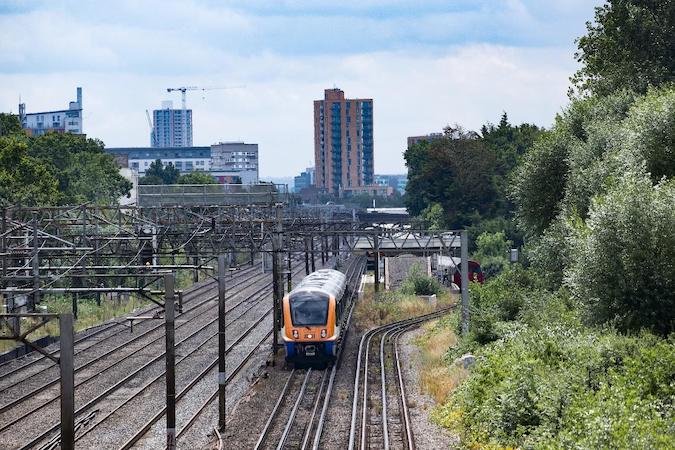
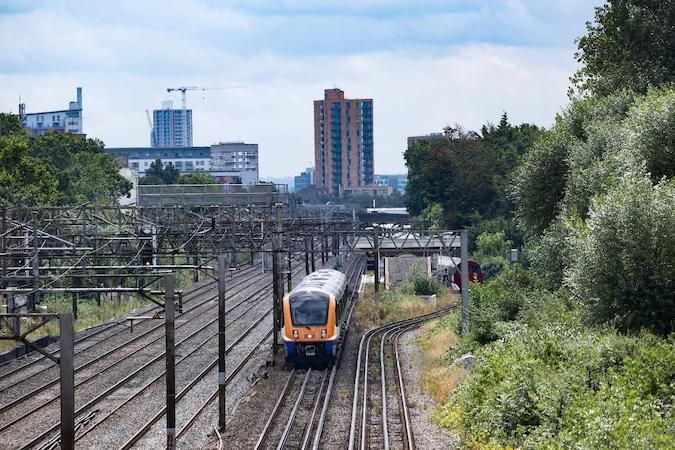
Figure 1: Overground train. [1]
Where did it come from?
The Commission Internationale de L’Eclairage (CIE) defines disability glare as “glare that impairs vision. It is caused by scattering of light inside the eye…The veiling luminance of scattered light will have a significant effect on visibility when intense light sources are present in the peripheral visual field and contrast of objects is seen to be low.” [2] Attempts to quantify the point at which glare becomes disability glare have been made by several individuals over the past century. The formula in its current form can be attributed to Holladay [3], with others including Stiles [4], Adrian and Bhanji [5], Hassall [6] contributing new ways of formulating the various modelling assumptions which go into the formula.
How is it calculated?
Veiling Luminance is calculated using the Holladay formula and in the context of railway glint and glare it is a function of:
- The angle from the observer’s line of sight to the source of the glare.
Glare which is in the near field of vision provides a more severe veil to other objects in the field of vision, and so the value is higher for smaller angles.
- The age of the observer.
Veiling luminance has more of an effect on older observers, so a higher value is calculated for these observers.
- How high the sun is in the sky.
When the sun is higher in the sky, more solar energy hits the glare source and therefore more solar energy is reflected towards the observer. When the sun is higher in the sky a greater proportion of incoming solar energy is light.
- The reflectance of the surface causing glare.
If a surface has a higher reflectance, more energy and therefore more light reflects off the surface towards the observer, increasing the veiling luminance.
David Hassall proposed [6] a threshold of 500 cd/m2 for disability glare and at the same time produced a glare protractor which provides a ready reckoner as to whether glare is likely to exceed the threshold for a given spot size, angle and surface reflectance.
It should be noted that veiling luminance is not the same as luminance, despite both being measured in candelas per metre squared. Veiling luminance is a measure of how a light source diminishes the visibility of surrounding objects. Luminance is the amount of light per unit area per unit direction emitted or received.
How can Pager Power help?
Pager Power has undertaken more than 1,400 glint and glare assessments worldwide. Pager Power can offer veiling luminance calculations alongside its standard geometric glint and glare modelling when undertaking glint and glare assessments for solar PV arrays and building facades in the vicinity of the railway. Pager Power also has relationships with the relevant stakeholders, ensuring that your building or solar project in the vicinity of the railway runs as smoothly as possible. For more information about what we do, please get in touch.
References
[1] London Less Travelled. (2021). Last accessed on 11.11.2024. Available at: https://www.flickr.com/photos/44079668@N07/51360309341/
[2] CIE 146:2002 & CIE 147:2002 Collection on glare (2002)
[3] L L Holladay (1927). Action of a light-source in the field of view in lowering visibility. J. Opt. Soc. Am. 14, 1-15
[4] W S Stiles (1929). The Scattering Theory of the Effect of Glare on the Brightness Difference Threshold. Proceedings of the Royal Society of London. Series B, Containing Papers of a Biological Character. Vol. 105, No. 735 (Jul. 4, 1929), pp. 131-146.
[5] W. Adrian and A. Bhanji. 1991. Disability glare. In International Commission on Illumination (CIE) Session, 22nd, 1991, Melbourne, Australia, Vol. 2.
[6] David NH Hassall (1991) Reflectivity, Dealing with Rogue Solar Reflections – ISBN 064607086
post contents
About the Author: Harry Watson

Latest News
US Continues to Build Out Solar Capacity
Earlier this month, the Solar Energy Industries Association (SEIA) released [...]
China’s Airborne Wind Turbines
In early 2026, China successfully developed an airborne wind turbine [...]
Shadow Flicker Assessments for Wind Turbines: A 2026 Update
Shadow flicker is the effect of rotating turbine blades, causing [...]