What Is a Lighting Impact Assessment and When Is One Required?
Last Updated: October 14, 2026
Share:
Artificial lighting is a crucial aspect of any new development, whether you are submitting planning for a new home, a sports facility, or an energy storage facility.
In urban and operational contexts, lighting provides safety and security. In public and domestic settings, alongside simply allowing us to see during darkness, well designed lighting schemes can elevate aesthetics to create spaces that improve our wellbeing too. Regardless of the development type, there will be environmental, technical, and regulatory considerations required from concept through to construction.
A Lighting Impact Assessment shows how a proposed lighting scheme will affect its surroundings, and whether how it can be designed to meet planning expectations.
What is a Lighting Impact Assessment?
A Lighting Impact Assessment is a technical study of the light a proposed development will produce and the effect that light will have on the people, the landscape, and any wildlife nearby. It looks at both permanent lighting, such as security and car park lighting, and temporary lighting used during construction.
The aim of the lighting assessment and the surrounding guidance is to ensure that the lighting scheme can perform its required function, providing safety, security and visibility, whilst also ensuring that the scheme is no more disruptive towards sensitive receptors than it needs to be.
What does a Lighting Impact Assessment involve?
Lighting Impact Assessments typically revolve around a consideration of the guidance applicable to the project, and assessment of the scheme against the relevant guidance. The relevant guidance depends on the purpose of the lighting scheme; there will be guidance about the minimum lighting levels required for lighting to fulfil its purpose, and other guidance about the maximum allowed lighting levels allowed towards sensitive receptors. The National Planning Policy Framework (NPPF) expects decisions to limit the impact of light pollution on local amenity, dark landscapes, and nature conservation [1].
Every project is unique, but the Institute of Lighting Professionals’ (ILP) PLG 04 Guidance on Undertaking Environmental Lighting Impact Assessments [2] and GN01 Guidance Notes for the Reduction of Obtrusive Light [3] are acknowledged as a common starting point when considering guidance which limits lighting levels within the UK.
Further to this, there are multiple British Standards in place to help more specific projects design effective and safe lighting, such as BS 5489-1 for Road Lighting [4] or BS 5266 for Emergency Lighting [5].
Local authorities often carry their own guidelines which must be considered alongside the standards set by ILP, NPPF, and BS documents. Therefore, it’s important to consult an expert to ensure that all the relevant guidance documents are considered in full.
Regardless of development type or location, most assessments will aim to determine the following things:
- Understand the site setting,
- Review the proposed lighting,
- Identify who or what could be affected,
- Compare the results against recognised guidance,
- Recommend mitigation (if necessary).
Assessments may include baseline surveys to measure existing light levels and identification of Environmental Zone classification. They will also include quantitative analysis of measures such as light intrusion (trespass), upward light ratio (sky glow), and viewed source intensity (glare).
The result is an objective report that planning officers, consultees, and the developer themselves can rely upon.
When is a Lighting Impact Assessment Required?
When lighting considerations are left until further along in the planning process, it can mean additional design iterations for something that was already considered final. Assessing lighting early allows the wider design team to build in sensible measures from the start, giving planners confidence and reducing the chance of challenges once the site moves into construction and operation phases.
There is no single rule, but the request is most likely to come from the local authority during planning. It is commonly requested when:
- The site is in a sensitive location, such as open countryside, a dark landscape, or an area close to protected habitats (e.g. bats);
- Homes or roads are nearby, and residents or drivers could be affected by glare or light spill;
- The scheme is large or prominent, such as a new sports ground or a substantial building;
- The council asks for it, either at validation, through comments from consultees, or as a condition of planning permission;
- Or it forms part of a wider Environmental Impact Assessment, where lighting is considered alongside ecology, landscape, and other topics.
Even when a Lighting Impact Assessment is not formally requested, it can still be worth doing. Excessive artificial light can be investigated as a statutory nuisance in accordance with the Environmental Protection Act 1990 [6]. Dealing with lighting at the design stage can often be more cost and time effective than having to accommodate for changes post-construction.
About Pager Power
The team at Pager Power have been assessing artificial and natural light for new and existing developments for almost 30 years. Our expertise includes lighting impact, daylight sunlight, right to light, glare, and crane operations.
If you have a project in the pipeline that you’d like to discuss, please give us a call on +44 (0)1787 319001 or make an enquiry.
References
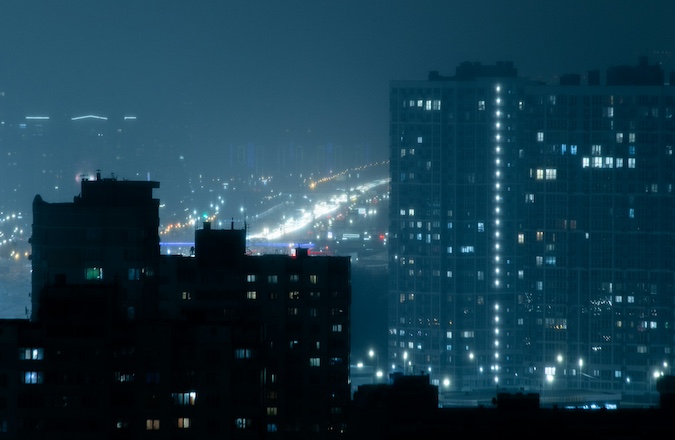
Image accreditation: Andrew Petrischev (Feb 2023) from Unsplash.com+. Last accessed on 14 October 2026. Available at: https://unsplash.com/photos/a-view-of-a-city-at-night-from-the-top-of-a-building-GrYYAQaNArk
post contents
About the Author: Tori Harvey