Do Planning Authorities Require EMF Studies for Solar or Wind Farms?
Last Updated: October 14, 2026
Share:
There is no blanket rule in UK planning that states every solar or wind development project must submit an electromagnetic (EMF) assessment, but that doesn’t mean projects can skip it. The need for such an assessment depends on the project, route of grid connection, and how close the infrastructure and cable route is to nearby residences, offices, and public spaces. Assessments likely to require an EMF assessment:
- Nationally Significant Infrastructure Projects (NSIPs) with cabling above 132kV, where the planning inspectorate expects EMF to be addressed in the Environmental Statement (ES) appendix, and EN-5 requires evidence of compliance with public exposure guidelines [1], [2].
- Offshore wind farms, where EMF from inter-array and export cables is routinely assessed for its effect on fish and other marine life [3], [4], [5].
- Any project where consultees or residents raise health concerns, for example where a substation, battery storage compound or overhead line sits close to houses, schools or footpaths [6], [7].
Where EMF Comes From on a Solar or Wind Farm
All electrical equipment produces electric and magnetic fields, and renewable energy projects are no exception. The main concern here is the strength of the EMF fields in public places that people frequent [8].
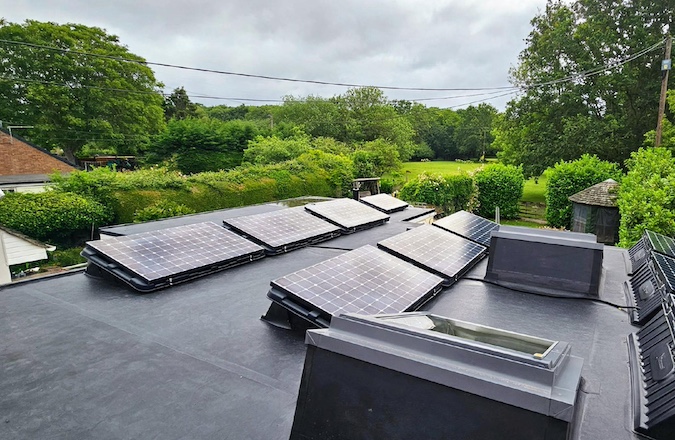
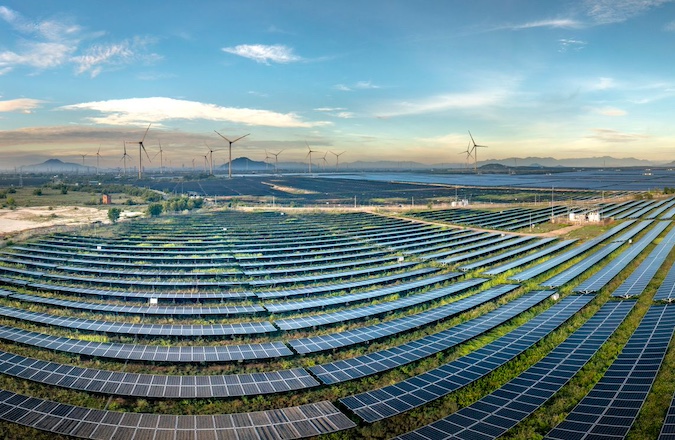
On a solar farm, the panels contribute very little to this. The main sources are the inverters and transformers that convert and step up the power, cabling, the on-site substation, any battery energy storage system (BESS), and the grid connection [9]. For local applications, EMF rarely appears on a validation checklist, but comes up more often due to health questions and concerns that residents have about new electrical equipment at the consultation stage [10], [11]. For NSIPs, the UK Health Security Agency (UKHSA)’s scoping responses typically remind applicants that the ES should comply with the exposure guidelines and the code of practice.
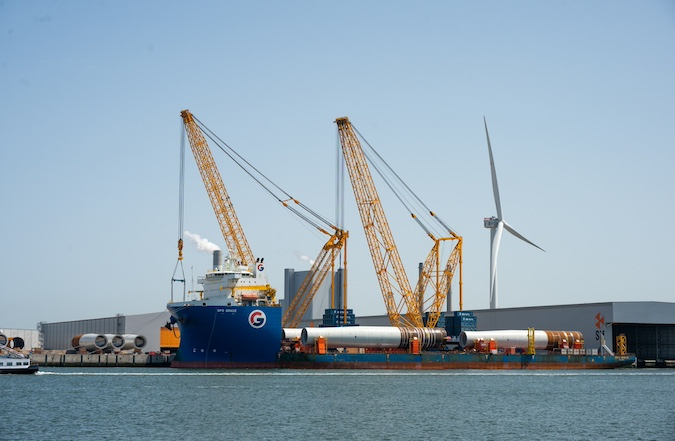
On a wind farm, sources are the generator and the transformer on top of the nacelle or at the base of the tower, the array cables, the substation and the grid connection cable. Offshore, those cables run along the seabed, which brings marine fauna and flora into the picture. Inter-array and export cables produce magnetic fields and induced electric fields along the seabed. Some species are sensitive to these fields. Sharks, skates and rays use electroreception to hunt and navigate, and are most highlighted. Certain fish and crustaceans are also considered within the assessment [1], [12].
The UK Policy Framework
UK policy on EMF has been the same for over a decade, and it depends on three documents, and any EMF assessment done for a solar or wind farm will be judged against them.
| Document | What it does |
| ICNIRP 1998 guidelines [13] | This sets the public exposure limits the UK applies, in terms of the 1999 EU recommendation |
| Written Ministerial Statement (2009) [2] | This confirms government policy: comply with ICNIRP 1998, plus optimum phasing of high-voltage overhead lines |
| DECC voluntary Code of Practice, 2012 [8] | This explains how compliance is demonstrated, and lists classes of equipment that can be treated as compliant |
| National Policy Statement EN-5 [1] and EN-3 (2025) [3] | This states the policy for nationally significant renewable energy and electricity infrastructure and sets out what the Secretary of State’s expectations are |
How Pager Power Can Help
Pager Power provides EMF assessments [14] for solar farms, wind farms, BESS, substations and grid connections based on site-specific technical data. Our work ranges from short statements for compliance for local applications to full EIA chapters and technical appendices for NSIPs.
We can help at every stage:
- Scoping: a technical note to support scoping EMF out, or to agree a scope.
- Application: an assessment or ES chapter demonstrating conformity with ICNIRP 1998, the Code of Practice and NPS EN-5.
- Consultation and examination: Responses to consultee and public questions on EMF.
EMF assessments can also be combined with our glint and glare, aviation, radar and telecommunications studies, giving a single point of contact for technical planning matters.
For more information about what we do, please get in touch.
References
[1] “National Policy Statement for electricity networks infrastructure (EN-5), 2025,” GOV.UK. Accessed: Oct. 14, 2026. [Online]. Available: https://www.gov.uk/government/publications/national-policy-statement-for-electricity-networks-infrastructure-en-5-2025
[2] “UK EMF policy | EMFs.” Accessed: Oct. 14, 2026. [Online]. Available: https://www.emfs.info/exposure-limits-and-policy/UK-policy
[3] “National Policy Statement for renewable energy infrastructure (EN-3), 2025,” GOV.UK. Accessed: Oct. 14, 2026. [Online]. Available: https://www.gov.uk/government/publications/national-policy-statement-for-renewable-energy-infrastructure-en-3-2025
[4] “COWRIE 1.5 The Potential Effects of Electromagnetic Fields Generated by Sub-Sea Power Cables Associated with Offshore Wind Farm Developments on Electrically and Magnetically Sensitive Marine Organisms – A Review | Tethys.” Accessed: Oct. 14, 2026. [Online]. Available: https://tethys.pnnl.gov/publications/cowrie-15-potential-effects-electromagnetic-fields-generated-sub-sea-power-cables
[5] A. B. Gill et al., “COWRIE 2.0 Electromagnetic Fields (EMF) Phase 2”.
[6] “Electric and magnetic fields: health effects of exposure,” GOV.UK. Accessed: Oct. 14, 2026. [Online]. Available: https://www.gov.uk/government/publications/electric-and-magnetic-fields-health-effects-of-exposure/electric-and-magnetic-fields-assessment-of-health-risks
[7] “Electromagnetic fields: sources and health effects,” GOV.UK. Accessed: Oct. 14, 2026. [Online]. Available: https://www.gov.uk/government/publications/electromagnetic-fields/electromagnetic-fields-sources-and-health-effects
[8] “Demonstrating compliance with EMF public exposure guidelines: voluntary code of practice,” GOV.UK. Accessed: Oct. 14, 2026. [Online]. Available: https://www.gov.uk/government/publications/demonstrating-compliance-with-emf-public-exposure-guidelines-voluntary-code-of-practice
[9] R. A. Tell, H. C. Hooper, G. G. Sias, G. Mezei, P. Hung, and R. Kavet, “Electromagnetic Fields Associated with Commercial Solar Photovoltaic Electric Power Generating Facilities,” J. Occup. Environ. Hyg., vol. 12, no. 11, pp. 795–803, 2015, doi: 10.1080/15459624.2015.1047021.
[10] T. Cleveland, “Health and Safety Impacts of Solar Photovoltaics”.
[11] “Supporting States and Communities on Renewable Energy Siting and Permitting.” Accessed: Oct. 14, 2026. [Online]. Available: https://carolinas-dash.org
[12] Pacific Northwest National Laboratory (PNNL), Richland, WA (United States), USDOE, A. Gill, and M. Desender, “2020 State of the Science Report, Chapter 5: Risk to Animals from Electromagnetic Fields Emitted by Electric Cables and Marine Renewable Energy Devices,” PNNL-29976CHPT5, 1633088, Sep. 2020. doi: 10.2172/1633088.
[13] R. Matthes and J. H. Bernhardt, Eds., Guidelines on limiting exposure to non-ionizing radiation: a reference book based on the guidelines on limiting exposure to non-ionizing radiation and statements on special applications. in ICNIRP, no. 7. Oberschleißheim: International Commission on Non-Ionizing Radiation Protection, 1999.
[14] “Electromagnetic Fields (EMF) Assessment,” Pager Power. Accessed: Oct. 14, 2026. [Online]. Available: https://www.pagerpower.com/services/electromagnetic-fields-emf-assessment/
Image accreditation: Quang Nguyen Vinh (Aug 2025) from Pexels.com. Last accessed on 14 October 2026. Available at: https://www.pexels.com/photo/wide-angled-view-of-expansive-solar-farm-and-wind-turbines-35105457/
post contents
About the Author: Vijayatha Vijayaraghavan