Do You Need Planning Permission to Install Solar Panels?
Last Updated: September 15, 2026
Share:
Solar panels are becoming an increasingly popular way for UK homeowners to generate renewable electricity and cut their energy bills. Typically, a formal planning application is not necessary for many household solar installations in England since they are covered under Permitted Development (PD). However, the installation must adhere to certain regulations, with listed buildings, conservation areas, and other protected places being subject to further limitations.
This article focuses solely on residential properties, including houses, flats, outbuildings and solar panels installed within residential gardens.
Solar Panels on Homes
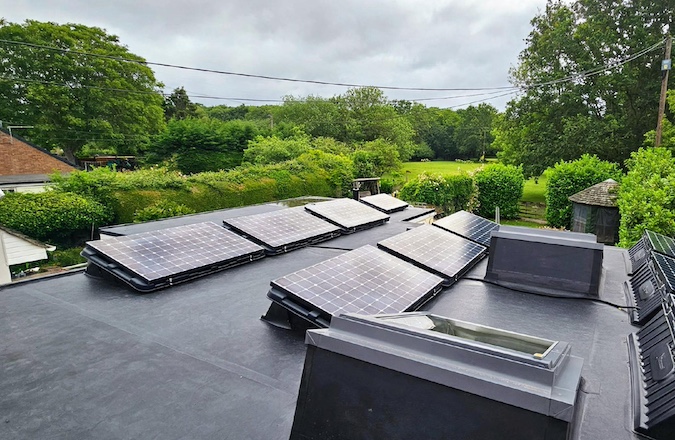
Under England’s PD rules, solar panels and associated equipment can generally be installed on a house, block of flats or a building within the home’s grounds without applying for formal planning permission.
The panels for roof-mounted equipment must typically follow the roof’s slope and not protrude more than 200 millimetres. Additionally, they cannot go above the roof’s highest point, with the exception of chimneys. Where the panels are installed upon a flat roof, they cannot be higher than 600 mm above the roof’s highest point. [1] When it comes to wall-mounted panels, there are also restrictions on how far they can protrude from the wall. For example, when the wall faces a road, the maximum projection is typically 200 millimetres; otherwise, it is 400 millimetres. [2]
The equipment should be sited and designed to minimise its effect on the external appearance of the building. It must also be removed as soon as reasonably practicable when it is no longer needed.
Plug-in and Balcony Solar
On the 27th of August 2026 new PD rules came into force in England that expressly mention plug-in solar equipment. This can include some small domestic systems connected to the home’s electrical installation using a standard plug and socket. [3]
Our article titled “Plug-In Solar Panels: A New Era for Domestic Renewable Energy in England?” explores the recent change and goes into further details. This can be found here.
Solar in Gardens
Ground-mounted solar panels in the garden may also be PD, but the installation must comply with height, size and location requirements.
The maximum applicable height is:
- 1 metre where the installation is within 5 metres of the property boundary and is positioned in front of a wall forming part of the home’s principal elevation.
- 2 metres where it is within 5 metres of the boundary.
- 2 metres where it is in a conservation area and closer to a bordering highway than the nearest part of the house.
- 4 metres in other circumstances.
The total surface area of the solar panels must not exceed 9 square metres. Only the first stand-alone solar installation may benefit from PD rights. Multiple arrays or additional equipment may require planning permission. [4]
Listed Buildings
The rules are significantly more restrictive for listed residential properties as solar panels can affect the character and appearance of the building or its setting. Solar equipment installed on a listed house, or on a building within the grounds of a listed house, does not generally benefit from the standard PD rights. This includes panels mounted on the roof or walls of the listed home, as well as panels installed on a garage, outbuilding or other structure within its curtilage. [5]
Conservation Areas
Domestic solar panels can still be PD in many conservation areas, but additional restrictions will apply. Roof-mounted panels may be permitted where they comply with the normal conditions, However, wall-mounted or balcony-mounted equipment generally cannot be installed on a wall, balcony or roof enclosure that fronts a highway. If a proposed system would be prominently visible from a road or other highway, a planning application may be required.
For garden-mounted solar, there is a similar pattern, prior approval may be required where the equipment is in a conservation area and would be closer to a highway than the house. Where this is the case, the homeowner must apply to the local planning authority before starting work so that it can assess the visual impact on the conservation area. [6]
Prior approval is different from a full planning application. The development may already have permission in principle under PD rights, but the local authority must first decide whether its appearance requires further control.
World Heritage Sites and Scheduled Monuments
Additional restrictions apply to homes in World Heritage Sites. Wall, balcony and roof-enclosure installations facing a highway may not qualify as PD. Garden-mounted solar may also be restricted where it is closer to a highway than the nearest part of the house or within 5 metres of the property boundary. [7]
Solar equipment installed on a scheduled monument is not covered by these domestic PD rights. Separate planning and heritage advice should be obtained before any proposal is prepared.
Article 4 Directions
An Article 4 direction can remove PD rights from homes in a particular area. This means that a domestic solar installation may require planning permission even if it would normally comply with the PD rights. Article 4 directions are especially relevant in historic areas and conservation areas. Homeowners should check with their local planning authority before relying on PD rights. [8]
Final Advice
Many residential solar installations in England can proceed without a full planning application, but only if the relevant PD limits and conditions are satisfied. Listed buildings, conservation areas, World Heritage Sites, scheduled monuments and properties affected by Article 4 directions require particular care. Before work begins, it is always best to speak to your local planning authority to confirm whether the proposal qualifies as permitted development, needs prior approval or requires a planning application.
About Pager Power
Pager Power undertakes technical assessments for developers of renewable energy projects and tall buildings worldwide.
For more information about what we do, please get in touch.
References
[1] Planning Portal, Solar equipment mounted on a house or a block of flats or on a building within the curtilage. Available at: https://www.planningportal.co.uk/permission/common-projects/solar-panels/planning-permission-solar-equipment-mounted-on-a-house-or-a-block-of-flats-or-on-a-building/ [2] The Town and Country Planning (General Permitted Development) (England) (Amendment) Order 2026, 2026 No. 896. Available at: https://www.legislation.gov.uk/uksi/2026/896/made [3] ‘Households can save as plug-in solar panels come to market’ (2026) Gov.uk. Available at: https://www.gov.uk/government/news/households-can-save-as-plug-in-solar-panels-come-to-market [4] Planning Portal, Planning Permission: Stand alone solar equipment (panels not on a building but within the grounds of a house or a block of flats) Stand-alone solar equipment in the grounds of a house or block of flats. Available at: https://www.planningportal.co.uk/permission/common-projects/solar-panels/planning-permission-stand-alone-solar-equipment-panels-not-on-a-building-but-within-the-grounds-of-a-house-or-a-block-of-flats [5] ‘Households can save as plug-in solar panels come to market’ (2026) Gov.uk. Available at: https://www.gov.uk/government/news/households-can-save-as-plug-in-solar-panels-come-to-market [6] Planning Portal, Planning Permission: Stand alone solar equipment (panels not on a building but within the grounds of a house or a block of flats) Stand-alone solar equipment in the grounds of a house or block of flats. Available at: https://www.planningportal.co.uk/permission/common-projects/solar-panels/planning-permission-stand-alone-solar-equipment-panels-not-on-a-building-but-within-the-grounds-of-a-house-or-a-block-of-flats [7] The Town and Country Planning (General Permitted Development) (England) (Amendment) Order 2026, 2026 No. 896. Available at: https://www.legislation.gov.uk/uksi/2026/896/made [8] Planning Portal, Planning permission: Solar panels. Available at: https://www.planningportal.co.uk/permission/common-projects/solar-panels/planning-permissionImage accreditation: Stammers, R. (2026). Solar Panels on residential dwelling in England.
post contents
About the Author: Rosie Stammers