Agrivoltaics – Harmony Between Renewable Energy and Farming
Last Updated: December 4, 2024
Share:
A common concern raised when discussing new solar farms, is the loss of agricultural land where the farm will be located. But what if we could have our cake and eat it too? Enter “agrivoltaics” which aims to blend solar energy generation while maintaining agricultural production.
Agrivoltaics, or agrivoltaic farming, is a collective term for a number of strategies aimed at combining solar farms with crop production or other farming produce. In this article we explore some of these strategies which could be the future of green energy generation and agriculture.
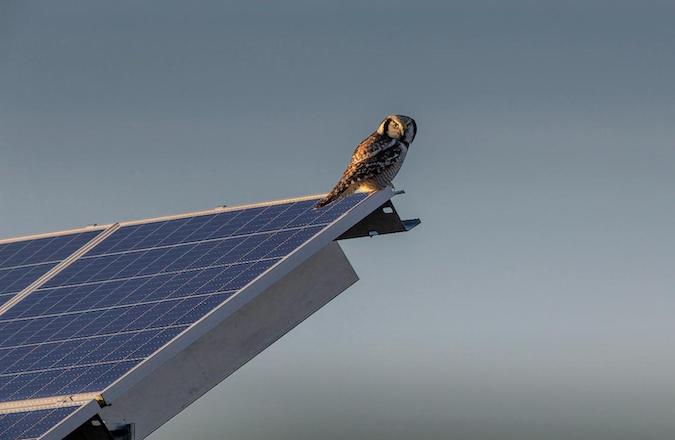
Figure 1: Owl resting upon solar panel. [1]
Agrivoltaics
Farming and energy generation often come down to economics. A fundamental principle of economics is “opportunity cost”, when using a resource for one purpose you forgo the benefits of using for another purpose. For example, some might argue using land for solar farms means we must forgo the benefits of using that land for crops. Agrivoltaics suggests the possibility of being able to enjoy both benefits and so eliminate that opportunity cost.
Solar panels can be raised on poles or be mounted on heightened racks, leaving space for crops to be grown under and between the panels. This strategy is not just about using land efficiently but could also improve output of crops and energy generation [2]. Panels can shade plants, reducing their exposure to direct sunlight, which could cause unwanted water loss, particularly during heatwaves. Further, plants may reduce the temperature under the panels and thus improve energy efficiency.
Growing crops under solar panels is not without drawbacks, however. Not all crops are suited to being located under panels, including types of wheat which don’t benefit from shading. Farm machinery must also be able to move between rows of panels for maintenance and harvesting, meaning the panel layout must be carefully considered [3].
Combining solar farms with crops has been tested in multiple countries across Europe and in North America. While agrivoltaics is yet to be widely adopted, counties with smaller land areas, and those where a large percentage of land is already developed and in use, such as the UK, it presents an opportunity to improve efficiency of land use.
Lancaster University is also conducting practical research on this topic with their own on-site solar farm to deepen our understanding of agrivoltaics and its potential in the UK’s journey toward a greener future [4].
Solar Grazing
Agricultural land is most frequently used for two purposes, growing crops and grazing livestock such as sheep and cattle. Solar grazing suggests allowing livestock to retain access to the grasslands while the solar farm is in operation. This has benefits for both the solar farm and the livestock when compared to keeping them separate [5].
Studies of the wellbeing of livestock has found welfare improvements among animals who graze in solar farms. The panels provide shade from direct sunlight and also from rain [6]. Some studies even found animals were more sociable when provided with the “creature comfort” of solar panels. Adding solar farms to the portfolio of a farm can diversify their income and thus reduce financial risk if weather is not conducive to good crop yields [7].
The solar farm can also benefit from easier maintenance, as the site operator can save on labour intensive mowing of the underlaying vegetation which might otherwise overgrow and obscure the panels from the sun [8], this can also reduce the risk of wildfires [7].
To provide space for animals, the layout of panels must be designed accordingly, and sometimes panels should be raised. For this reason, solar grazing tends to be easier for sheep than cattle, due to the former’s comparatively lower height.
Bee Keeping
Sufficient pollination and biodiversity is key is maintaining a healthy ecosystem for prosperous farming. Co-locating bee hives on land used for solar may be an opportunity to support this. Low Cardon operates bee hives at over 20 solar farms across the UK and has supported research which has found solar farms are well suited as habitats for bees [9]. Bee keeping at solar farms has been implemented by companies across the world [10], along with wildflowers to promote biodiversity [11].
Bee keeping requires careful maintenance but could be a key step towards increasing the bee population and improving biodiversity in rural areas, which offers significant improvements for our environment.
Overall Conclusions
In conclusion, there has been significant research and experimentation into the question of combining solar energy generation with farming production. While it remains a small practice, it could be a significant step toward maintaining food production and improving biodiversity while creating green energy via efficient land use.
Any combination of solar infrastructure and agricultural uses must be planned in from the start, with coordination between energy companies and farmers. These strategies work best when planning is thorough and coordinated between the relevant stakeholders.
About Pager Power
Pager Power undertakes technical assessments for developers of renewable energy projects and tall buildings worldwide. For more information about what we do, please get in touch.
References:
[1] Erik Karits (2021) on Pexels.com. Last accessed on 4th December 2024. Available at: https://www.pexels.com/photo/a-bird-perched-on-a-solar-panel-18714233/
[2] Wheeler, R. (2024) ‘What is Agrivoltaics or Agrivoltaic Farming?’ NxtGenEnergy, 24 June. Available at: https://nxtgenenergy.co.uk/blog/what-is-agrivoltaics-or-agrivoltaic-farming/ (Accessed 26 November 2024)
[3] Christian, M. ‘Agrivoltaic Farms – Farming meets green electricity production’ AquaSwitch, Available at: https://www.aquaswitch.co.uk/blog/agrivoltaic-solar-farms/ (Accessed 26 November 2024)
[4] Lancaster University (2024) ‘Solar Photovoltaic Farm’. Available at: https://www.lancaster.ac.uk/facilities/estates/solar-photovoltaic-farm/ (Accessed 26 November 2024)
[5] Wheeler, R. (2024) ‘Solar Grazing: A Win-Win Solution for Solar and Agriculture’ NxtGenEnergy, 10 June. Available at: https://nxtgenenergy.co.uk/blog/solar-grazing-a-win-win-solution-for-solar-and-agriculture/ (Accessed 26 November 2024)
[6] Lesté-Lasserre, C. (2023) ‘Putting solar panels in grazing fields is good for sheep’ NewScientist, 1 February. Available at: https://www.newscientist.com/article/2357545-putting-solar-panels-in-grazing-fields-is-good-for-sheep/ (Accessed 26 November 2024)
[7] Brown, B. (2024) ‘Farmers who graze sheep under solar panels say it improves productivity. So why don’t we do it more?’ The Guardian, 12 June. Available at: https://www.theguardian.com/australia-news/article/2024/jun/13/farmers-who-graze-sheep-under-solar-panels-say-it-improves-productivity-so-why-dont-we-do-it-more (Accessed 26 November 2024)
[8] Kockendoerfer, N. Hain, L. Thonney, M. (2024) ‘The agricultural, economic and environmental potential of co-locating utility scale solar with grazing sheep’ David R. Atkinson Centre. Available at: https://solargrazing.org/wp-content/uploads/2021/02/Atkinson-Center-Full-Report.pdf (Accessed 26 November 2024)
[9] Low Carbon (2022) ‘Celebrate biodiversity and support local beekeepers’. Available at: https://www.lowcarbon.com/blog/celebrate-biodiversity-and-support-local-beekeepers (Accessed 26 November 2024)
[10] Davis, R. (2021) ‘Global buzz for solar with pollinators and beekeeping’ Fresh Energy, 25 June. Available at: https://fresh-energy.org/solar-beekeeping-goes-global (Accessed 26 November 2024)
[11] Limb, L. (2021) ‘Planting wildflowers around solar panels could make them a home for bees’. EuroNews, 14 December. Available at: https://www.euronews.com/green/2021/12/14/planting-wildflowers-around-solar-panels-could-make-them-a-home-for-bees (Accessed 26 November 2024)
post contents
About the Author: Phillip Charhill