Shining a New Light: The Regulations for Installing Solar Panels on New Buildings in the UK Today
There is a significant need for more housing in the UK and a growing demand for green energy due to high energy bills and net zero goals. It would, therefore, make sense to address these issues by requiring solar panel systems in all new homes across the UK.
This article will explore the current opportunities for solar panels on new builds in the UK, following the research conducted in the 2021 article “Are New Homes the Way Forward for Solar Panel Energy?”.
Currently, solar panels are not mandatory for new builds, but developers commonly use them to meet building regulations and create more sustainable developments. Many construction companies install them to achieve the required SAP (Standard Assessment Procedure) score for efficiency.
By incorporating solar panels into new builds, developers can improve the properties’ energy performance and make them more appealing to environmentally conscious buyers who want to save on the upfront cost of solar panels [1].
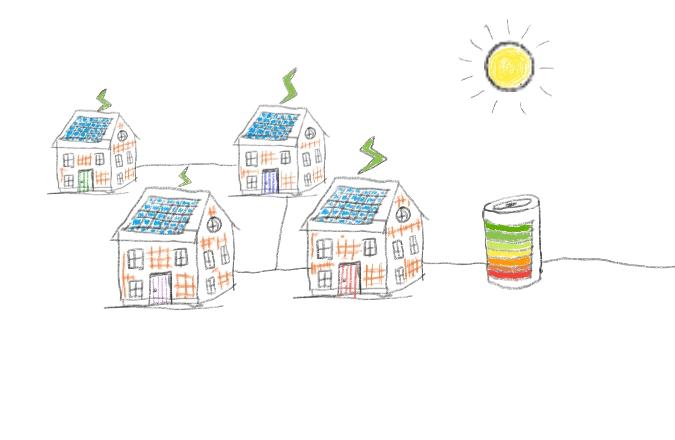
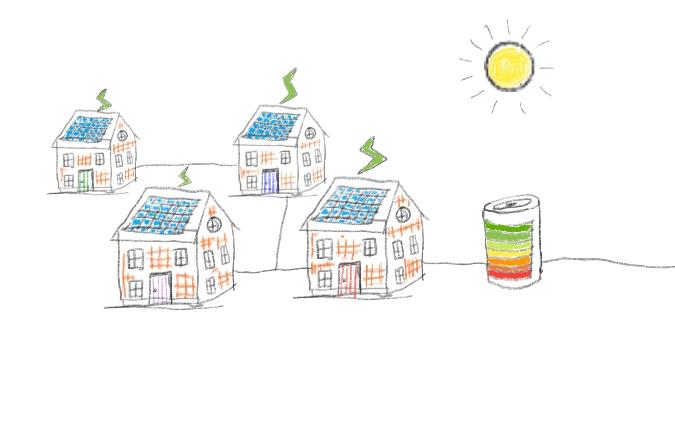
Solar Houses by Gabby Rush.
Exploring the Adoption of Solar Panels Across UK Homes
According to the latest government data, more than 1.4 million households in the UK have installed solar panels, representing 5% of the UK’s 28.4 million households. In December 2020, the number was less than a million, indicating significant growth in a short period [2].
While the current supply of new homes has been increasing over time, it has not yet reached the previous Conservative government’s estimate of 300,000 new homes needed per year.
Approximately 234,400 new homes were built in 2022/23 [3]. Comparatively, before the pandemic, around 170,000 new homes were being constructed yearly in the UK.
The number of UK homes with solar panels could significantly increase if:
- installation was mandatory, and;
- the entire roof space of each house was utilised for installation.
However, a prevalent issue is that developers often do not use all the available roof space. This results in a less effective solar panel system.
While a property might achieve a higher SAP score with only a few solar panels, the actual impact on energy bills is minimal. This situation can lead to logistical challenges if the homeowner expands their solar panel system later. Often, the original panels need to be removed to make room for a more extensive system, which increases the total cost [1].
Shining a New Rule: Will Solar Panels be the Standard on Future Foundations?
There is increasing support for making solar panels compulsory on new constructions. A nationwide survey conducted in February 2024 found that 70% of UK adults back the requirement for solar panels on newly built homes, with nearly half indicating plans to install solar within the next five years.
A recent YouGov poll of 107 MPs in January 2024 revealed that 79% support including solar panels in all new builds by 2025, signalling a move towards more environmentally friendly building regulations.
In March 2024, the European Parliament passed a law mandating solar panels on all new residential buildings by 2030, aiming to boost energy efficiency and cut carbon emissions in the EU. The rollout will begin with public and commercial buildings until 2026 and extend to residential structures by 2030 [1].
Conclusions
The potential for legally mandated solar panels on new constructions represents a pivotal step forward for sustainable development in the UK, signalling a brighter, more eco-friendly future.
While this promising change is on the horizon, developers must eschew the practice of installing merely a token number of solar panels on new buildings in the interim. Such half-measures serve only to complicate the lives of homeowners down the road.
It is imperative that all stakeholders, from policymakers to builders, commit to meaningful, impactful actions that will pave the way for a sustainable, energy-efficient future. This approach will not only help mitigate the environmental impact but also enhance the quality of living for future generations.
About Pager Power
Pager Power undertakes technical assessments for developers of renewable energy projects and tall buildings worldwide. For more information about what we do, please get in touch.
References
[1] Sunsave – Solar panels on new builds: what are the rules? Accessed on 07/10/24. Available at: https://www.sunsave.energy/solar-panels-advice/installation/new-builds
[2] Sunsave – How many homes have solar panels in the UK? Accessed on 08/10/28. Available at: https://www.sunsave.energy/solar-panels-advice/cities-and-regions/homes-with-solar
[3] Full Fact – House Building in England: explained. Accessed on 13/10/24. Available at: https://fullfact.org/economy/house-building-england-election-2024/#:~:text=The%20current%20supply%20of%20new,were%20supplied%20in%202022%2F23.
post contents
About the Author: Gabby Rush

Latest News
US Continues to Build Out Solar Capacity
Earlier this month, the Solar Energy Industries Association (SEIA) released [...]

China’s Airborne Wind Turbines
In early 2026, China successfully developed an airborne wind turbine [...]

Shadow Flicker Assessments for Wind Turbines: A 2026 Update
Shadow flicker is the effect of rotating turbine blades, causing [...]