The ‘Eat Local’ Myth: The Carbon Footprint of Your Diet
Last Updated: April 11, 2023
Share:
Most of us will have heard of the ‘Eat Local’ myth, the advice that if you buy and eat food from your local independent stores, farmers, butchers, small businesses, that it will reduce the carbon footprint of your diet. Granted, eating local will help to support independent, small businesses which is great, however, it won’t necessarily reduce the carbon footprint of your diet.
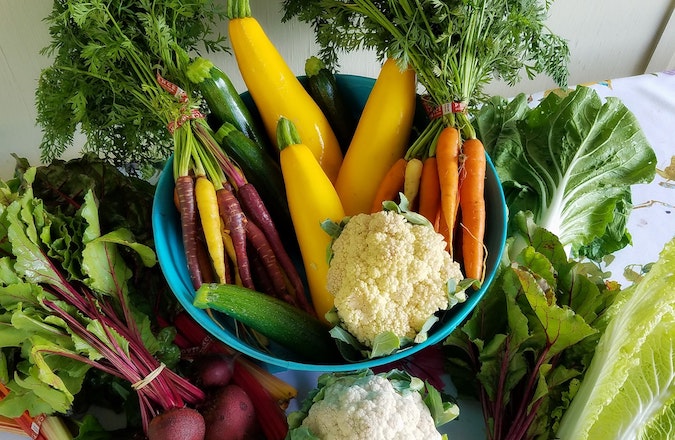
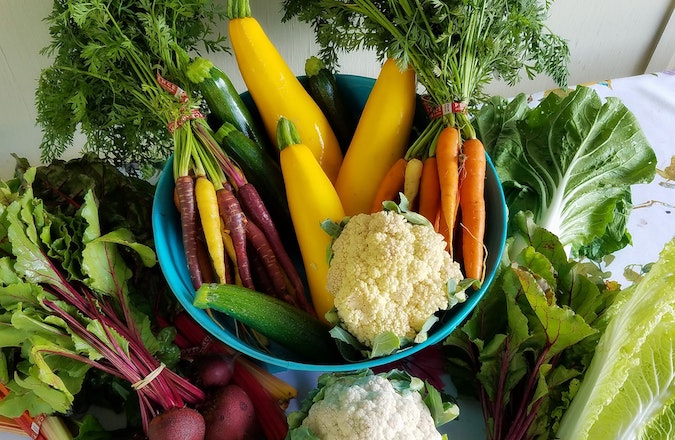
Figure 1: Selection of Vegetables. [2]
The Carbon Footprint of Your Diet
Contrary to popular belief, transport tends to account for a small percentage of greenhouse gas emissions. Eating locally would only have a significant impact if transport was responsible for a large share of food’s final carbon footprint, but for most foods, this is not the case. It is far more important to bear in mind what you eat, rather than where your food has travelled from.
‘Our World in Data’ created a graph to visualise the Green House Gas (GHG) emissions from 29 different food products in 2018. [1] The graph shows, for each product, which stage in the supply chain its emissions originate. The data comes from the largest meta-analysis of global food systems to date, published in “Science by Joseph Poore and Thomas Nemecek.”
In this comparison, they looked at the total GHG emissions per Kilogram of food product. CO2 is the most important GHG, but it isn’t the only one. Farming produces a large source of GHG methane and nitrous oxide. This metric takes into account all GHG.
The graph results quite clearly show that plant-based products such as:
- Nuts
- Vegetables
- Fruit
- Soya
- Wheat
Produce considerably less GHG emissions overall than products such as:
- Fish
- Oils
- Poultry meat
- Chocolate
- Coffee
On the extreme end of the spectrum, beef products produced more GHG emissions than any of the other 29 food products by a huge leap. This is due to the methane production from cows, land conversion for grazing and animal feed. In second is lamb and mutton products for very similar reasons, but still no way near as harmful in GHG as beef products.
In this data, they took into account, land use change, farming, animal food, processing, transport, retail and packaging. Each of the 29 products had different levels of each of these, but by far, the most problematic and highest reoccurring problem was farming and the emissions produced from animals, fertilisers, manure and farm machinery.
One of the lowest was the transport emissions for all of these products, even considering GHG emissions from energy use in the transport of food items in-country and internationally, those results were still considerably lower than most of the other factors.
So What Can We Take From This Data?
This article is not here to try to convert you into cutting out products that produce high GHG emissions entirely, but to think differently about what we eat and how much of it we consume. Buying from independent, small companies, butchers and farmers is a great way to support local businesses and will reduce some GHG emissions to an extent. Reducing the amount of meat and poultry products we consume will help massively. CO2 emissions from most plant-based products are as much as 10-50 times lower than most animal-based products. Cutting down on the amount of highly perishable foods (foods that will perish quickly after being harvested such as avocados, berries, asparagus) will reduce your food carbon footprint too as they are generally grown in other countries and are more often than not transported by air to get them to the consumer as quickly as possible to maintain freshness.
This means that if you want to reduce your food carbon footprint, you could avoid air-freighted food products where you can, eat less meat and dairy or switch from ruminant meat to chicken or pork, or plant-based alternatives. If everyone changed their eating habits a bit, we could make a massive difference together.
About Pager Power
Pager Power undertakes technical assessments for developers of renewable energy projects and tall buildings worldwide. For more information about what we do, please get in touch.
References
[2] Solar Flares (August 2019) on Pexels.com. Last Accessed on 11th April 2023. Available at: https://www.pexels.com/photo/assorted-vegetables-2751755/
post contents
About the Author: Georgia Low