British Horse Society Guidance and Glint and Glare
Last Updated: May 26, 2026
Share:
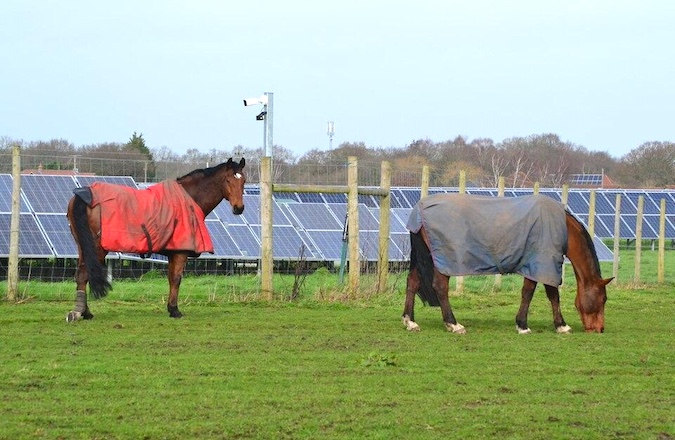
In August 2025, the British Horse Society (BHS) updated their guidance on solar farms near routes used by equestrians [1]. This guidance covers a variety of topics, including noise, drainage, security and glint and glare. This article will focus on glint and glare, but it is worth noting that the BHS asserts that they have no broad position towards solar developments and they acknowledge that impacts upon equestrian routes is unlikely to constitute a ‘material planning consideration’.
The BHS Guidance
The BHS guidance on glint and glare states that due to the material properties of solar PV panels (which are less reflective than glass), glare is “unlikely to be a direct problem to horses or equestrians because of the angles and distances involved and because the surface has a dull sheen rather than glare even on a bright day” [3]. It further states that “The Society has no evidence of ‘glint and glare’ from solar panels and no evidence of horses reacting to it or of it being detrimental to the health and wellbeing of horses. Reports from sites with both solar panels and horses, including a solar array beside an arena used for riding horses, indicate no reflection and no reaction from or impact on horse or rider.” [4]
The guidance suggests that horses may initially react to a solar farm, as they would to any new feature in their environment but will quickly accept the solar farm and there is no evidence that horses see solar panels differently than humans or are any more susceptible to glint and glare.
The Effect
Despite BHS guidance stating that glint and glare is unlikely to affect equestrian routes, this is a common concern raised by local residents and equestrians when solar farms are proposed in their vicinity. Pager Power recommends that these concerns are considered in their own merits whenever raised by local communities, but impacts towards horses are unlikely to constitute a significant impact requiring mitigation. In most cases, a high-level commentary on potential effects towards horses and their riders is likely to be sufficient, rather than requiring full geometric modelling.
What is a Glint and Glare Assessment?
A glint and glare assessment is a technical assessment undertaken to assess the effects of solar reflections from solar panels or a building towards a variety of receptors. These can include residential dwellings, roads, railways, public rights of way, and both licensed and unlicensed airfields.
Pager Power have produced our own glint and glare guidance for how to assess and classify the effects of solar reflections, which is now on its fourth edition. Click here to find out more.
If you want to see some case studies of projects we have worked on, including glint and glare assessments, click here.
About Pager Power
If you have a solar project that needs a glint and glare assessment to be undertaken, or need some more advice on anti-glare solutions, please get in touch.
References
[1] British Horse Society, ‘Advice on solar farms near routes used by equestrians’ (August 2025)
[2] David Martin (2nd February 2020) from WikiCommons. Accessed on: 25th May 2026.
[3] BHS (2025), pg. 9
[4] ibid
post contents
About the Author: James Plumb