Research Update – Eliminating “Yellow” Glare
Last Updated: April 10, 2017
Categories:
Share:
Background
Large Solar PV developments cause direct solar reflections which can affect aircraft, trains, road vehicles and residential amenity. Pager Power has undertaken over 250 glint and glare assessments which explain the times, dates and durations of expected glare. Glare which is expected to cause a temporary after-image is classified as “Yellow”. Mike Watson is currently researching methods of eliminating “Yellow” glare from solar PV developments so that the developments can proceed without causing significant interference.
Glare Levels
For aeronautical glint and glare assessments levels are calculated in terms of impact on the eye in accordance with the table below:
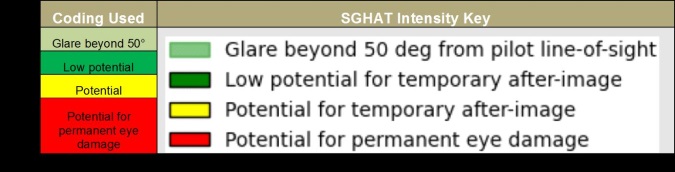
Under US Federal Aviation Administration (FAA) requirements red and yellow glare is unacceptable for the last 2 miles of runway approaches. This means that solar schemes near airports sometimes have to be reengineered so that they do not cause yellow glare.
This glare classification is dependent on the glare intensity and the apparent size of the glare area as viewed from the eye. The graph below shows intensity and apparent size with the boundaries between green, yellow and red glare.
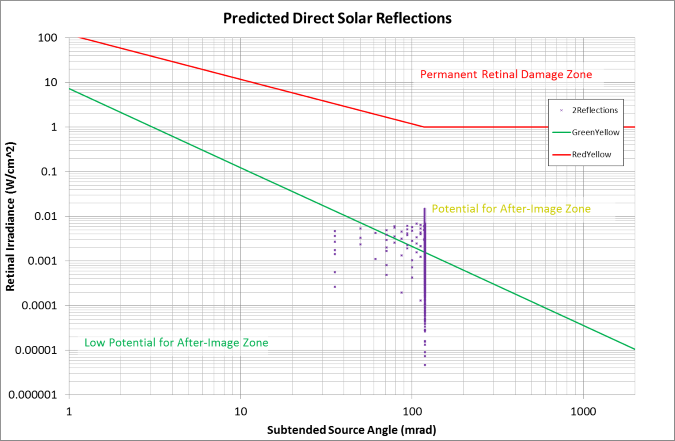
Glare Factors
There are many factors that could potentially affect the glare level. These include:
- The type of solar panel
- The panel angle
- The panel orientation
- Size of solar development
- Shape of solar development
- Distance between solar development and observer
- Angle to observer
- Relative height of observer
- Development location
Eliminating yellow glare
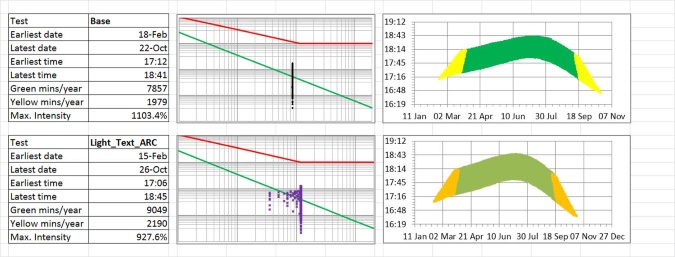
Where yellow glare is predicted it can often be eliminated on an ad-hoc basis. This may often be achieved by changing the orientation of some panels or by changing the panel surface type. The modelling tool accommodates surfaces with varying smoothness and anti-reflective coating (ARC).
Research
A base model was developed with a specimen solar panel and observer scenario in Richmond, south west London. The annual glint and glare was then made for this scenario. 27 alternate scenarios were then developed by changing a single parameter at a time (e.g. slope or distance between observer and solar development). A tool was then built for comparing the results. Example output from the comparison tool is shown below:
Conclusions
As a result of the research undertaken so far Pager Power has:
- A better understanding of the specific factors that cause yellow glare
- A tool that makes its internal process for minimizing nuisance glare faster and more predictable
- An improved capability for advising solar PV developers on glint and glare issues
To discuss your solar project please contact Mike Watson mike@pagerpower.co.uk or Danny Scrivener danny@pagerpower.co.uk on +44 (0) 1787 319001.
post contents
About the Author: Mike

Latest News
US Continues to Build Out Solar Capacity
Earlier this month, the Solar Energy Industries Association (SEIA) released [...]
China’s Airborne Wind Turbines
In early 2026, China successfully developed an airborne wind turbine [...]
Shadow Flicker Assessments for Wind Turbines: A 2026 Update
Shadow flicker is the effect of rotating turbine blades, causing [...]