What is ‘Directly in-Front’ of Road Users With Respect to Glint and Glare
Last Updated: November 25, 2026
Share:
When carrying out a Glint and Glare Assessment which includes the assessment of road users, reference is often made to a driver’s primary field-of-view in determining the potential effect of solar reflections. This is a relevant consideration in the assessment as the location where glare occurs from can significantly affect how it is perceived by a road user, and the consequent effect upon road safety.
Pager Power produced a Whitepaper on this topic in 2021, which determined that the relevant primary field-of-view for road users should be 50° either side of the direction of travel.
While the 2021 Whitepaper focussed on defining the extent of the sensitive field-of-view, it did not address what should be considered as a road user’s central vision, where effects are most impactful, which is the focus of this article.
Where Do Road Users Look?
A road user must constantly be gathering information of their surroundings in order to safely navigate in a vehicle. To do this, a road user’s eyes must frequently move so that the central vision can focus on various locations to gain as much understanding of their surroundings as possible (e.g., reading the road ahead or scanning for hazards).
This presents a challenge when defining what is directly in front of a road user, as their focus may move over time. However, given that many of the key regions are almost directly in front of them (e.g., lane positioning, ensuring safe distance to the vehicle ahead, looking at upcoming road conditions or traffic lights), it is likely that a driver will spend most of their time looking at, or close to, their direction of travel.
The most relevant guidance relating to where road users should be expected to look comes from the Traffic Signs Manual, produced by the Department for Transport [1]. This states that to maintain safe driving, road users should not need to divert their eyes more than 10° away from the road ahead.
Conclusions
Due to the above considerations, it has been concluded by Pager Power that solar reflections within 10° either side of a road user’s direction of travel are treated with the greatest sensitivity, so much so that glare in the central vision will have a high impact on road safety if no other mitigating factors are present.
As such, within a Glint and Glare Assessment, where solar reflections are geometrically possible, consideration will be given to the location of glare, both with respect to the 50° primary field-of-view and 10° central vision.
What is a Glint and Glare Assessment?
A glint and glare assessment is a technical assessment undertaken to assess the effects of solar reflections from solar panels or a building towards a variety of receptors. These can include residential dwellings, roads, railways, public rights of way, and both licensed and unlicensed airfields.
Pager Power has produced our own glint and glare guidance for how to assess and classify the effects of solar reflections, which is now on its fourth edition. Click here to find out more.
If you want to see some case studies of projects we have worked on, including glint and glare assessments, click here.
References
[1] Traffic Signs Manual (4th October 2006). Department for Transport. Accessed on: 23rd November 2026.
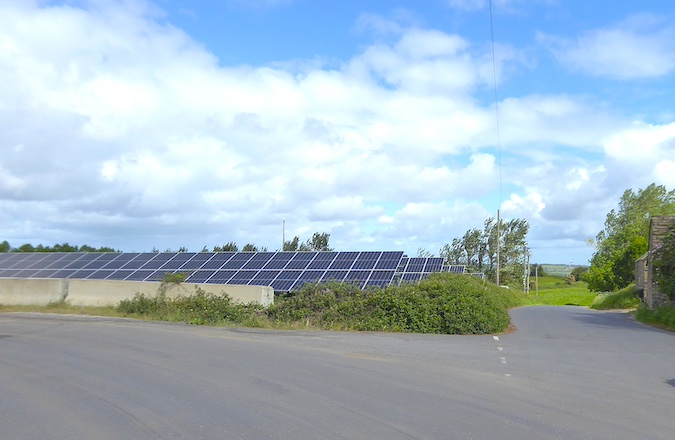
Image accreditation: Kevin Waterhouse (25th May 2025) from WikiCommons. Accessed on: 20th November 2026.
post contents
About the Author: James Plumb