The Future of Non-Automatic Initiation Zones (NAIZ) and MoD Air Defence Radar

Last Updated: December 16, 2025
Share:
One of the technical mitigation options that is used for certain wind developments is the implementation of a Non-Automatic Initiation Zone (NAIZ). This is also sometimes called Non-Auto Initiation Area (NAIA), or Non-Initiation Window (NIW). In the UK there is precedence for NAIZ to be used as an interim solution for mitigating effects on air defence radar operated by the MoD from single turbines (or sometimes small turbine clusters).
Technical background
When a radar pulse is reflected by a target, the location of the target is calculated, and this can be displayed on the air traffic controller’s screen. Returns from a single target such as this are known as a ‘plot’. A plot can be created by a wanted target such as an aircraft or an unwanted target such as a wind turbine.
If a number of plots are received in succession in close proximity to one another, advanced radar can identify this as a ‘track’ associated with a moving target. This process is known as ‘plot extraction’. In this way, the heading of an aircraft can be displayed on the air traffic controller’s screen, making it easier for them to manage traffic in the area. The purpose of a NAIZ is to ensure that tracks are not initiated by unwanted targets such as wind turbines. This is a modification to the radar software, which allows construction of a three-dimensional zone around the wind turbine/cluster in which the radar will ‘ignore’ aircraft tracks that are initiated within it. The zone is defined in three dimensions, in which plot extracted tracks will be prevented from initiating. This then means that false plots will not spontaneously be created by the moving turbine blades, thereby removing the false returns. However, aircraft tracks that started outside of the NAIZ will continue to be tracked as they pass over the wind turbine, therefore ensuring the radar’s capability is not impeded by the presence of the wind development.
A 2D radar has to establish a NAIZ across the entire wind farm, however, it is possible for advanced 3D radars to define individual NAIZs around each individual wind turbine as long as they have sufficient separation.
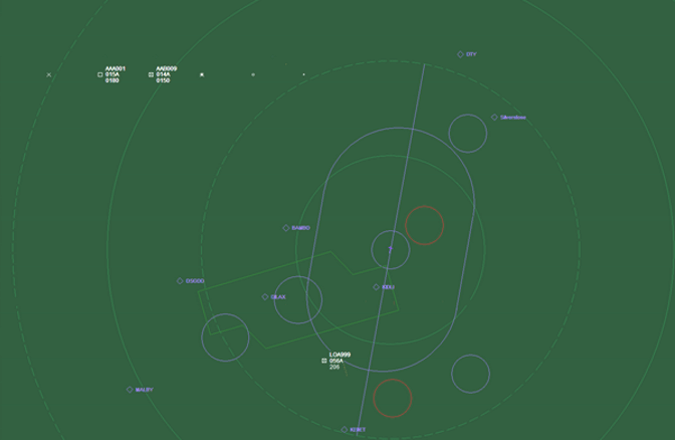
A Pager Power simulation of Thales STAR 2000 radar mitigation (Blanking and Non-Auto Initiation) [1]
The future of NAIZ
As with any mitigation, NAIZ is not a perfect solution. Some of the disadvantages are as follows:
- Only work on some radar (modern PSR radar that have in-built tracking systems);
- Less effective for larger wind developments;
- Less effective in areas where there are complex aircraft manoeuvres.
Analysis of trials undertaken in 2021 as part of the Defence and Security Accelerator (DASA) competition document [2] for windfarm mitigation for UK Air Defence identified that current mitigation methods including NAIZ are insufficient to meet the agreed aviation specification. It is suggested in a 2022 study [3] undertaken by ORE Catapult (a technology innovation and research centre for Offshore Renewable Energy) in partnership with the Offshore Wind Industry Council, that a sufficiently skilled pilot may be able to avoid detection altogether because of the inability to form tracks on aircraft originating within the NAIZ.
It’s likely that NAIZ still has a part to play in at least the short to medium term future. It would be seldom used as a sole mitigation solution, apart from for single turbines or small clusters. For larger developments, NAIZ is unlikely to prove an effective mitigation solution by itself but could be used as part of a multi-tier solution. The preferable solutions are likely to involve infill radars or next generation radars as a replacement. Pager Power will be keeping up to date with the latest wind turbine mitigation technologies/strategies so that we can advise our clients to deal with air defence radar objections.
About Pager Power
Pager Power has expertise in helping wind developers assess the impacts of both offshore and onshore wind projects upon aviation operations and infrastructure, as well as engaging with stakeholders like the MoD. Pager Power can advise developers on the location of the nearest UK Air Defence Radar, whether any technical impacts are likely to be possible, and how to approach mitigation.
For more information about what we do, please get in touch.
References
[1] How it works – Thales STAR 2000 Radar – Pager Power
Image accreditation: Karsten Wurth (June 2016) from Unsplash.com. Last accessed on 16th December 2025. Available at: https://unsplash.com/photos/landscape-photography-of-grass-field-with-windmills-under-orange-sunset-lsJ9jHKIqHg
post contents
About the Author: Waqar Qureshi