Where does wind turbine TV interference occur?
Last Updated: May 5, 2016
Categories:
Share:
Wind turbines affect TV signals. In some cases, this causes noticeable interference at nearby residences. It is common for planning authorities to set conditions that obligate wind farm developers to investigate and mitigate any TV interference caused by their turbines. Moreover, disruption to TV services makes for bad press.
Where does interference occur around a wind farm?
In very general terms, homes within a few kilometres of a wind development that have TV aerials pointed towards the turbines are likely to be at the highest risk.
However, to answer the question in more detail, the underlying interference mechanisms must be understood. This article gives an overview of how interference works and what the implications are.
There is a common misconception that digital TV is immune to interference from wind turbines, which is unfortunately a myth.
Interference
There are three ways that wind turbines affect TV signals:
- Blocking of the signal – the wind turbine as a physical structure reduces the strength of the signal behind it. This is similar to a building blocking the path between two walkie-talkie handsets.
- Reflection of the signal – the large surfaces of a wind turbine can redirect TV signals in other directions.
- ‘Chopping’ of the signal – if the path of the signal from transmitter to receiver passes through the spinning rotor, the received power level can fluctuate significantly (illustrated in the figure below).
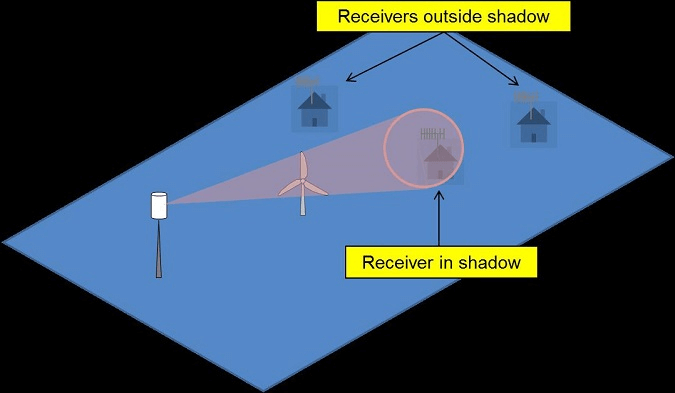 Figure 1: Effect of chopping from the turbine rotor.
Baseline coverage
The baseline quality of TV coverage in the area influences the significance of any interference. If current reception is of very high strength and good quality [1], small amounts of interference are unlikely to be noticeable.
Conversely, if coverage is relatively poor but still good enough to decode channels clearly, a small amount of signal degradation can upset the apple cart.
Recipe for disaster
The worst-case scenario, with regard to TV interference is for all of the following conditions to be satisfied:
- The transmitter has radio line of sight to the turbines.
- The transmitter does not have radio line of sight to the receiving aerial.
- The receiving aerial has radio line of sight to the turbines.
- The bearing from the receiving aerial to the turbines is close to the bearing from the receiving aerial to the transmitter.
- The receiving aerial is close to the wind turbines.
Naturally, the best-case scenario is for none of these conditions to be satisfied.
What it means in practice
Interference is most often observed at receiving locations which are:
- Within a few kilometres of multiple wind turbines.
- In an area with moderate or weak TV coverage.
- Within the forward scatter region – explained below.
The forward scatter region is the area in the wind development’s shadow from the transmitter’s perspective. The figure below, taken from the International Telecommunication Union (ITU) publication listed in Reference 1, illustrates the forward scatter region.
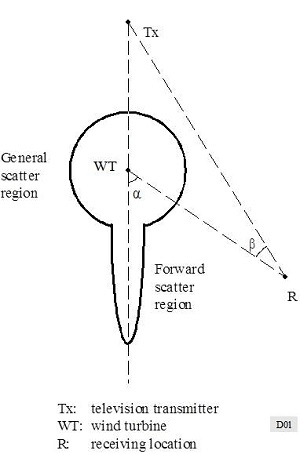 Figure 2: Forward Scatter Region
Naturally, the interference areas will depend on which transmitter is serving the surrounding areas. In some cases multiple transmitters provide coverage to different areas around a wind farm.
What to do
The safest, and recommended, approach when considering TV interference is to undertake a specific impact assessment for the development in question. This means:
- Identifying the relevant transmitters.
- Modelling the predicted impact, based on the details of the wind development and the surrounding terrain.
- Undertaking field surveys to bolster the modelling results.
Completing the above steps is the best way to predict the issues and evaluate any reports of interference, should these arise.
What not to do
Taking a ‘wait and see’ approach to TV interference is not recommended. Problems associated with doing this include:
- Interference reports that are difficult to verify.
- Bad publicity.
- Scapegoat problems – there have been cases where complaints of interference due to a wind farm have been made when in actuality the problems were shown to be due to a 4G base station located nearby.
Foot Note
[1] i.e. a low carrier to interference rate (analogue signals) or a low bit error rate (digital signals)
References
- ITU, 1992, Recommendation BT.805-0
- ITU, 2015, Recommendation BT.2142-2
- Guidance for digital TV interference caused by wind turbines, Pager Power, April 2016
post contents
About the Author: Mike

Latest News

Are London Homes Getting Too Hot?
London, like most large cities, experiences an average temperature that [...]
What is Wind Farm Repowering?
There are a lot of potential constraints when it comes [...]

Do Construction Cranes Require Aviation Consent or Lighting, and Who Sets the Rules?
Cranes used for construction will likely reach elevations above the [...]