Cosmic Megastructures: Dyson Sphere and Future of Solar Energy

Solar energy, which is widely abundant and renewable, has become a hopeful substitute for fossil fuels in meeting the world’s energy demands. Harnessing solar power efficiently is limited by issues such as unreliable weather conditions, intermittent availability due to daylight hours, and a shortage of adequate land [1]. Dyson Sphere offers an innovative solution to these issues by proposing a giant structure surrounding a star beyond the orbit of the planet. Such a structure would tap a massive amount of the energy the star radiates into space [2]. In the case of our Sun, it would harness a colossal 3.828×1026 Watt of energy irradiated into space [3].
The concept of Dyson sphere was proposed by the physicist Freeman Dyson in 1959 [4]. Dyson spoke of a superstructure near the sun that could capture its energy and provide a limitless source of power. He theorised a shell-like structure that would covert light emanating from star into infra-red radiation [5]. Quoting his own words addressing the comments on his paper, ‘A solid shell or ring surrounding a star is mechanically impossible. The form of ‘biosphere’ which I envisaged consists of a loose collection or swarm of objects traveling on independent orbits around the star.’
Nikolai Kardashev’s Scale and Clean Energy
The Kardashev scale proposed by Russian astrophysicist Nikolai Kardashev, classifies civilizations based on their energy production and needs. The development of technology has led to an increasing demand for energy, categorising civilizations into Type 1, Type 2, and Type 3 based on their energy requirements.
A Type 1 civilization must transition to clean energy sources to achieve sustainability and harness all possible energy and resources of the home planet. A Type 2 civilization harnesses energy from sources beyond its planet, such as its host star. A Type 3 civilization would be able to use available energy sources in their host galaxy [6].
Currently we are 0.72 on the scale and are likely to attain Type 1 in another few hundred years [7]. Michio Kaku, a physicist proposed that if humans raise their consumption of energy by 3% each year, they may attain Type 1 status in about 100-200 years, Type 2 status within a few 1,000 years, and Type 3 status around 100,000 to a million years [8]. However, the depletion of fossil fuels and the limitations of clean energy pose challenges to reaching Type 1 status. Balancing energy needs with sustainability is essential to advance into higher civilization tiers.
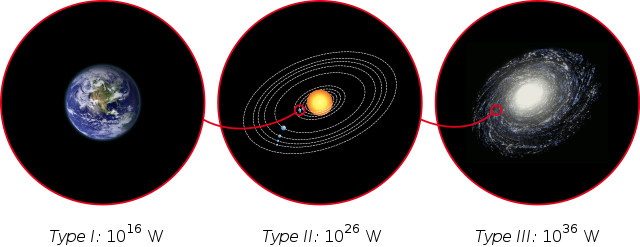
Figure 1: Energy consumption in three types of civilizations defined by Kardashev scale. Last accessed 12th April 2024. Available at: Wikimedia Commons
Designing a Dyson Swarm for Renewable Energy
While the construction of a Dyson Sphere remains speculative, its framework informs discussions on the future of solar energy utilisation. The simplest and more feasible configuration is called Dyson ring, which comprises of series of solar cells in an orbit. Many such Dyson rings make up a variant of Dyson sphere called Dyson Swarm, resembling swarm of bees surrounding their hive [9].

Figure 2: Dyson Swarm variant. Last accessed on 12th April 2024. Available at: Wikimedia Commons
Solar energy would be lifeblood for this megastructure since the construction and maintenance of Dyson Swarm would rely heavily on it. Dyson Swarm would harness most of a star’s energy output rather than just capturing a fraction of the sunlight that reaches Earth. The scalability of a Dyson Swarm makes it promising venture for future renewable energy production.
About Pager Power
Pager Power undertakes technical assessments for developers of renewable energy projects and tall buildings worldwide. For more information about what we do, please get in touch.
References
[1] Hassan, Q., Algburi, S., Sameen, A. Z., Salman, H. M. & Jaszczur, M. A review of hybrid renewable energy systems: Solar and wind-powered solutions: Challenges, opportunities, and policy implications. Results Eng. 20, 101621 (2023).
[2] SFE: Dyson Sphere. https://sf-encyclopedia.com/entry/dyson_sphere.
[3] Sun Fact Sheet. https://nssdc.gsfc.nasa.gov/planetary/factsheet/sunfact.html.
[4] Sandberg, A. Dyson Sphere FAQ. https://www.aleph.se/Nada/dysonFAQ.html#OTHER.
[5] Search for Artificial Stellar Sources of Infrared Radiation | Science. https://www.science.org/doi/10.1126/science.131.3414.1667.
[6] Hsiao, T. Y.-Y. et al. A Dyson sphere around a black hole. Mon. Not. R. Astron. Soc. 506, 1723–1732 (2021).
[7] Namboodiripad, A. Predicting the Timeline for Earth Achieving Kardashev Scale Type 1 Status.
[8] The Physics of Interstellar Travel : Official Website of Dr. Michio Kaku. https://mkaku.org/home/articles/the-physics-of-interstellar-travel/.
[9] Wee, A. The Dyson Sphere. (2016).
post contents
About the Author: Vijayatha Vijayaraghavan

Latest News
US Continues to Build Out Solar Capacity
Earlier this month, the Solar Energy Industries Association (SEIA) released [...]

China’s Airborne Wind Turbines
In early 2026, China successfully developed an airborne wind turbine [...]
Shadow Flicker Assessments for Wind Turbines: A 2026 Update
Shadow flicker is the effect of rotating turbine blades, causing [...]