UK Wind and Solar Electricity Production Overtakes Fossil Fuel Production for the First Time
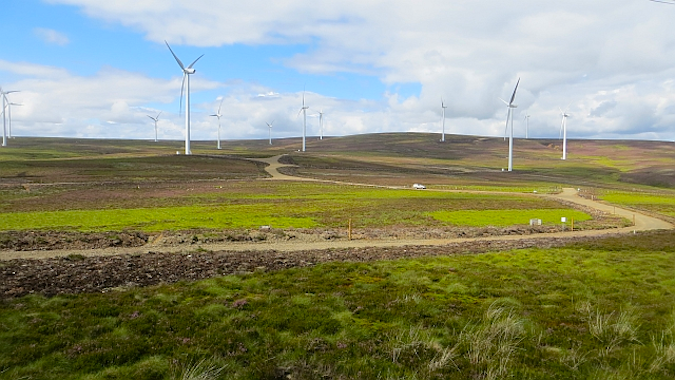
In January, we reported that the record for instantaneous wind power generation had been broken twice in quick succession, and we can now celebrate some further records regarding power generation over an entire three-month period.
Wind and Solar Outstrip Fossil Fuels
In the first quarter of 2023, wind and solar energy production combined has outstripped energy production from fossil fuels, with shares of 43% and 40% respectively in the nation’s electricity production [1,2]. Wind has been the primary mode of electricity generation in the UK over a period of three months. In the first quarter of 2023, wind accounted for 39% of UK electricity generation, overtaking natural gas which accounted for 38% this quarter and which had previously been the modal method of generation since 2015 [1,2].
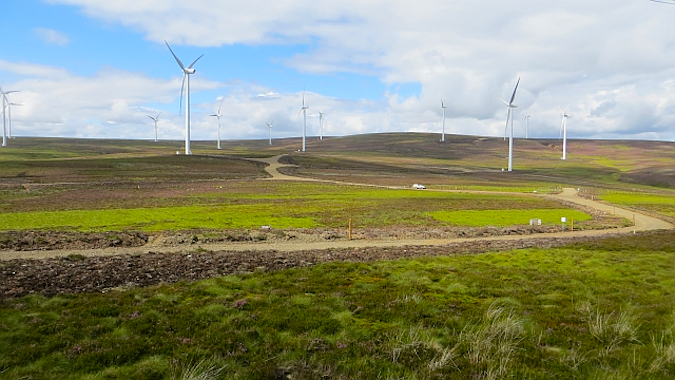
Figure 1: Fallago Rig Power Station. [5]
Despite this record breaking news there is still a long way to go in the decarbonisation of the UK’s electricity supply. The majority of the UK’s renewable electricity generation comes from wind, and generally the UK is more windy during the winter months. In 2022, for instance, wind accounted for 35% of electricity generation in January to March, but only 22% in July to September [1,2]. 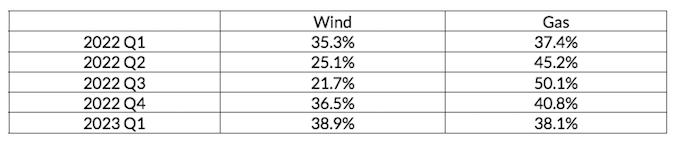 Table 1: UK electricity production from wind and gas. Wind power production and renewable energy production in general fluctuate quite considerably over the course of a typical year.
Other Renewables Opportunities
The result of this is that fossil fuels still account for the majority of electricity generation in the summer months, and there are still challenges which need to be overcome in order to store large amounts of energy, something which will be necessary due to the large fluctuations in energy production from wind and solar farms. Solutions could improve pumped storage, whereby excess energy is used to pump water up a hill, before the water then being used to generate energy by hydroelectric power when there is a deficit of energy production from other sources. Pumped storage systems already exist. The largest in the UK is Dinorwig in North Wales, which can store 9.1 GWh of energy. Another possibility is green hydrogen, whereby the electricity produced by wind and solar is used to electrolyse water to produce hydrogen, which can then be used in gaseous form later.
It should also be noted that electricity currently accounts for only 18% of UK total energy consumption [3], and that as we shift from other uses of energy such as mains gas for domestic heating, and petrol and diesel in transport, more electricity will be needed. UK energy demand could indeed double by 2050 [4].
Challenges to Reach Net Zero Remain
The records that have been broken are quite momentous in the sense that they reinforce the idea that we are progressing towards full renewable energy production. There are still challenges abound in order to reach net zero not only in our existing electricity production but also total energy production. These include the continued rollout of electric cars, adequate energy storage to mitigate the effects of fluctuations in energy production, connection of new wind and solar farms to the electricity grid, and planning constraints when building new wind and solar farms.
About Pager Power
Pager Power contributes towards this effort by assisting developers of wind farms and solar farms in their efforts to overcome planning objections. Pager Power’s services include aviation and telecoms assessments for wind farms, and glint and glare assessments for solar farms. Since 2002 Pager Power has undertaken 427 aviation assessments, 217 telecoms assessments and 1039 glint and glare assessments, whilst also consulting with stakeholders.
Click here to see some case studies of our work.
Click here to learn more about green hydrogen.
References
[1] National Grid ESO Portal – https://data.nationalgrideso.com/
[2] Balancing Mechanism Reporting Service – https://www.bmreports.com/bmrs/?q=help/about-us
[3] Stallard, E. BBC News – Wind is main UK source of electricity for the first time – https://www.bbc.co.uk/news/science-environment-65557469
[4] National Grid – How will our electricity supply change in the future? – https://www.nationalgrid.com/stories/energy-explained/how-will-our-electricity-supply-change-future
[5] cc-by-sa/2.0 – Fallago rig power station by Richard Webb – geography.org.uk/p/4106733
post contents
About the Author: Harry Watson

Latest News
US Continues to Build Out Solar Capacity
Earlier this month, the Solar Energy Industries Association (SEIA) released [...]
China’s Airborne Wind Turbines
In early 2026, China successfully developed an airborne wind turbine [...]
Shadow Flicker Assessments for Wind Turbines: A 2026 Update
Shadow flicker is the effect of rotating turbine blades, causing [...]