The European Renewable Energy Supergrid
There are many parts involved in moving towards more energy being supplied from renewable sources, not least of which is the grid used to transfer this energy from the source to where it’s needed.
In the summer months on the west coast of the USA, it is common for the state of California to disconnect renewable power sources, mainly solar panels and wind turbines, from its statewide electrical grid. In 2019, California curtailed 223.195 MWh [1]. This is because the demand on the grid was already being met, and keeping those sources of electricity connected to the grid would have damaged the grid. This is an issue that any state or country moving towards higher renewable energy production is likely to face, and it stems from an inherent problem of weather based renewable energy; it is inconsistent. To achieve 100% renewable energy, a power grid must have enough renewable energy sources to be able to supply all power demands when they are least productive i.e. when the wind is slow and there is strong cloud cover. However, if this is achieved, it must then be true that when the sun is shining and the wind is strong, too much energy will be entering the grid. So should we just disconnect the sources and waste all that energy? Or is there a more collaborative approach?
The most obvious solution is to store that excess energy for a rainy day, literally. However, building enough pumped hydro dams and battery storage for an entire power grid is probably not going to be practically, or economically feasible. So the next solution is to sell it.
Selling excess energy to another power grid is a feasible solution because not all power grids have the same make up of energy supply, some have more renewables than others, some may be more focused on wind energy etc, additionally, the weather is not always consistent between states and countries.
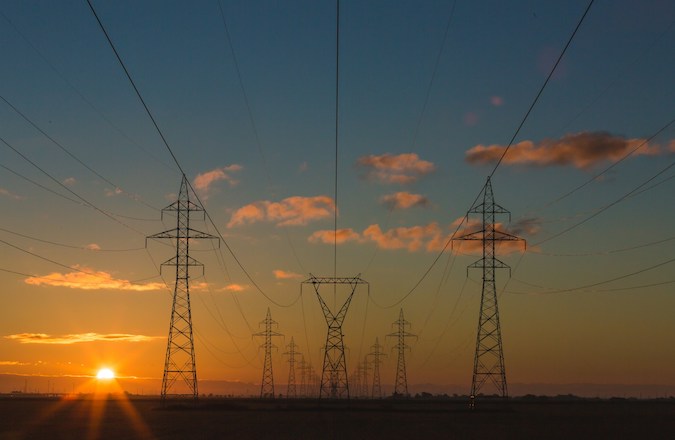
Figure 1: Power Lines.
The World’s Largest Interconnected Grid
Europe already has the world’s largest interconnected grid, allowing countries to benefit from cheap power from countries that have excess. For example, Norway regularly purchases excess wind power from Denmark to fill their hydro pump dams and store the energy, which they then use domestically or sell at a higher price in the future when power production is lower. The interconnected grid improves competition in the renewable market, and allows countries to benefit from their competitive advantage, such as the UK and Ireland’s windy coastlines, Spain’s sunny hillsides and Scandinavia’s landscape which is ideal for hydro pumps and dams, all while having confidence that they will always have other renewable energy sources to draw from when needed. There is also the additional benefit that energy prices for consumers should remain competitive.
Increasing Connectivity
Although the European energy grid is already interconnected, the EU plan to increase connectivity between countries by adding more grid interconnectors, increasing the number of countries connected to the grid, and increasing the amount of energy that can be transferred. In particular, the Celtic Interconnector will be laid down between Ireland and France to provide a direct connection between Ireland and mainland Europe [2]. The ultimate aim is to for the European Renewable Energy Supergrid.
The European Supergrid will set the example to other countries around the world of the benefits of interconnected grids and how they can be economically and environmentally beneficial. So why isn’t California selling its excess energy to neighbouring states? Unfortunately, although it would be economically beneficial for the state, the legal process of joining a wider national grid would mean California would have to give up control of its grid, something they are unwilling to agree to. Maybe the European Supergrid will be a wakeup call to the USA on how it should alter its policies on state and national renewable energy and power production.
About Pager Power
Pager Power undertakes technical assessments for developers of renewable energy projects and tall buildings worldwide. For more information about what we do, please get in touch.
References
[1] “Calif. sets record for solar, renewable curtailments”, American Public Power Association, 25 June 2019.
(Online) Available: https://www.publicpower.org/periodical/article/calif-sets-record-solar-renewable-curtailments [Accessed 27 September 2024].
1] “Celtic Interconnector to get €530m in funding from EU”, Ireland’s National Public Service Media, 02 October 2019.
(Online) Available: https://www.rte.ie/news/business/2019/1002/1080716-celtic-interconnector-to-get-530m-in-funding-from-eu/ [Accessed 27 September 2024].
Figure 1: Power Lines, unsplash.com, 8 September 2016. (Online) Available: https://unsplash.com/photos/photo-of-truss-towers-yETqkLnhsUI [Accessed 27 September 2024]
post contents
About the Author: Jacob Cunningham

Latest News
US Continues to Build Out Solar Capacity
Earlier this month, the Solar Energy Industries Association (SEIA) released [...]

China’s Airborne Wind Turbines
In early 2026, China successfully developed an airborne wind turbine [...]
Shadow Flicker Assessments for Wind Turbines: A 2026 Update
Shadow flicker is the effect of rotating turbine blades, causing [...]