Geothermal Energy: Is It Too Hot to Handle?
Geothermal Energy, the use of earths natural heat below the surface to heat water into steam in order to run generators for electricity, is clean, efficient and can be built on both small and large scale. On the face of it, geothermal energy should be a major component in the move to renewable energy world wide, so why isn’t it?
Limited Geographic Feasibility
The easy answer is that it can only be feasibly built in areas which have high geothermal activity close to the surface. These areas are not common, the notable examples being Iceland, New Zealand and certain parts of California, therefore how could it possibly play a significant part in worldwide renewable energy production? However, this reasoning glosses over a key issue with Geothermal Energy; why is it only feasible in areas with high geothermal activity?
Understanding the Role of Borehole Depth
It is not because a Geothermal Power Plant placed in high geothermal activity areas is any more energy efficient than one placed elsewhere, as the ground temperatures that can be accessed in Iceland are the same as can be accessed in say Canada. The issue is how deep a borehole must be to access these temperatures.
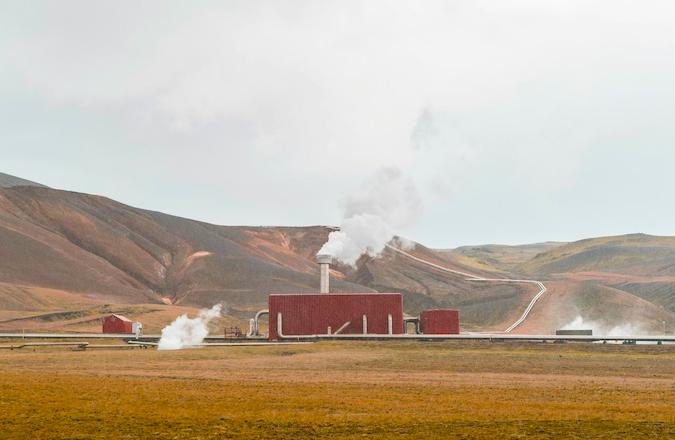
Figure 1: Geothermal Plant in Iceland.
The High Costs of Deeper Boreholes
The cost of a borehole increases exponentially with depth for several reasons; the first is that a deeper borehole takes longer to drill, therefore greatly increased labour costs, it also requires a longer pipe and more reinforcing, but perhaps the largest factor is that the drill needs replacing more often. The drill needs replacing more not just because there is a longer distance to drill, but the geology of the earth further down tends to get harder. In addition to this, unlike in high geothermal activity areas, the gradient of temperature increase in lower geothermal activity areas is shallow, that means the drill spends more time in high temperature rock before reaching the desired depth, which increases wear on the drill and reduces its efficiency, meaning more replacements are required.
Advancing Drilling Technology
So clearly, if cheaper and more efficient drilling methods/technology was available, geothermal energy would be more feasible worldwide. This is the mission of FERVO Energy [1], a company striving to make geothermal energy more feasible through research and development, they are currently exploring a borehole method that doesn’t use drills but instead vaporises the rock with high energy pulses, therefore eliminating the requirement to replace the drill.
About Pager Power
Pager Power undertakes technical assessments for developers of renewable energy projects and tall buildings worldwide. For more information about what we do, please get in touch.
References
[1] FERVO Energy.
(Online) Available: https://fervoenergy.com/technology/. [Accessed 26 March 2025].
Figure 1: Geothermal Plant in Iceland, unsplash.com, 26 November 2020. Last accessed 26 March 2025. Available at: https://unsplash.com/photos/red-and-white-barn-near-brown-field-under-white-clouds-during-daytime-t6u6EPbWNjw [https://www.pagerpower.com/wp-content/uploads/2025/03/geothermal-thumbnail.jpeg
post contents
About the Author: Jacob Cunningham

Latest News
US Continues to Build Out Solar Capacity
Earlier this month, the Solar Energy Industries Association (SEIA) released [...]
China’s Airborne Wind Turbines
In early 2026, China successfully developed an airborne wind turbine [...]
Shadow Flicker Assessments for Wind Turbines: A 2026 Update
Shadow flicker is the effect of rotating turbine blades, causing [...]