Carbon capture- The UK’s Next Step To Net Zero
What is Carbon Capture?
Carbon capture is a climate change mitigation strategy in which the carbon dioxide produced in various industries like fossil fuel power plants, oil refinery and chemicals is separated from the other by-product gasses and stored underground in order to stop it being released into the atmosphere and contributing to global warming.
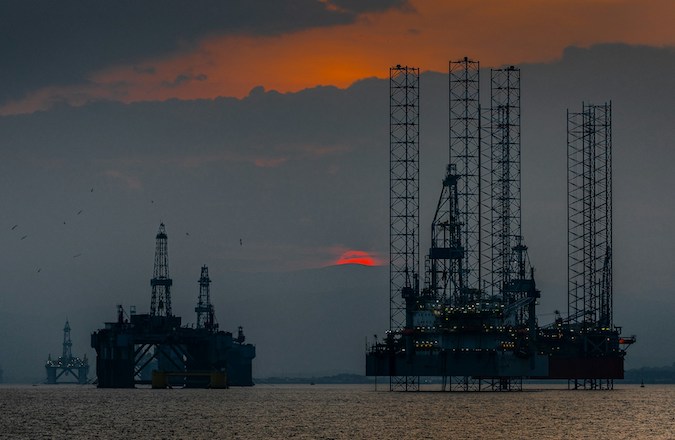
Figure 1: A group of oil rigs in the sea.
How is Carbon Capture Being Implemented?
The UK has significant plans for the implementation of carbon capture and pledges to capture and store 20-30 million tonnes of carbon dioxide (CO2) by the year 2030. In order to achieve the overall goal of net zero by 2050. Some of these projects include:
- Hynet- Hynet is looking to begin rapid industrial decarbonization by introducing carbon capture technology (CCS) into existing industry and at their hydrogen production plant in the North west.
- East coast cluster- The east coast cluster aims to implement CCS in the north east and Humber region . They aimed to begin implementing CCS infrastructure in mid-2025 with three initial projects (NZT Power, Hz Teesside, Teesside hydrogen CO2 capture) that are expected to be operational in 2028. Future expansion of this cluster is also expected, to allow for the transportation and storge of up to 23million stones of CO2 per year.
- Acorn project- Acorn will work with Scottish cluster to develop Scotland’s only advanced CO2 storage and transportation network . This will be implemented via the reuse of existing legacy oil and gas infrastructure to transport the CO2 from Scottish cluster to a storage facility in the north sea. This will specifically help Scotland achieve their goal of net zero by 2045.
- Viking cluster- The Viking cluster is aiming to be implemented in the Humber region in the UK. It will capture CO2 emissions from high emission industries at Immingham and the surrounding area and transport the CO2 via the Viking CCS pipeline which connects to an existing subsea pipeline that will transport the CO2 to depleted gas reservoirs in the north sea for storage.
What This Means ?
Carbon capture is an important step for the UK and its net zero goal. Carbon capture allows for the reduction of industrial CO2 emissions, in turn allowing the UK to slowly transition to greener methods of energy production without immediately stopping the current non net zero methods of energy production. These efforts will heavily contribute to the ongoing battle against climate change while new technology is being implemented.
About Pager Power
Pager Power undertakes technical assessments for developers of renewable energy projects and tall buildings worldwide. For more information about what we do, please get in touch.
References
Bandilla, K.W. (2020). Carbon Capture and Storage – an overview | ScienceDirect Topics. [online] www.sciencedirect.com. Available at:.https://www.sciencedirect.com/topics/earth-and-planetary-sciences/carbon-capture-and-storage.
eastcoastcluster.co.uk. (n.d.). East Coast Cluster. [online] Available at: https://eastcoastcluster.co.uk/.
Evero.energy. (2025). UK Net Zero Goals: Policy & Carbon Capture’s Role. [online] Available at: https://evero.energy/news/net-zero-uk [Accessed 28 Jul. 2025].
Pipeline, H.N.W.H. (2023). Home. [online] HyNet North West Hydrogen Pipeline. Available at: https://www.hynethydrogenpipeline.co.uk/.
The Acorn Project. (n.d.). The Acorn Project. [online] Available at: https://theacornproject.uk/.
UK Government (2025). UK Carbon capture, Usage and Storage (CCUS). [online] GOV.UK. Available at: https://www.gov.uk/government/collections/uk-carbon-capture-usage-and-storage-ccus.
Viking CCS. (n.d.). Viking CCS | Humber CCS | Carbon Capture and Storage. [online] Available at: https://www.vikingccs.co.uk/.
Image accreditation: Ben Wicks (2022) from Unsplash.com. Last accessed on 1st August 2025. Available at: https://unsplash.com/photos/a-group-of-oil-rigs-in-the-ocean-Ej2FQy1W7z4https://www.pagerpower.com/wp-content/uploads/2025/07/camerons-article-thumbnail.jpeg
post contents
About the Author: Cameron Sabouni

Latest News
US Continues to Build Out Solar Capacity
Earlier this month, the Solar Energy Industries Association (SEIA) released [...]
China’s Airborne Wind Turbines
In early 2026, China successfully developed an airborne wind turbine [...]
Shadow Flicker Assessments for Wind Turbines: A 2026 Update
Shadow flicker is the effect of rotating turbine blades, causing [...]