Understanding the Impact of Shadowing Solar Panels
If a shadow was cast over half of a solar panel, then only half the amount of sunlight will be reaching the panel, and therefore the energy output of the solar panel will be halved, right? Unfortunately, the physics is not so straightforward, and shadowing just a single cell in a solar panel could result in output losses of up to 80% [1].
How Shadowing Affects Solar Panel Performance
A solar panel is made up of a number of modules, and each module contains a number of cells. These cells (and often the modules as well) are connected in series, which is the main cause of the disproportionate output loss when a small part of the panel is in shadow. You may recall from your physics lessons that all components in a circuit connected in series must operate with the same current. Therefore, the component in a circuit with the weakest current input/output dictates the current of that circuit.
Why Even Partial Shadowing Can Lead to Significant Energy Loss
When a cell is shadowed, its output current is reduced because it is unable to push the same volume of electrons into the circuit. For further explanation on this, see ‘The First Photovoltaic Cell’. As such, all the other cells in that module are now operating at a lower current, and because the output voltage of a solar module is constant (for a given amount of sunlight), the overall output energy of the module is reduced. In more detail, the excess energy is dissipated in the shadowed cell as heat. The output loss is compounded if the modules in a solar panel are also connected in series.
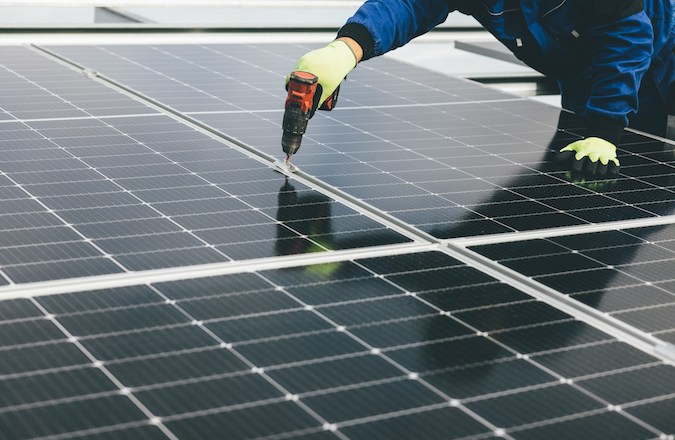
Figure 1: Solar Cells and Modules.
Shadowing Solar Panels and Energy Efficiency
So why connect the components of a solar panel in series? Confusingly, the reason is to increase efficiency. A circuit connected in series has the benefit of operating at a higher voltage than the same circuit connected in parallel. This is because, in a series circuit, the voltage of the components is cumulative, allowing a solar panel, and therefore the solar array/farm, to operate at a much higher voltage. Operating at a higher voltage is desirable for a developer as it reduces losses due to resistance (in the solar panels and the wires alike) and improves grid connectivity.
Optimising Solar Panel Layouts to Minimise Shadowing
Overall, overshadowing does not pose a major concern for most solar developers as most developments are built in open areas where shadowing is unlikely. Shadowing from the solar panels themselves can be partially mitigated through optimal panel layouts.
For smaller developments, such as rooftop solar installations, shadowing can pose more of an issue. Luckily, solar panels built with parallel circuits are available and are perfectly suitable as small developments don’t require access to the grid.
For small-scale solar installations, such as those on rooftops, the use of parallel circuits can help mitigate the impact of shadowing. These systems are less affected by shadowing, as the energy output from the shadowed cells doesn’t reduce the overall current for the rest of the panel. This makes them more suitable for areas where partial shadowing is more likely.
About Pager Power
Pager Power undertakes technical assessments for developers of renewable energy projects and tall buildings worldwide. For more information about what we do, please get in touch.
References
[1] “Avoid Solar Panel Shading: How To Minimize Its Impact”, Velo Solar, 13 June 2024.
(Online) Available: https://www.velosolar.com/solar-panel-shading/#:~:text=A%20static%20shaded%20module%20produces,a%20whopping%2050%2D80%25. [Accessed 15 November 2024].
Figure 1: Solar Cells and Modules, unsplash.com, 10 November 2022. (Online) Available: https://unsplash.com/photos/a-person-working-on-a-solar-panel-rNn_TU8dvoY [Accessed 15 November 2024]
post contents
About the Author: Jacob Cunningham

Latest News
US Continues to Build Out Solar Capacity
Earlier this month, the Solar Energy Industries Association (SEIA) released [...]
China’s Airborne Wind Turbines
In early 2026, China successfully developed an airborne wind turbine [...]
Shadow Flicker Assessments for Wind Turbines: A 2026 Update
Shadow flicker is the effect of rotating turbine blades, causing [...]