Sustainable Chocolate Series, Part 2
Following on from our previous article on the yummy topic of sustainable chocolate [1], guilt free chocolate is becoming more of a reality as scientists in Switzerland have invented a way to make chocolate healthier and more sustainable.
Chocolate is made from the Cocoa fruit and only cocoa beans and pulp are extracted for the chocolate we currently know and love, such as:
- Galaxy
- Cadbury
- Thorntons
- Hershey’s
- Lindt
- Guylian
- Milka
Cocoa Fruit Chocolate
Researchers at the ETH Zurich Federal Technology Institute have discovered that the cocoa pod husk can also be used, as a replacement for granulated sugar. [2] Their new recipe involves taking what’s known as the endocarp, the inner layer of the fruit shell, and mixing it with some of the pulp surrounding the beans to make a sweet cocoa jelly. This can then be used instead of granulated sugar to sweeten the chocolate to the taste we are all familiar with. This sweet cocoa jelly can also be dried out and ground into a powder, to form a chocolate sweetener. The Scientists spent a long time trying to perfect the new recipe in the lab with start-up Koa and Swiss chocolate manufacturer Felchlin. They wanted to get the taste to be as close to the traditional chocolate that our taste buds would recognise. They came to realise that too much sweet cocoa jelly made the consistency of the chocolate too lumpy and too little created a lack of sweetness. The new cocoa-fruit chocolate is healthier for us, according to the researchers, since it has a higher fibre content, reduced saturated fat percentage and less sugar.
This means that Cocoa farmers can now diversify their product offerings and make more money by utilising more of the fruit and in turn, creating a healthier, more sustainable chocolate product to sell. Traditionally, the shell/husk is used as fuel or composting material and the rest of the by products would go to waste.
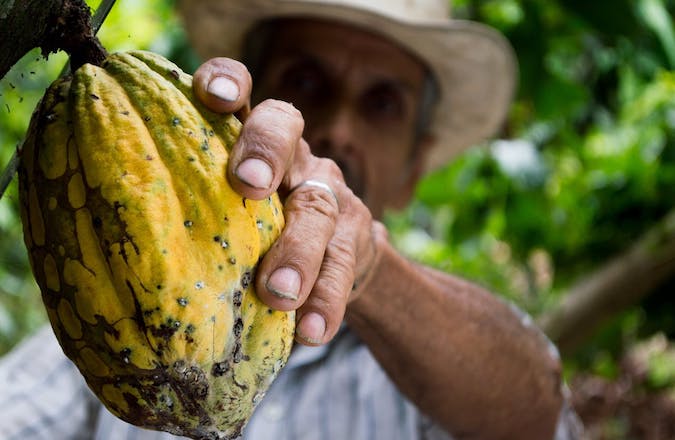
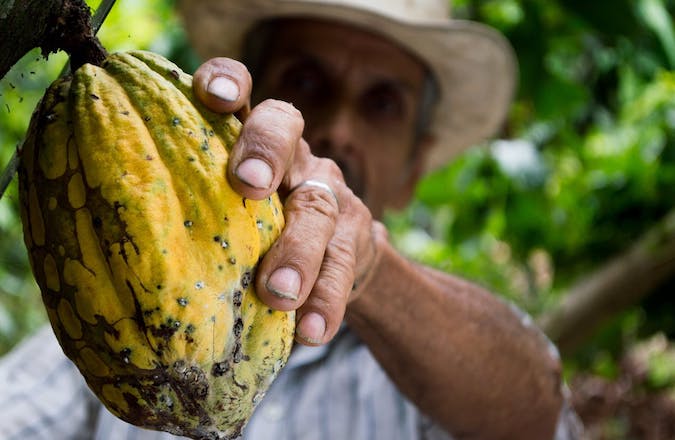
Figure 1: Image of a Farmer about to cut a Cocoa fruit from the tree. [3]
Lower Farming Impact
Land-use change from farming is responsible for over 70 per cent of environmental impacts for all chocolates, so by using fewer cocoa beans and therefore less land, the lab chocolate is linked to lower ‘farm impacts’. It does require more processing than the average European bar – with the heating up of the endocarp powder responsible for most of these ‘factory impacts’. But overall, the cocoa-fruit chocolate creation has a lighter carbon footprint when scaled up. You also must consider the time and energy used to create sugar to sweeten our usual chocolate in comparison to the endocarp powder.
“Cocoa-fruit chocolate can only be produced and sold on a large scale by chocolate producers once enough powder is produced by food processing companies.” But an important first step has been taken: ETH has filed a patent for its cocoa-fruit chocolate recipe. We could see ETH chocolate coming to our shelves in the next few years!
About Pager Power
Pager Power undertakes technical assessments for developers of renewable energy projects and tall buildings worldwide. For more information about what we do, please get in touch.
References
[1] https://www.pagerpower.com/news/did-i-hear-you-say-guilt-free-chocolate/
[3] Image of Farmer about to cut a Cocoa fruit from the tree. Image last accessed 20/06/2024. https://www.pexels.com/photo/man-picking-yellow-cocoa-fruit-50707/ Photo credit: Pixabay.
post contents
About the Author: Georgia Low

Latest News
US Continues to Build Out Solar Capacity
Earlier this month, the Solar Energy Industries Association (SEIA) released [...]

China’s Airborne Wind Turbines
In early 2026, China successfully developed an airborne wind turbine [...]
Shadow Flicker Assessments for Wind Turbines: A 2026 Update
Shadow flicker is the effect of rotating turbine blades, causing [...]