Solar Trees: An Artistic Approach to Overcoming Urban Planning Restrictions?
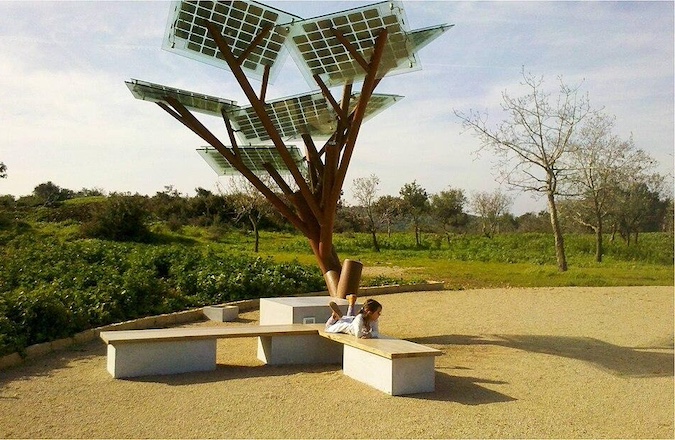
As the United Kingdom works toward its Net Zero 2050 goals, the need for solar photovoltaic (PV) infrastructure has expanded beyond rural fields and industrial rooftops to the “built environment.” However, the necessity for high renewable yields, constrained ground space, and strict aesthetic design criteria frequently provide a dilemma for urban developers. Solar trees, which are vertical PV structures inspired by biology, have become an attractive answer to these problems. Although solar trees are sometimes written off as “eco-art,” their technical reality indicates that they are becoming an essential instrument for optimising energy density in developments with limited space.
The Science of Verticality: Efficiency and Biology
Solar trees use a “phyllotaxy” arrangement, which is the spiral pattern of leaves on a plant stem, in contrast to conventional flat-plate panels. According to research, placing panels in Fibonacci sequences, can increase annual energy generation by optimising the angular layout to catch sunlight at different solar altitudes throughout the day.
One of the most significant benefits for developers is increased land use efficiency. For every megawatt (MW) of capacity, conventional ground-mounted solar farms usually need three to four acres. Solar trees, on the other hand, can occupy as little as 1% of the land footprint required by traditional systems to generate equivalent generation, thanks to a vertical “trunk” that reduces ground-level interference. This makes them excellent for multi-use settings like parking lots, where they can provide shade and EV charging without affecting parking capacity.
Environmental Symbiosis: Microclimates and Urban Heat Islands
The capacity of solar trees to reduce the Urban Heat Island (UHI) effect is a significant benefit over conventional ground-cover PV. Traditional solar arrays, which replace plants with dark, heat-absorbing surfaces, can sometimes contribute to localised warming. On the other hand, solar trees offer high shade, which considerably lowers the “mean radiant temperature” of the ground below.
This “solar shading” is crucial for public spaces and pedestrianised areas from a planning standpoint. Solar trees can lower ground temperatures by up to 10°C by absorbing solar radiation before it reaches paved surfaces. This reduces the cooling demand for nearby buildings and enhances the “thermal comfort” of outdoor areas. By serving as both a power plant and an environmental cooling system, this dual function enables developers to tick a number of Sustainability Impact Assessment boxes that a typical rooftop array just cannot.
Navigating Structural and Environmental Constraints
The “tree” design needs to take substantial structural stresses into consideration in addition to aesthetics. Solar trees, in contrast to roof-mounted panels, are subject to severe wind loads on their “branches,” requiring sturdy foundation designs like deep pilings or ground screws. The “Terra” Sustainability Pavilion at the Dubai Expo, which included 18 “Energy Trees” in addition to a main canopy, is a noteworthy case study. These revolving trees were intended to produce 2.6 GWh of electricity per year, proving that vertical PV can supply a sizable amount of a site’s energy requirements when included into a larger architectural concept.
Conclusion
Solar trees are an example of how renewable technology and architectural requirement may coexist. The value they bring in terms of land preservation, public participation, and planning viability in sensitive regions is significant, even though their “cost per watt” is still higher than that of conventional utility-scale solar. Early technological due diligence is crucial for developers to ensure that a solar tree’s sculptural beauty doesn’t lead to unexpected shine, glare, or safety concerns.
About Pager Power
Pager Power undertakes technical assessments for developers of renewable energy projects and tall buildings worldwide.
For more information about what we do, please get in touch.
References
[1] Ukpanah, I. (2025) Solar trees: The future of green energy, GreenMatch. Available at: https://www.greenmatch.co.uk/blog/solar-trees [2] Oranus78 (2016) eTree in Israel. Available at: https://commons.wikimedia.org/wiki/File:ETree_3.jpg [3] Gonçalves de Bem, L. et al. (2022) ‘Solar Photovoltaic Tree Multi Aspects Analysis − A Review’, Renewable Energy and Environmental Sustainability, 7, p. 26. doi:10.1051/rees/2022014. [4] Bolinger, M. and Bolinger, G. (2022) ‘Land Requirements for Utility-Scale PV: An Empirical Update on Power and Energy Density’, IEEE Journal of Photovoltaics, 12(2), pp. 582-588. [5] Taleghani, M. (2018) ‘Outdoor thermal comfort by different heat mitigation strategies: A review’, Renewable and Sustainable Energy Reviews, 81, pp. 2011-2018. [6] Middle East Institute (2022) Solar Shading and Urban Cooling: Technical Brief. Available at: https://www.mei.edu/publications/ [7] GreenLancer (2025) Overcoming Utility Solar Design & Engineering Challenges. Available at: https://www.greenlancer.com/post/utility-solar-design [8] Grimshaw (2021) Terra – The Sustainability Pavilion Expo 2020 Dubai: Case Study. Available at: https://grimshaw.global/sustainability/
post contents
About the Author: Rosie Stammers

Latest News
US Continues to Build Out Solar Capacity
Earlier this month, the Solar Energy Industries Association (SEIA) released [...]
China’s Airborne Wind Turbines
In early 2026, China successfully developed an airborne wind turbine [...]
Shadow Flicker Assessments for Wind Turbines: A 2026 Update
Shadow flicker is the effect of rotating turbine blades, causing [...]