Shadow Flicker Assessments for Wind Turbines: A 2026 Update
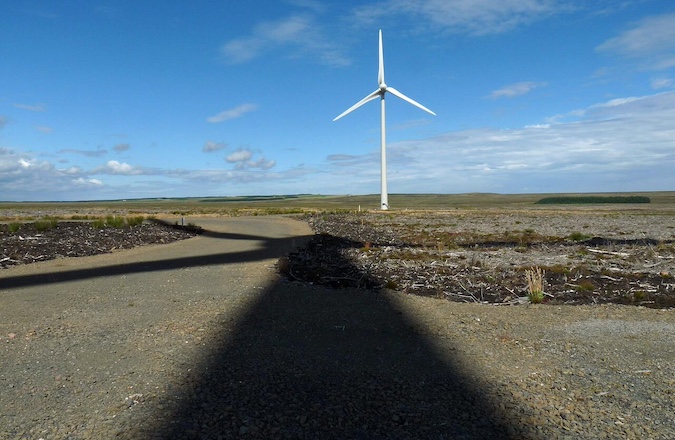
Shadow flicker is the effect of rotating turbine blades, causing brightness levels to vary periodically at locations where they obstruct the Sun’s rays. It can only occur when specific conditions are met, i.e. when the Sun is low in the sky, the sky is clear, and the turbine is operational and rotating in a particular direction relative to the location of the Sun and a receptor. This effect can be a cause of annoyance at dwellings, places of work, or any sensitive building development near wind developments. Figure 1 below shows a photograph of a wind turbine blade obstructing the Sun. This scenario can give rise to shadow flicker impacts if experienced through a window, or similar.
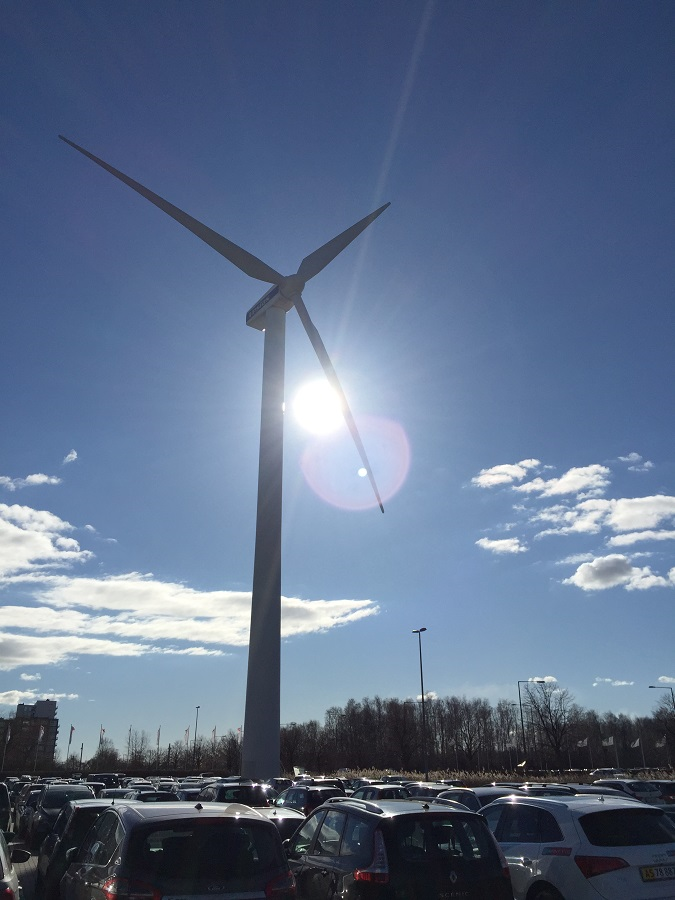
Figure 1: Wind turbine obstructing the Sun
Is Shadow Flicker a Real Problem?
To some, this may not seem like a big problem, particularly if it only occurs for short amounts of the day/year. Nevertheless, shadow flicker is a genuine technical planning constraint that must be assessed appropriately, with impacts leading to amenity issues or worse. Three ways shadow flicker can make life difficult for a wind developer are:
- It can be one of a number of reasons for opposition by local residents and stakeholders due to the potential for disturbances or even health risk issues (although the latter has little or no evidence to support it), unless it is managed appropriately.
- The planning authority may apply a condition that relates to shadow flicker, to ensure it has been assessed correctly and will be mitigated as necessary for a certain period of time after a development is built.
- Post-construction complaints over shadow flicker can arise if the issue has been ignored, leading to a requirement for retrospective assessment and mitigation. This may lead to unplanned shutdown times that were not previously accounted for to adhere to guidance limits.
Figure 2 below shows a video highlighting how shadow flicker effects may materialise. Note this is an external view, whereas shadow flicker effects are experienced internally.
Figure 2: Real-world shadow flicker effects
How are Shadow Flicker Impacts Assessed?
The good news is that shadow flicker effects can be readily predicted by modelling known geometry. Modelling needs to consider the path of the Sun at the turbine location, the size and dimensions of a turbine, the receptor locations and the terrain data for the area. This allows us to determine where, when and for how long effects will take place. The outputs can be used to refine and adjust turbine layout, or to specify turbine shutdowns to comply with guidance limits. Figure 3 below shows an example of modelling output at a given receptor.
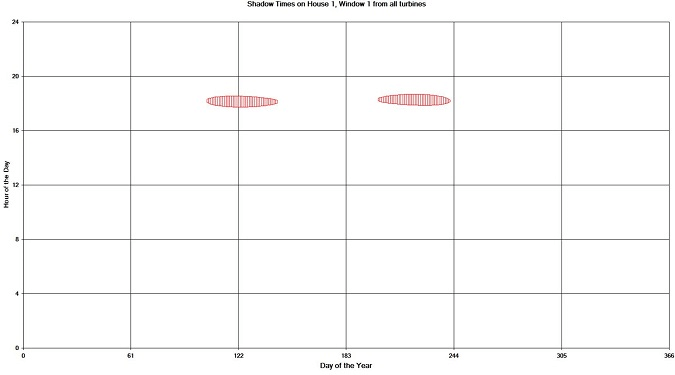
Figure 3: Example modelling output
In this example, it can be seen that effects are predicted around 18:00-19:00 for parts of April/May and July/August.
How Much Shadow Flicker Is Too Much?
This is somewhat of a grey area, but there is some national guidance that states what needs to be considered and the limits that need to be met [1],[2]. The typical limit is 30 minutes per day or 30 hours per year. However, these limits are not set in stone, and guidance can vary from country to country and even from different planning authorities. There have been historical references to the requirement to completely eliminate shadow flicker in the Republic of Ireland[3]; however, a final version of this guidance is awaiting publication, and it remains the case that the limits quoted above are routinely followed (more information on this guidance can be found here). It is, however, essential that the required shadow flicker limits are known to avoid costly delays.
The best approach is to quantify the effects and understand the impacts relative to the local guidance in order to address the issue responsibly. Pager Power’s best practice approach (in the absence of any guidance) is to consider the limits of 30 minutes per day or 30 hours per year of shadow flicker, out to 10 rotor diameters from the wind turbine in the absence of any mitigating factors, however we can change the assessment parameters based on local requirements if needed.
How can Shadow Flicker be Mitigated?
The most practical solutions to shadow flicker issues are set out below. The best strategy will depend on the constraints for each individual development.
- Shut down the offending turbine(s) during the periods where shadow flicker effects can occur above the reference limits.
- Design the development to minimise potential effects – usually by adjusting turbine size or position.
- Provide screening to limit the view of the offending turbine(s) from affected windows.
Recommendation
It is advisable to consider shadow flicker effects as early in the project timeline as possible, especially when it is clear dwellings, or other key receptors, are located in close proximity to the wind development. This allows the issues to be understood ahead of time and also maximises potential mitigation options at the design phase.
Speak to an Expert
Pager Power has extensive experience dealing with shadow flicker issues, before and after objections are received.
We have completed detailed Shadow Flicker Assessments and Environmental Chapters for developments in Britain, Ireland and further afield as part of the planning process. We have also designed shutdown schemes for developments where impacts have been predicted, and these have then served as mitigation to avoid adverse effects.
If you would like to receive advice on shadow flicker impacts for your project, or to receive a quote for an assessment, please make an enquiry or give us a call on +44 (0)1787 319 001.
About Pager Power
Pager Power is a dedicated technical consultancy that has been providing independent guidance and advice regarding solar, wind, and building developments internationally since 2002.
Pager Power has completed over 1,800 glint and glare assessments, over 1,000 aviation, radar and safeguarding assessments, and over 1,000 telecommunications assessments, including the assessment of point-to-point link infrastructure, and television, mobile phone, and radio reception surveys. Pager Power is a truly international technical planning consultancy, having worked in over 60 countries.
References
1 Update of UK Shadow Flicker Evidence Base, Parsons Brinckerhoff (2011)
2 Renewable and low carbon energy. Ministry of Housing, Communities and Local Government, (August 2023)
3 Draft Revised Wind Energy Development Guidelines December 2019. Department of Housing, Local Government and Heritage (2019)
Image accreditation: Wind Turbine Shadow (2017) Gepograph Britain and Ireland. Last accessed on 16th March 2026. Available at: https://commons.wikimedia.org/wiki/File:Wind_turbine_shadow,_Stroupster_Wind_Farm,_Caithness_-_geograph.org.uk_-_5484170.jpg
post contents
About the Author: Danny Scrivener

Latest News
US Continues to Build Out Solar Capacity
Earlier this month, the Solar Energy Industries Association (SEIA) released [...]
China’s Airborne Wind Turbines
In early 2026, China successfully developed an airborne wind turbine [...]
Shadow Flicker Assessments for Wind Turbines: A 2026 Update
Shadow flicker is the effect of rotating turbine blades, causing [...]