Building Developments: Do Solar Reflections from Building Façades Present a Safety Hazard?

In our day-to-day lives we experience and observe many reflections of the Sun from a variety of different surfaces in our surrounding environment. From shop windows to car bodywork, or even from our mobile phone screens, many surfaces produce reflections which can redirect sunlight in unwanted ways.
A lot of the time, these are just annoyances rather than safety issues, however, what if the solar reflection became a genuine problem that could endanger people or damage property? To help answer this question, we present a brief overview of reflection types and case studies where solar reflections have become a problem.
Reflection Types: Specular and Diffuse
It is first important to distinguish between the two types of reflection that can occur: specular and diffuse. The difference between the two can be seen in Figure 1 below, taken from the Federal Aviation Administration’s (FAA) “Technical Guidance for Evaluating Selected Solar Technologies on Airports”.
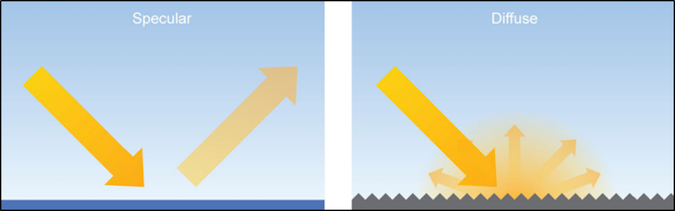
Figure 1 Diagram of specular and diffuse reflections.
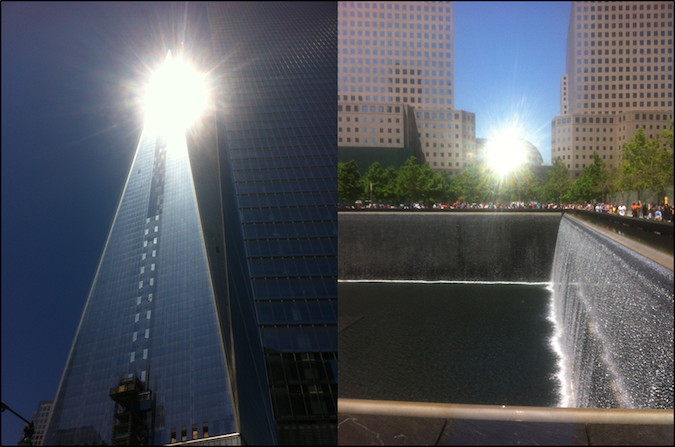
Based on the surface conditions, light reflections can either be specular or diffuse. A specular reflection has a characteristic similar to that of a mirror, where incoming light is reflected in a particular direction, whilst diffuse reflections scatter the light in many directions. The images below show real life examples of specular reflections from two buildings in New York.
Case Studies
Solar reflections that are specular in their nature (or ‘glint and glare’) are most likely to be deemed a nuisance or hazard to safety. Presented below are some famous examples where issues have been raised regarding specular solar reflections from buildings.
The Shard in London, England
The Shard in London, designed in a pyramid-like shape and measuring over 300m tall, has large glass façades angled upwards. This design, coupled with its location next to the railway line into London Bridge train station, created glare impacts for trains approaching the station at particular times of the day. It is understood that the glare was mitigated through operational changes that were implemented by the train operators.
The Vdara Hotel in Las Vegas, USA
The glass design of the Vdara Hotel in Las Vegas produced glare that left guests with burns and melted plastic bags! The reflective properties of the concave glass façade concentrated the Sun’s rays towards a small area around the poolside. This impact was mitigated primarily by applying a non-reflective coating to the glass, as well as increasing the level of shade on the ground.
20 Fenchurch Street in London, England
The well-known ‘Walkie-Talkie’ building was a unique addition to the London skyline when it was first unveiled in 2015. However, it was soon discovered that the building produced a similar impact to that of the Vdara Hotel, and concentrated the Sun’s rays, melting a car and a nearby bicycle. The building has since had its glass façade covered to prevent this from occurring.
The Museum Tower in Dallas, USA
The residential tower encountered controversy after the building’s glass façade redirected solar reflections toward the Nasher Sculpture Centre. It is claimed that the glare produced was so intense that the artwork was melted. Certain sections of the exhibit were also closed to the public for safety.
Conclusions
In two of the case studies (The Vdara Hotel and 20 Fenchurch Street), the building’s concave design meant that the solar reflections were a hazard to safety because the incoming light was reflected and concentrated in a particular direction. However, the other two case studies (The Shard and The Museum Tower) demonstrate that solar reflections from buildings with non-concave façades can also create problems. These developments both comprise large areas of materials capable of producing specular solar reflections toward sensitive locations.
As the examples reveal, solar reflections from structures have the potential to negatively impact the surrounding environment, and can have impacts upon amenity, or worse, affect public safety. Whilst reflections from buildings are not always an issue, it is worthwhile examining a proposed building development to understand whether reflections of the Sun may create an unwanted problem post-construction.
Our Experience
We have extensive experience assessing the potential impact of solar reflections from proposed building developments, whether it be for glass façades or other materials capable of producing specular reflections.
Based upon our experience, an assessment may be requested wherever there is a possibility that solar reflections could cause safety concerns for surrounding receptors, e.g. railway or aviation infrastructure. The developments in question are most often large structures with glass façades that have the potential to reflect incoming light.
Speak to an Expert
For more information regarding our glare consultancy services, click here.
If you would like to discuss a particular project or need more information regarding glint and glare, follow this link to make an enquiry. Alternatively, we would be more than happy to have a discussion with you over the phone on +44 (0)1787 319001.
About Pager Power
Pager Power is a dedicated technical consultancy that has been providing independent guidance and advice regarding solar, wind, and building developments internationally since 2002.
Pager Power has completed over 1,800 glint and glare assessments, over 1,000 aviation, radar and safeguarding assessments, and over 1,000 telecommunications assessments, including the assessment of point-to-point link infrastructure, and television, mobile phone, and radio reception surveys. Pager Power is a truly international technical planning consultancy, having worked in over 60 countries.
Image accreditation:
Figure 1: Image originally found in Chapter 3, page 39 of “Technical Guidance for Evaluating Selected Solar Technologies on Airports” by FAA, November 2010.
Feature image: Juan Castro (February 2023) found on Unsplash.com+. Last accessed on 26th January 2026. Available at: https://unsplash.com/photos/a-very-tall-building-with-a-lot-of-windows-xRYP1uPhCCo
post contents
About the Author: Danny Scrivener

Latest News
US Continues to Build Out Solar Capacity
Earlier this month, the Solar Energy Industries Association (SEIA) released [...]
China’s Airborne Wind Turbines
In early 2026, China successfully developed an airborne wind turbine [...]
Shadow Flicker Assessments for Wind Turbines: A 2026 Update
Shadow flicker is the effect of rotating turbine blades, causing [...]