Cosmic Chaos: How Solar Storms Disrupt Energy Storage and Communication
When we think about the weather, we usually picture thunderstorms, snowy landscapes, or a sunny day at the beach. But there’s another kind of weather that affects us all, even though we can’t see it and it happens way up in space. This type of space weather is caused by the Sun’s activities. One spectacular manifestation of space weather are auroras, with their dancing ribbons of light displays. You might also have seen reports about Auroras sighted over the UK during the last couple of weeks. While these natural phenomena are breathtaking, they are tied to powerful forces that can have a surprising impact on our energy storage systems and communication.
Space Weather
Space weather is a branch of physics that deals with the varying conditions within the solar system and its heliosphere and its effects on the Earth’s atmosphere and magnetosphere [1]. This includes:
Solar Flares: Sudden and large eruptions of electromagnetic radiation due to the re-organization of magnetic field lines on the Sun’s surface [2].
Solar Winds: Continuous stream of plasma particles from the sun.
Coronal Mass Ejections (CMEs): Explosive release of clouds of plasma and magnetic field from the Sun’s corona [3].
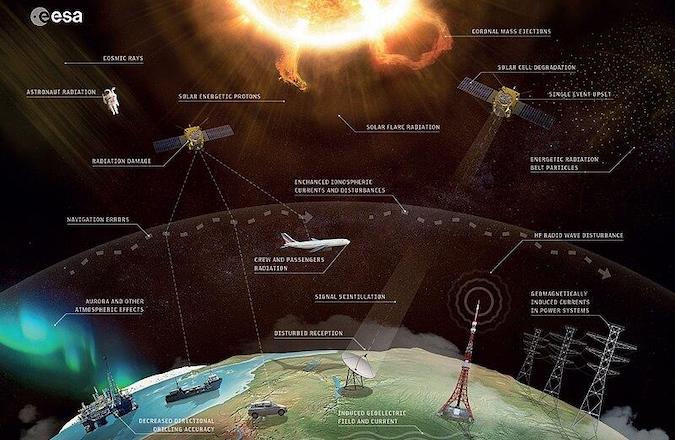
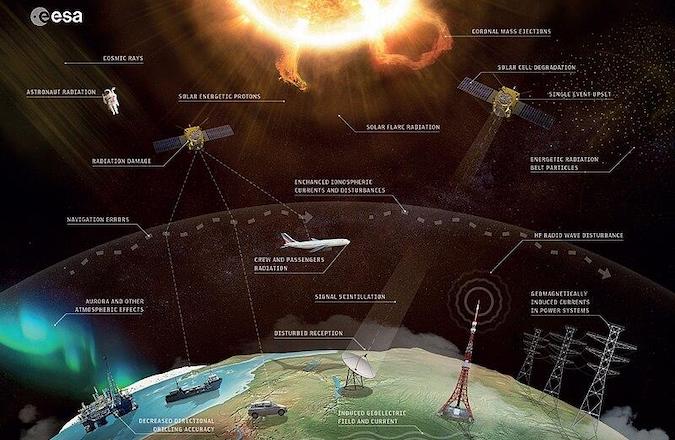
Figure 1: Space weather. [4]
Geomagnetic Disruptions
The most visible effect of space weather is the aurora, which you might know as the northern lights (aurora borealis) or the southern lights (aurora australis). Auroras occur when charged particles from the solar wind collide with atoms and molecules in Earth’s atmosphere. These collisions excite the atmospheric gases, causing them to emit light in various colours. The occurrence of auroras is most frequent in regions near the Earth’s magnetic poles, where the magnetic field lines converge and guide charged particles into the atmosphere.
These charged particles ejected by the Sun interact with Earth’s magnetic field, they create disturbances called geomagnetic storms. These storms can cause a range of effects on our planet, including disruptions to satellite communications, GPS systems, and even power grids [5].
“Solar events like the Aurora Borealis are created by what we call geomagnetic storms, which are caused by solar flare activity and solar winds. When that hits the atmosphere, it creates electromagnetic disruptions, which in turn affect the power grid,” says Dr. Paul Moses from the University of Oklahoma [6].
The severe geomagnetic storms can induce currents in power lines. These geomagnetically induced currents (GIC) could potentially damage inverters and transformers via overheating and cause temporary voltage instability or also lead to widespread blackouts [7] [8]. Space weather also affects satellite communications, High-Frequency (HF) radio communications for long-distance aircraft and global navigation systems [9].
Picture this: you’re on a flight, and out of nowhere, the plane’s HF communications cut out for hours. Pilots have to scramble to use backup methods or reroute the flight, leading to delays and higher fuel consumption. GPS signals can have degraded accuracy or disappear altogether, making navigation a real challenge, especially in remote areas or over oceans where there are few alternative navigation aids.
There are ways to mitigate the impacts caused by geomagnetic storms. For example, surge protectors can be installed in solar farms to avoid voltage spikes caused by geomagnetic storms. The effect of space weather on the energy grid can also be reduced through decentralised or distributed energy storage systems and infrastructure hardening [10]. The National Oceanic and Atmospheric Administration (NOAA) has introduced a scale as a way to communicate the space weather conditions and their possible effects with the general public [11]. In addition to changing flight routes and communication protocols, these forecasts help airlines prepare for potential disruptions. Space weather is a challenge not only to our energy infrastructure but also to our skies and this can only be addressed through continued research and technological advancements.
Definitions:
Heliosphere: It comprises of magnetosphere, Stellar-wind bubble and Sun’s Corona.
Magnetosphere: Magnetic field surrounding an astronomical object.
Stellar Wind Bubble: Cavity-like structure filled with hot gas that was ejected from the star by high velocity stellar winds.
Corona: Outermost part of the Sun’s atmosphere.
Plasma: It is the fourth state of matter comprising of charged particles.
About Pager Power
Pager Power undertakes technical assessments for developers of renewable energy projects and tall buildings worldwide. For more information about what we do, please get in touch.
References
[1] R. Schwenn, ‘Space Weather: The Solar Perspective’, Living Rev. Sol. Phys., vol. 3, no. 1, p. 2, Dec. 2006, doi: 10.12942/lrsp-2006-2.
[2] ‘What are solar flares?’ Accessed: Aug. 13, 2024. [Online]. Available: https://www.esa.int/Science_Exploration/Space_Science/What_are_solar_flares
[3] ‘Coronal Mass Ejections | NOAA / NWS Space Weather Prediction Center’. Accessed: Aug. 13, 2024. [Online]. Available: https://www.swpc.noaa.gov/phenomena/coronal-mass-ejections
[4] ESA/Science Office, CC BY-SA IGO 3.0, CC BY-SA 3.0 IGO <https://creativecommons.org/licenses/by-sa/3.0/igo/deed.en>, via Wikimedia Commons. Last accessed on 14th August 2024.
[5] ‘67-68[1].pdf’. Accessed: Aug. 13, 2024. [Online]. Available: https://nora.nerc.ac.uk/id/eprint/17403/1/67-68[1].pdf
[6] C. Julian, ‘How could the Aurora Borealis affect energy grids when renewables are added to the mix?’ Accessed: Aug. 13, 2024. [Online]. Available: http://www.ou.edu/research-norman/news-events/2023/how-could-the-aurora-borealis-affect-energy-grids-when-renewables-are-added-to-the-mix.html
[7] R. Fritts and A. G. Union, ‘Protecting power grids from space weather’. Accessed: Aug. 13, 2024. [Online]. Available: https://phys.org/news/2023-12-power-grids-space-weather.html
[8] D. H. Boteler, ‘Space Weather Effects on Power Systems’, in Space Weather, American Geophysical Union (AGU), 2001, pp. 347–352. doi: 10.1029/GM125p0347.
[9] ‘space_weather_full_report_final.pdf’. Accessed: Aug. 13, 2024. [Online]. Available: https://raeng.org.uk/media/lz2fs5ql/space_weather_full_report_final.pdf
[10] ‘Space Weather Preparedness Strategy’.
[11] ‘NOAA Space Weather Scales | NOAA / NWS Space Weather Prediction Center’. Accessed: Aug. 13, 2024. [Online]. Available: https://www.swpc.noaa.gov/noaa-scales-explanation
post contents
About the Author: Vijayatha Vijayaraghavan

Latest News
US Continues to Build Out Solar Capacity
Earlier this month, the Solar Energy Industries Association (SEIA) released [...]
China’s Airborne Wind Turbines
In early 2026, China successfully developed an airborne wind turbine [...]
Shadow Flicker Assessments for Wind Turbines: A 2026 Update
Shadow flicker is the effect of rotating turbine blades, causing [...]