The Future of the Strategic Raw Material: Phosphate
Most people are, at the very least, aware of what a solar panel is. By drawing in the preexisting energy given off by the sun, the panels convert that energy into electricity [1].
But not so many people are aware that there is an important raw material called phosphorus used within a solar panel along with boron and silicon.
In line with the Critical Raw Materials Act 2023, phosphorus has been listed as a strategic critical raw material (CRM) by the European Commission. The 2023 fifth list of 34 CRMs also included 6 other strategic raw materials including arsenic, coking coal, feldspar, lithium, and manganese [2].
Earlier this year, scientists warned of a “phosphogeddon” as supplies grew to an all-time low and any discoveries of the CRM are crucial ‘…to put it simply, there is no life on Earth without phosphorus,’ says Professor Penny Johnes, who teaches biochemistry at the University of Bristol [3].
Reliable and unhindered access to certain raw materials is a growing concern within the EU and across the globe, so when discoveries are made of said materials, there are hopeful estimates regarding the time scales strategic raw materials will be available for and how long they can serve in their relative fields of function such as food and plant fertiliser and solar panels.
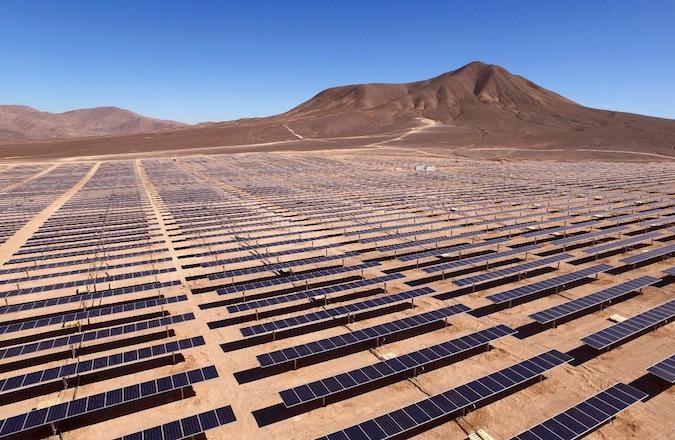
Figure 1: Landscape Photography of Blue Solar Panels in Región de Antofagasta, Chile.
A recent example of a large discovery of phosphorus was in Norway, May 2023, a mining company called Norge Mining discovered a huge deposit of the valuable mineral. Norge Mining say there are up to 70 billion tonnes of phosphorus present in their discovery, which is enough to meet demand for the next 50 years [4].
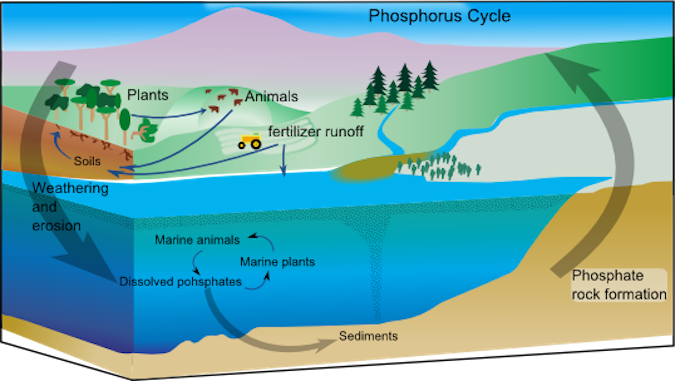
Figure 2: Phosphorus Cycle Diagram.
The Phosphorus Demand
Every year approximately 50 million tonnes of phosphate supplies are sold to play a role in feeding our population of 8 billion and counting.
Nearly all the phosphorus that farmers use today—and that we consume in the food we eat—is mined from a few sources of phosphate rock, mainly in the United States, China, and Morocco. By some estimates, those could run out in as little as 50 to 100 years.
In 2012, The Hague issued a report warning of upcoming phosphate shortages. Russia controls the biggest deposit of the chemical compound, but imports have been curbed since the Ukraine invasion [5]. Morocco, China, Iran and Syria also have large deposits of the material, but the war has still had an impact, realised through rising fertiliser costs.
Conclusion
Although the growing concerns for phosphorus shortages in years to come are worrying, there are ways in which the nutrient can be recycled from wastewater using chemical or bio-based technologies.
Today phosphate is mostly obtained from mined phosphate rock, but natural reserves of phosphate rock are concentrated in a limited number of countries. The leakage of phosphate-containing fertilisers, detergents and sewage into water bodies is causing irreversible eutrophication problems [6].
Presently, the recovery and reuse of phosphorus are still far from being a mainstream practice. Yet, the techniques already accepted and applied differ by the origin of the used matter (wastewater, sludge, ash) and are mainly focused on the process of precipitation.
In other words, discharges of phosphorus-rich effluent have triggered large-scale contamination of water and created harmful levels of cyanobacteria in rivers, lakes, and seas that generates a chemical 80 times more potent than carbon dioxide at warming the atmosphere when it decays [3].
To help combat this, scientists stress that we must find a better means of recycling the nutrient and ensure there is a societal shift towards healthy diets with low phosphorus footprints as soon as possible.
‘We might be able to turn back, but we have really got to pull ourselves together and be an awful lot smarter in the way we use phosphorus. If we don’t, we face a phosphogeddon.’ Says Professor Phil Haygarth of Lancaster University.
About Pager Power
Pager Power undertakes technical assessments for developers of renewable energy projects and tall buildings worldwide. For more information about what we do, please get in touch.
References
[1] https://www.tomorrowsworldtoday.com/2018/07/27/the-surprisingly-simple-science-behind-solar-panels/
[3] https://thred.com/change/why-are-scientists-warning-of-a-phosphogeddon/
[4]https://www.bbc.co.uk/newsround/66099273
Photos:
[1] Antonio Garcia (August 2017) from Unsplash. Accessed on: July 2023. Available at: https://unsplash.com/photos/ndz_u1_tFZo
[2] Bonniemf Incorporates work from NASA Earth Science Enterprise (November 2013) from WikiCommons. Accessed on August 2023. Available at: https://commons.wikimedia.org/wiki/File:Phosphorus_cycle.png
post contents
About the Author: Gabby Rush

Latest News
US Continues to Build Out Solar Capacity
Earlier this month, the Solar Energy Industries Association (SEIA) released [...]

China’s Airborne Wind Turbines
In early 2026, China successfully developed an airborne wind turbine [...]
Shadow Flicker Assessments for Wind Turbines: A 2026 Update
Shadow flicker is the effect of rotating turbine blades, causing [...]