Could We Be On The Brink Of Solving Our Plastic Problem?
Plastic, we love the stuff. From food packaging to drinks bottles, cutlery, toys and Tupperware, plastic seems to be all around us. Every day, all of us will use, dispose of, and come into contact with some sort of plastics. It can make life easier and more convenient in a lot of ways. In other ways it has hugely helped to save lives; or instance plastic medical equipment, such as IV tubes, catheters, syringes, and blood bags amongst many more.
Why is Plastic Such a Big Problem?
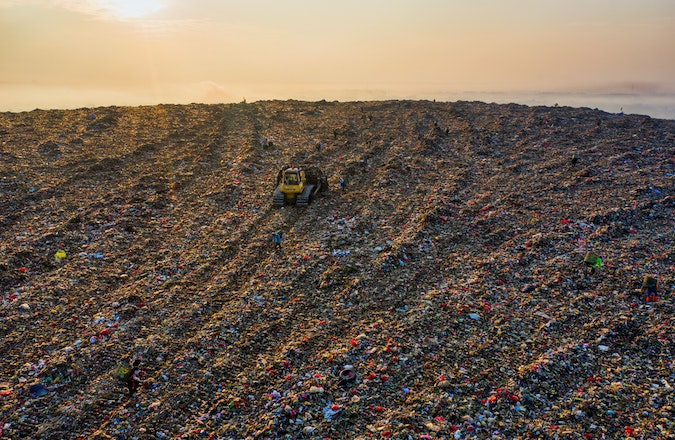
The majority of the plastics listed above are single use plastics, meaning that after they have been used once, they are disposed of. This is where the biggest problem lies. Some plastics can take over 1,000 years to breakdown, therefore landfills are filling up with waste that takes too long to decompose and causes landfills to overflow. Waste like this then blows around and ends up polluting other areas like the oceans.
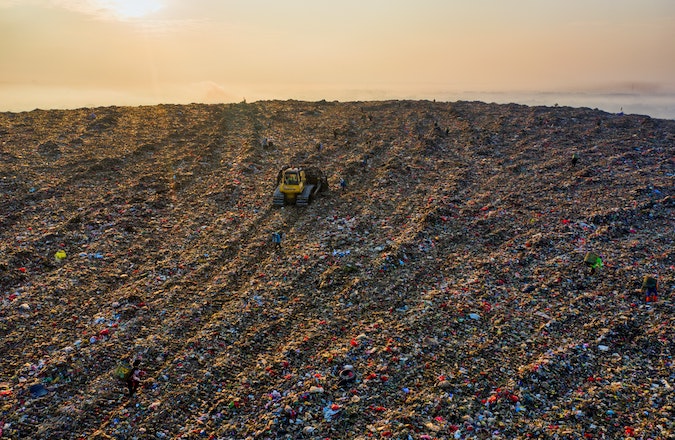
Figure 1: Aerial view of an overflowing landfill site. [1]
How Did Covid-19 Affect the Usage of Plastic?
When the Covid-19 pandemic hit, it was vital that everything was sterile and decontaminated to prevent the spread of Covid-19. This meant that a lot of single use plastics were introduced. Medical staff changing and disposing of PPE (Personal Protective Equipment) after every use, Covid-19 LFT (Lateral Flow Tests) and PCR (Polymerase Chain Reaction) tests were all filled with plastic parts, and whilst this helped to keep it all sterile, it was more single use plastic being disposed of. Not to mention the billions of single use face masks that were used and disposed of daily.
Plastic Facts From the National Geographic Website
- Less than a fifth of all plastic is recycled globally.
- Plastic recycling rates are highest in Europe at 30%. China’s rate is 25% whilst the United States recycles just 9% of its plastic waste.
- 40% of plastic produced is packaging, which is used just once and then discarded.
- Around 18 billion pounds of plastic waste flows into the oceans every year from coastal regions.
- Plastic bottles can take about 450 years to decompose in landfill.
- It takes around 1,000 years for a single plastic bag to degrade in a landfill. Unfortunately, these bags don’t break down completely but instead photo-degrade, becoming microplastics that absorb toxins and continue to pollute the environment. [2]
We are making, using, and discarding plastic much quicker than it takes to decompose and it is building up, polluting the environment. Sea creatures get caught up in plastics in the oceans, such as fishing lines. Other animals mistake plastics for food and choke on them or ingest so much plastic they die. Microplastic pollution has now been detected in human blood, which can only mean that we are consuming plastics somewhere down the line without knowing, most likely from drinking water.
What Happens to the Plastic we do Recycle?
In the best cases, they will be cleaned and either shredded into flakes or melt-processed to form pellets. These can then be moulded into new products such as water bottles. However, sadly, a lot of UK plastic recycling is still exported abroad. It can be difficult to track what happens to the exported plastic, but it seems it is mostly sent to landfill or burnt; both of which release toxins and harmful gases into the atmosphere.
Is There a Light at the End of the Tunnel?
Researchers at the University of Texas at Austin Cockrell School of Engineering and College of Natural Sciences started a project that focuses on polyethylene terephthalate (PET), a significant polymer found in most consumer packaging, including drinks bottles, fruit and vegetable packaging, and certain fibres and textiles. PET plastic makes up for around 12% of all global waste.
The Researchers used a machine learning model to generate novel mutations to a natural enzyme called PETase that allows bacteria to degrade PET plastics. The model predicts which mutations in these enzymes would accomplish the goal of quickly depolymerizing post-consumer waste plastic at low temperatures.
They studied 51 different post-consumer plastic containers, 5 different polyester fibres/fabrics and water bottles all made from PET plastic. The researchers were able to prove the effectiveness of the enzyme, which they have called FAST-PETase (functional, active, stable, and tolerant PETase).
The enzyme was able to complete a “circular process” of breaking down the plastic into smaller parts and then chemically put it back together. Some of these plastics were fully broken down to monomers in as little as 24 hours. [3] Comparing that to as long as 1,000 years to break down, this enzyme could drastically reduce the amount of plastic in landfills taking too long to breakdown and piling up rapidly.
To Conclude
Although this new enzyme is a massive break through, we are still a long way off from clearing our landfills and oceans of post-consumer single use plastics. We would need to mass produce this enzyme to drastically reduce our PET plastic waste.
What Can You do to Help?
- Reduce the amount of single use plastics you buy.
- Recycle all plastics that can be recycled.
- Responsibly dispose of waste that cannot be recycled.
- Try to re-use multi-use shopping bags such as bags for life, hessian bags or fabric bags instead of single use plastic bags.
About Pager Power
Pager Power undertakes technical assessments for developers of renewable energy projects and tall buildings. For more information about what we do, please get in touch.
References
[1] Figure 1: Aerial view of overflowing landfill site. Credit – Tom Fisk. Accessed 29/04/2022. https://www.pexels.com/photo/aerial-footage-of-landfill-5441306/
[2] Accessed 29th April 2022. Laura Parker – 20/12/2018 https://www.nationalgeographic.com/science/article/plastics-facts-infographics-ocean-pollution
[3] Accessed 29th April 2022. 26/04/2022 https://cockrell.utexas.edu/news/archive/9475-plastic-eating-enzyme-could-eliminate-billions-of-tons-of-landfill-waste
post contents
About the Author: Georgia Low

Latest News
US Continues to Build Out Solar Capacity
Earlier this month, the Solar Energy Industries Association (SEIA) released [...]

China’s Airborne Wind Turbines
In early 2026, China successfully developed an airborne wind turbine [...]
Shadow Flicker Assessments for Wind Turbines: A 2026 Update
Shadow flicker is the effect of rotating turbine blades, causing [...]