ADS-B
Background
It is expected that flights volume will increase in the future. This will put air traffic management under pressure, and it will require the surveillance system to be improved. Therefore, many countries are shifting towards ADS-B surveillance systems.
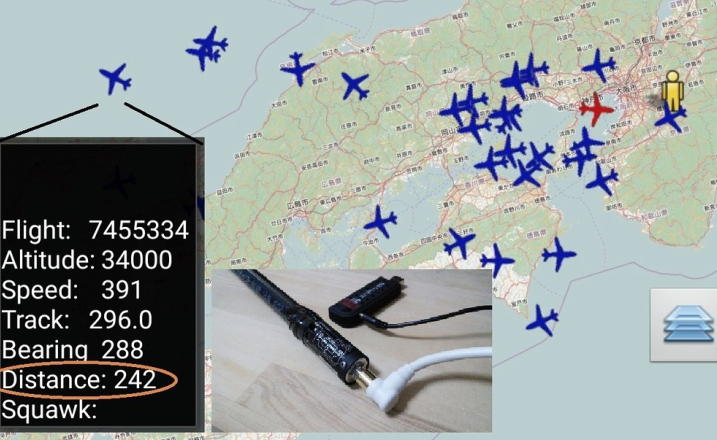
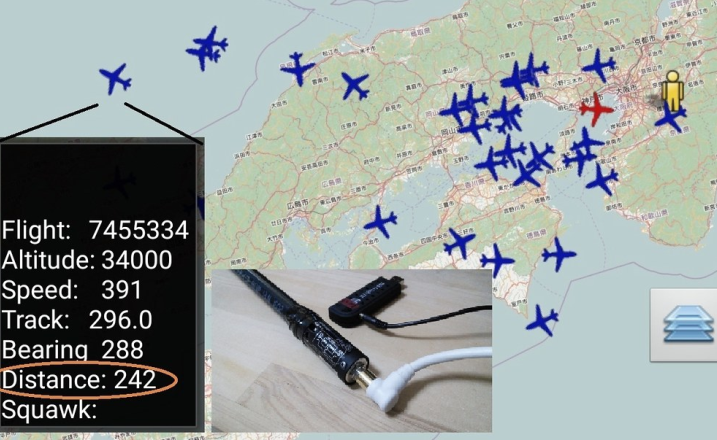
ADS-B surveillance system [1]
The ADS-B system
ADS-B is a surveillance system which permits aircrafts to broadcast information (aircraft ID, altitude, velocity and other data) to air traffic control or satellites (ADS-B Out) and to other aircraft, if the system is fully equipped (ADS-B in).
The ADS-B acronym stands for:
- Automatic – no pilot input or external interrogation.
- Dependant – Depends on correct operation of onboard equipment.
- Surveillance – Provides aircraft position, altitude, velocity, and other surveillance data to facilities that require the information.
- Broadcast – Information is continually broadcast for monitoring by appropriately equipped ground stations or aircraft [2].
The working principle
The position of the aircraft is transmitted via an ADS-B enabled transponder at regular and short intervals to an ADS-B receiver (satellite or ground station) which collects and sends the data to other air traffic control management units. The ability of the ADS-B receiver to receive a signal depends on altitude, distance from the site and obstructing terrain. The maximum range of an ADS-B transponder can exceed 250 nautical miles. In airspace immediately surrounding each ground station, surveillance coverage extends to near the surface [2].
The benefits
ADS-B surveillance system, when compared to existing systems (SSR), has several benefits for the ATM network:
- Full “Network-wide” Surveillance coverage,
- Surveillance “everywhere”, i.e. no gaps from gate-to-gate (departure to arrival),
- Air-to-air surveillance possible, i.e. traffic situational awareness picture available on board,
- The aircraft is integral part of the network,
- Surveillance data provided directly from on-board systems.
- High performance (compared to existing technology),
- Improved safety (compared to existing technology),
- Increased capacity (compared to existing technology),
- Cost-efficiency,
- Reduced cost of the Surveillance infrastructure (ADS-B is cheaper than radar),
- More efficient flight profiles (in areas where previously surveillance was not cost-effective),
- Fuel savings due to a more smooth and linear landing manoeuvre etc.
- Environmental sustainability (CO2 reduction),
- Reduced RF (radio frequency) pollution (leading to an increased viability of the 1090 MHz datalink),
- Global interoperability,
- Foundation for future ATC applications (separation, self-separation) [3].
The EU regulation
Many countries and regions are passing regulations in order to favour the adaptation of ADS-B by airports and aircraft. In the United States of America, the FFA (Federal Aviation Administration) has mandated that aircraft operating in airspace that now requires a Mode C transponder must be equipped with ADS-B Out by Jan. 1, 2020 [4], Australia has the same deadline but has made some exceptions [5]. The EU mandate has set the 7th of June 2020 as a deadline date for the ADS-B implementation on aircraft. The aircraft affected will have the following characteristics:
- weigh more than 5700kg, or
- have a max cruise speed greater than 250 knots
The implementation delays
The industry has, however, low confidence in the deadline set by the European Council. A report carried out by SESAR (Single European Sky ATM Research) in 2018 showed that only the 20% of the fleets affected by the regulation have implemented ADS-B and it is expected that the 15% to 25% will not meet the deadline [6]. Currently EASA (European Union Aviation Safety Agency) is developing a proposal for potential exemptions based on the ADS-B Implementation Plan developed by SDM (SESAR DM), which will be assessed by the European Commission and should be published soon [7].
References
[1] Airframe 242 nautical miles away by RTL2832U ADSB receiver, coniferconifer, date: 25th June 2016, last access: 13th June 2009
[2] How ADS-B works, Air Services Australia, date: 18th September 2015, last access: 13th May 2009
[3] Automatic Dependent Surveillance Broadcast (ADS-B), SKYbrary, date: 25th January 2019, last access: 13th May 2009
[4] AIR TRAFFIC SERVICES BRIEF — AUTOMATIC DEPENDENT SURVEILLANCE-BROADCAST (ADS-B), AOPA, 3rd June 2015, last access: 13th May 2009
[5] ADS-B mandates 2014-2017, Air Services Australia, date: 1st February 2017, last access: 13th May 2009
[6] ADS-B and other means of surveillance implementation status, SESAR, date: 15th May 2018, last access: 13th May 2009
[7] European Operators, Regulators Working on New ADS-B Implementation Plan, Woodrow Bellamy III, date: n.d., last access: 13th May 2009
post contents
About the Author: Andrea Mariano

Latest News

US Continues to Build Out Solar Capacity
Earlier this month, the Solar Energy Industries Association (SEIA) released [...]

China’s Airborne Wind Turbines
In early 2026, China successfully developed an airborne wind turbine [...]

Shadow Flicker Assessments for Wind Turbines: A 2026 Update
Shadow flicker is the effect of rotating turbine blades, causing [...]