Anti-Glare Solutions for Solar Panels
Last Updated: April 16, 2026
Share:
Depending on the surface conditions reflections of light can be specular or diffuse. A specular reflection has a reflection characteristic similar to that of a mirror, whereas a diffuse reflection will reflect the incoming light and scatter it in many directions. The figure below, taken from FAA guidance, demonstrates the difference between the two types of reflections. Because standard solar panels are flat and typically have a smooth surface, most of the light reflected is specular, which means that incident light from a specific direction is reradiated in a specific direction.
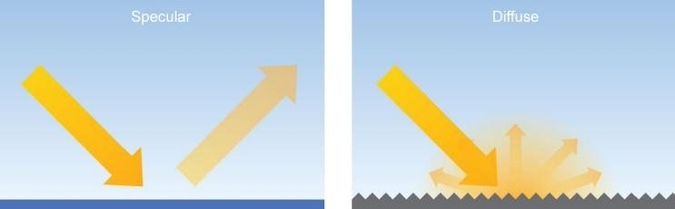
Figure 1: Specular and diffuse reflections. [1]
The Role of the Glint and Glare Assessment
The definition of glint and glare is as follows:
- Glint – a momentary flash of bright light typically received by moving receptors or from moving reflectors;
- Glare – a continuous source of bright light typically received by static receptors or from large reflective surfaces.
Pager Power is an industry leader in assessing glint and glare generated by ground-mounted and roof-mounted solar power plants and can help developers to determine the impact upon nearby receptors, including road users, residential amenity, aviation activity and railway infrastructure.
The glint and glare assessment is a vital step in understanding the potential for significant glint and glare effects. The assessment is generally undertaken pre-planning, using a conservative/worst-case scenario, and if significant effects are identified, Pager Power may recommend that a developer consider taking measures to mitigate the effects.
Mitigation options for significant glint and glare effects can vary depending on the specifics of a particular project, but the main ones are outlined below:
- Adjusting panel geometry (azimuth and tilt angles);
- Temporary/permanent screening;
- Using a less reflective type of solar panel, this may be marketed as an ‘anti-glare solar panel’;
- Adding a coating onto the solar panels, these are often marketed as ‘anti-glare solutions’.
Anti-Glare Solutions
‘Anti-glare solutions’ typically refer to methods of introducing a rougher surface on the solar panels that disperse glare and scatter it into more directions, meaning that more of the light reflected is diffuse rather than specular. The term would generally refer to the implementation of a solution onto an existing solar panel by a third-party company, but could also include solar panels manufactured as anti-glare.
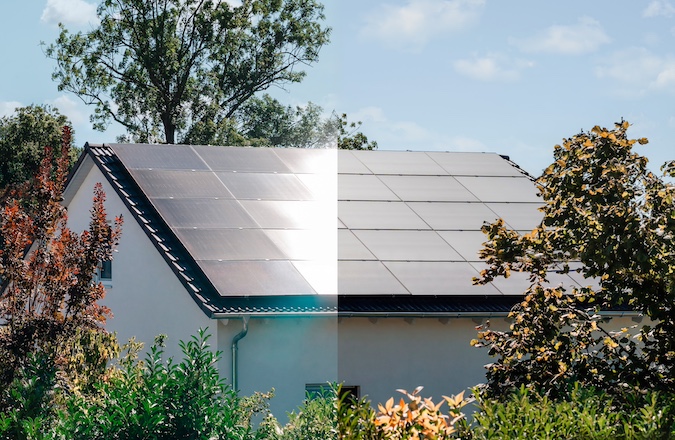
One such third-party provider of an anti-glare solution that Pager Power are aware of is a company called Phytonics. They provide the following information:
Phytonics offers a self-adhesive anti-glare film that can be retrofitted to almost any solar module to resolve reflection issues reliably. Its specialized microstructured surface suppresses direct reflections, physically eliminating dangerous glare for pilots and air traffic control. The film features the lowest reflected luminance values on the market, enabling solar installations in glare-sensitive areas such as airports, highways, and residential neighbourhoods.
Constructed from highly weather-resistant PMMA with a microstructured anti-glare coating, this solution is already proven in the field. It is currently utilized at PV installations at several major international hubs, including Munich, Schiphol, Charleroi, and Brussels airports, providing a reliable way to push reflected luminance values below regulatory limits. Thereby it enhances planning certainty for solar installations in safety-critical environments while maintaining project feasibility.
Pager Power is engaging with Phytonics to learn more about their product and how it can be used to reduce the impacts of schemes we are working on. If any other panel manufacturer would like to reach out and discuss their product, we would be more than happy to speak with you.
A Word of Warning
It is important to note that anti-glare solutions do not completely remove the potential for glare to be geometrically possible, rather, they generally reduce the intensity and the potential for significant glare effects. These must be treated carefully because glint and glare modelling software does not have the capability to specifically account for every type of anti-glare solar panel or coating. Simulating the wrong panel surface type can lead to overstating or, worse, understating the potential for glint and glare effects. Pager Power uses experience built from undertaking over 1,700 Glint and Glare assessments to agree the most appropriate modelling approach with developers and stakeholders, including projects where anti-glare solar panels or coatings may be proposed. Where appropriate, Pager Power will recommend a conservative modelling approach rather than risk understating effects.
About Pager Power
If you have a solar project that needs a glint and glare assessment to be undertaken, or need some more advice on anti-glare solutions, please get in touch.
References
[1] Technical Guidance for Evaluating Selected Solar Technologies on Airports, Federal Aviation Administration (FAA), date: 04/2018, accessed on: 15/04/2026.Image accreditation: Before/after installation photo of Phytonics Anti-Glare Film on residential rooftop PV. Provided for our use by Phytonics.
post contents
About the Author: Waqar Qureshi