How Can Glare Risks be Reduced for my Solar Project?
Last Updated: April 16, 2026
Share:
Glare is an important environmental impact to consider during the planning of solar developments due to the potential impacts upon aviation activity, residential amenity, road safety, railway operations and infrastructure.
This article delves into how glint and glare can be handled throughout a solar project to minimise the likelihood of unforeseen delays and significant planning hurdles.
Pre-Planning and Project Design
Accounting for possible glint and glare impacts early in the planning process is key to minimising risk for proposed solar developments. Key considerations include:
- Vicinity / Location: Solar developments that are within close proximity to impacted stakeholders carry higher planning risk. For typical assessment distances, please see this article.
- Legislation / Guidance: Glint and glare does not have any single piece of legislation that determines how it should be assessed and may vary between different counties in the UK, and countries across the globe. As such, knowledge of the location-specific requirements is vital.
- Existing Projects: Nearby solar developments may provide valuable information on previously explored planning considerations.
- Project Layout / Landscaping: If impacts are identified early in the planning process, these can be factored into the development layout and could also be considered within a site’s landscaping plan to accommodate any concerns.
Stakeholder Engagement
Proactive engagement with concerned stakeholders is also important, as this helps address and mitigate raised concerns ahead of time, reducing the likelihood of unforeseen issues further down the line.
Stakeholders that may benefit from proactive communication could include:
- Local Residents – Glint and glare may impact residential amenity for residents living in the vicinity of a solar development, if glare is predicted to occur for extended periods of time. [1][2]
- National Highways – If glare is predicted to occur within a driver’s field-of-view, this may impact a driver’s vision and impact local road safety.
- National Rail – Glint and glare may impact railway safety if it obscures signals, warning lights or impacts a train driver’s vision.
- Aerodrome Safeguarding Teams – If glare is predicted towards an aerodrome’s ATC tower, approach paths, visual circuits or runways, this may negatively impact a pilot’s vision. [3]
Mitigation Strategies
If early engagement or project design isn’t enough to mitigate issues raised by concerned stakeholders, specific mitigation strategies can be implemented to actively reduce the impact caused by glint and glare towards specific receptors. These may include:
Screening
Screening is commonly used to mitigate glint and glare towards ground-based receptors and would typically take the form of opaque fencing. Alternatively, vegetation can be used, provided it would screen reflections when they are geometrically possible. If reflections are possible in colder months, evergreen vegetation is typically relied upon.
This screening doesn’t necessarily need to be constructed around the entire periphery of the site, as it only needs to block line-of-sight towards impacted receptors.
Screening may also take the form of building parapets for rooftop solar developments if fencing or vegetation isn’t possible.
Layout / Design changes
One form of layout changes includes layout optimisations. This involves the initial modelling of the panels in their current state, considering their elevation, tilt and azimuth angle. The panels are then remodelled within a defined angle envelope, considering alternative tilt and azimuth angles that may be able to shift glare away from impacted receptors.
This strategy can be effective for all types of impacted receptors, but may inadvertently shift impacts towards different receptors, so other receptors with line-of-sight of the development should also be considered.
Alternatively, layout repositioning may be possible, depending on the size and flexibility of the site. However, this may be limited by restrictions from other planning considerations.
Other Strategies
Niche strategies also exist to reduce the impact of glint and glare towards receptors, which may include investment into panels with specialised anti-reflective coating, or the organisation of internal mitigation strategies with impacted stakeholders, such as blinds for residents where residential amenity may be impacted. However, these mitigation strategies may only be effective on a case-by-case basis.
Our Experience:
Pager Power is a specialist technical consultancy based in the United Kingdom and has been providing independent expertise on planning issues for solar, wind, and building developments for over 20 years.
Established in 1997, the company initially specialised in assessing the impact of wind turbines on radar systems. Pager Power has since expanded into a multidisciplinary technical planning consultancy that offers a comprehensive range of services and has supported renewable and building projects in more than 60 countries. This includes completing over 1,800 glint and glare assessments.
For more information about what we do, please get in touch.
References
[1] Renewable and low carbon energy. 2023. MHCLG and DLUHC. Available at: https://www.gov.uk/guidance/renewable-and-low-carbon-energy (Last accessed: 15/04/2026)
[2] National Policy Statement for renewable energy infrastructure (EN-3), 2025. 2026. DESNZ. Available at: https://www.gov.uk/government/publications/national-policy-statement-for-renewable-energy-infrastructure-en-3-2025 (Last accessed: 15/04/2026)
[3] CAP 738: Safeguarding of Aerodromes. 2020. UK Civil Aviation Authority. Available at: https://www.caa.co.uk/data-and-publications/publications/documents/content/cap-738/ (Last accessed: 15/04/2026)
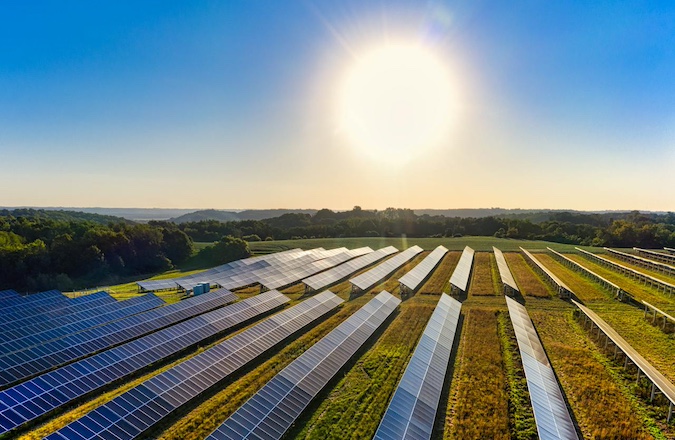
Image Accreditation: Solar Farm at Sunny Day. 2021. Tom Fisk. Available at: https://www.pexels.com/photo/solar-farm-at-sunny-day-9893729/ (Last accessed: 15/04/2026)
post contents
About the Author: Adam Hardie