Common Radar Mitigation Solutions
Background
Wind turbines and large buildings can have an adverse impact on radar systems. This article examines the some of the more common mitigation solutions for reducing or eliminating these impacts.
Why do buildings and turbines cause interference?
Radar is designed to detect aircraft, shipping and weather. It works by sending and receiving radio signals. The position of targets is determined from the bearing of the antenna and the time delay between transmitted and received signals. Large structures can block and reflect signals – thus having an impact on the radar’s performance. Wind turbines add a further complication because their blades move at high speed which means signals pass through filters designed to eliminate static objects.
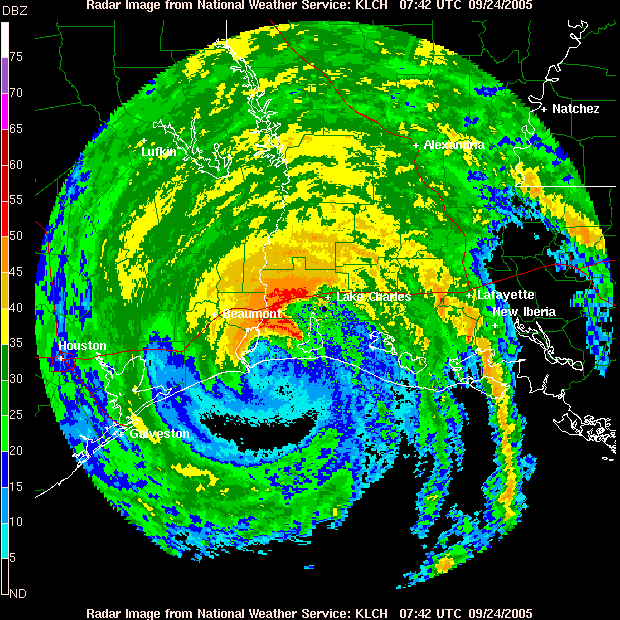
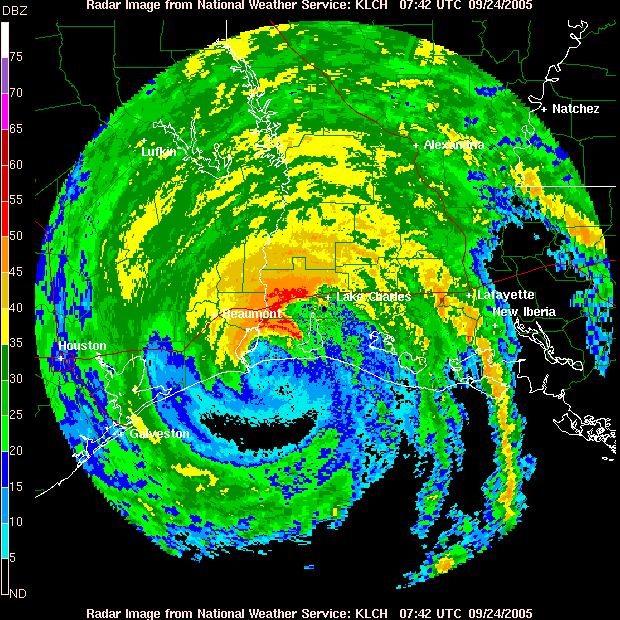
Figure 1 Meteorological Radar Image showing Hurricane
What sort of radar can be affected?
The following radar types can be affected:
- Air traffic control radar
- Air defence radar
- Meteorological radar
- Marine radar
Which organisations object to developments due to radar?
In the United Kingdom the majority of objections are raised by:
- The Ministry of Defence
- NATS (formerly National Air Traffic Services) En-Route
- Airports
What are the most common mitigation solutions?
The solutions that actually enable developments to go ahead are:
- Screening – Ensuring the development is partially screened from the radar by terrain, vegetation, Earth curvature, other structures or by a combination of these.
- Distance – Ensuring the development is a suitable distance from the radar. Generally impacts reduce with distance.
- Physical Characteristics – Modifying the physical characteristics of the development. This could involve changing size, materials or physical orientation.
- Radar Reconfiguration – Reconfiguring the radar so that the development location is internally stored. This enables the radar to reject interference caused by the development. In Primary Surveillance Radar (PSR) the location may be configured as a “blank” or a “Non Auto Initiation Zone”. In Secondary Surveillance Radar (SSR) the location may be configured as a reflector.
- Alternate Radar – Use data from an alternative radar that will be unaffected by the proposed development. This could be an existing radar that cannot detect the development or could be a new radar designed to reject interference effects.
- MRT – Multi radar tracking systems are used by the MOD, NATS and the Met Office (in the UK) to provide wide area coverage from multiple overlapping radar. Blanking one radar in an MRT system can provide continuous coverage whilst mitigating the effects of the development.
Conclusions
There are many varying solutions for mitigating the effects of developments on radar. This article identifies the most common variants. To discuss mitigation options for your development please get in touch.
Image accreditation: https://images.app.goo.gl/hJfxcDUf3Xi3juxE8
post contents
About the Author: Mike

Latest News
US Continues to Build Out Solar Capacity
Earlier this month, the Solar Energy Industries Association (SEIA) released [...]

China’s Airborne Wind Turbines
In early 2026, China successfully developed an airborne wind turbine [...]
Shadow Flicker Assessments for Wind Turbines: A 2026 Update
Shadow flicker is the effect of rotating turbine blades, causing [...]