Understanding radar objections for building developments

All modern primary surveillance radar (PSR) have the capability to remove returns from static structures. This is essential to ensure that the radar can work effectively in built up areas or where terrain can obstruct the radar’s beam.
Both PSR and secondary surveillance radar (SSR), however, are susceptible to the obstruction blocking the radar beam. This can lead to stakeholders objecting to new buildings at the planning application stage.
Interference Mechanism
‘Radar beam blocking’ can affect the functionality of a radar by reducing and degrading its coverage in the airspace beyond the structure.
For air traffic control radar (PSR and SSR), this can cause aircraft to be hidden or ‘lost’ in the affected airspace.
For Meteorological radar, the obstruction may lead to weather systems being missed or miscalculated.
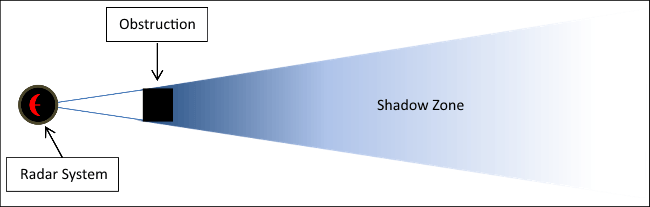
The figure below shows an aerial view of a radar and an obstruction e.g. a building. The reduction in radar signal strength is greatest in the immediate area behind the obstruction. The signal strength then increases as the distance beyond the obstruction increases.
Guidance
The International Civil Aviation Organisation (ICAO) have produced guidelines for calculating the exclusion zone around radar installations. This exclusion zone is known as a ‘Building Restricted Area’ (BRA). These zones are presented in the ICAO document titled ‘European Guidance Material On Managing Building Restricted Areas [1]’.
Example – Proposed Housing Development in Scotland
An example of a radar-based building objection is presented in a news article from Press and Journal [2]. A proposed 4,700 homes in Aberdeen were subject to a NATS radar objection due to the possible impact upon the Perwinnes en-route radar.
Conclusions
If you are planning to develop a large structure near a PSR or SSR installation (within 15km for aviation radar), it is important to consult with the relevant radar stakeholders to understand whether an objection may be raised. In the majority of cases it may be that no objection materialises, however to avoid any unnecessary delays, consultation with the relevant radar stakeholder is advised.
Please get in touch should you receive a radar objection for your proposed building development, we will be happy to help.
[1] ICAO EUR DOC 015, 2009. EUROPEAN GUIDANCE MATERIAL ON MANAGING BUILDING RESTRICTED AREAS, second edition.
post contents
About the Author: Mike

Latest News

US Continues to Build Out Solar Capacity
Earlier this month, the Solar Energy Industries Association (SEIA) released [...]

China’s Airborne Wind Turbines
In early 2026, China successfully developed an airborne wind turbine [...]

Shadow Flicker Assessments for Wind Turbines: A 2026 Update
Shadow flicker is the effect of rotating turbine blades, causing [...]