Defining Glint and Glare

Last Updated: January 15, 2026
Share:
The two terms ‘glint’ and ‘glare’ refer to the unwanted reflection of the Sun’s rays from materials capable of producing specular reflections, such as solar panels or glass.
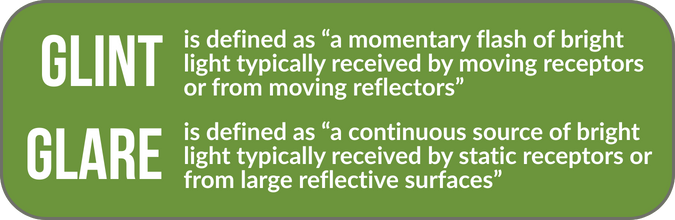
These definitions are aligned with those presented within the National Policy Statement for Renewable Energy Infrastructure (EN-3) [1] and the Federal Aviation Administration (FAA) [2] in the USA. The term ‘solar reflection’ may be used to refer to both reflection types.
Glint is a momentary flash of light. It is time-dependent and is produced as a result of a direct solar reflection from a specular reflector, as experienced by an observer passing at speed, such as a motorist.

Glint from a glass building.
Glare is a continuous source of excessive brightness. It may be experienced by a stationary or slow-moving observer located in the path of reflected sunlight from a specular reflector.
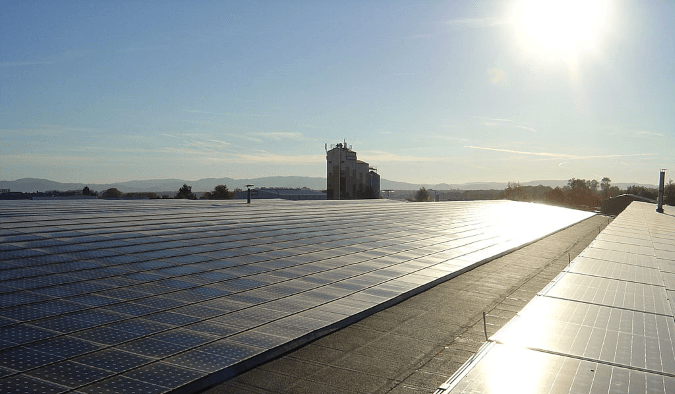
Glare captured on solar photovoltaic panels.
Potential Impacts of Glint and Glare
Solar reflections can be produced by solar panels, or buildings where their façades are made from specular materials such as glass. These reflections can cause a distraction or lead to an after-image being experienced by an observer, which can present a nuisance and, under some circumstances, a safety hazard. This is why it’s possible for solar and building developments to receive objections due to potential impacts caused by glint and glare.
Examples of Significant Glint and Glare Impacts
Key examples where impacts have been experienced include a solar development near Schiphol Airport impacting flight operations at the airport, and that of The Fenchurch Building (The Walkie-Talkie), in London, damaging parked cars on the roads below. For reference, an image of specular reflections from the Shanghai World Financial Centre is shown below.

Glare from Shanghai World Financial Centre.
Assessing Potential Impacts
Many solar developments and building developments now require a Glint and Glare Assessment in order to satisfy the Local Planning Authority or key stakeholders, such as the National Highways, civil aerodromes or the Ministry of Defence (MOD), for example.
Early assessment of the potential issues and relevant mitigation measures can ensure that projects are not held up or derailed at the planning stage.
References
[1] National Policy Statement for renewable energy infrastructure (EN-3), DESNZ
[2] Technical Guidance for Evaluating Selected Solar Technologies on Airports, Federal Aviation Administration
Image accreditations:
“First Array” by Russ Ferriday / CCBY 2.0 / Resized from original.
“Mansueto Library” by Barb / CCBY 2.0 / Cropped and resized from original.
“Sonnenfleck 1” by Micha Jost / CCBY 3.0 / via WikiMedia / Cropped and resized from original.
“The Bottle Opener” by Lori Branham / CCBY 2.0 / Cropped and resized from original.
post contents
About the Author: Danny Scrivener