The First Photovoltaic Cell
To understand how the first photovoltaic cell was created, we must first understand the basics of how they work. Here is a very brief overview of the basic principles.
For a current to be produced, there must be a difference between positive and negative charges within a substance, this difference will cause electrons to flow (from negative to positive), generating a current. A battery achieves this by having cathode, made of an electron poor material (therefore overall positively charged) and an anode, made with an electron rich material (therefore overall negatively charged), connecting the two with a wire will induce a current.
A solar panel, however, uses a somewhat different method to create the positive and negative charge difference. A solar panel makes use of atoms that exhibit the photovoltaic effect, that is atoms with electrons that when hit with a specific wavelength electromagnetic photon, the electron will ‘break free’ from its atom. Thereby creating a free negative charge (the electron) and a positive charge (the empty space where the electron was). This difference can then be capitalised by connecting the substance to a circuit, allowing the flow of electrons and generating a current. And that is how to get electricity from the sun!
The most common material used in photovoltaic cells today is silicon, due to its properties as a semiconductor, being photovoltaic and its cheap and widespread availability.
Charles Fritts and The First Photovoltaic Cell
On the rooftop of a New York City apartment in 1884, Charles Fritts tested his invention of the photovoltaic cell. His solar array consisted of thin blocks of selenium topped with a very thin layer of gold, so thin as to be semi-transparent. This gold layer (and the steel bed the selenium was lying on) acted as the connecting surfaces between the photovoltaic selenium and the rest of the circuit. As the sun over New York City beat down on Fritts’ solar array, the photons free electrons from their atoms in the selenium and they flow through the circuit, generating a current “that is continuous, constant, and of considerable force” [1]. Thus, the first photovoltaic cell was created.
The Problem with Fritts’ Solar Array
If photovoltaic cells have been known about since the 1880s (only a few years after Thomas Edison’s first fossil fuel power plants) why has solar power only been taken up in the last few decades?
The primary reason Fritts’ photovoltaic cells never took off was competition, fossil fuel power plants were vastly more efficient. Fritts’ solar array achieved an efficiency of 1%, which was too low, even then, when only a few homes and factories used electricity. Furthermore, selenium was (and still is) expensive, due to its rarity and the energy involved in extracting it, plus covering it gold wasn’t exactly cheap either!
Another reason is that in the 19th century, they had no reason to deviate from fossil fuels, as unlike today, they were unaware of the negatives associated with burning fossil fuels.
It wouldn’t be until the 1950s that an efficient, commercially viable photovoltaic cell was created.
Photovoltaic cells are now far more efficient than Fritts’ first cell and have a quoted efficiency of up to 20%. Nevertheless, modern photovoltaic cells still aren’t perfect, and light is still reflected causing glint and glare.
About Pager Power
Pager Power has undertaken over 1,000 glint and glare assessments from solar panels due to potential impacts upon road users, residential dwellings, aviation activity, railway operations and infrastructure, and more.
To download the latest edition of Pager Power’s Glint and Glare Guidance, click here.
References
[1] SPW. (2013, December 4th). From Selenium To Silicon Solar Panels: An Excerpt From Let It Shine. Retrieved from SolarPowerWorldOnline.com: https://www.solarpowerworldonline.com/2013/12/selenium-silicon-solar-panels-excerpt-let-shine/
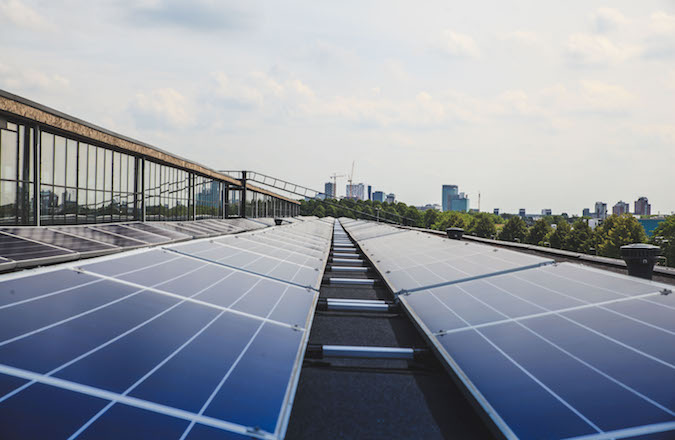
Thumbnail image accreditation: Jeroen van de Water (April 2021) from Unsplach.com. Last accessed on 17th April 2023. Available at: https://unsplash.com/photos/aQOzmgcT6sI
post contents
About the Author: Jacob Cunningham

Latest News

Are London Homes Getting Too Hot?
London, like most large cities, experiences an average temperature that [...]

What is Wind Farm Repowering?
There are a lot of potential constraints when it comes [...]

Do Construction Cranes Require Aviation Consent or Lighting, and Who Sets the Rules?
Cranes used for construction will likely reach elevations above the [...]